
No products in the cart.
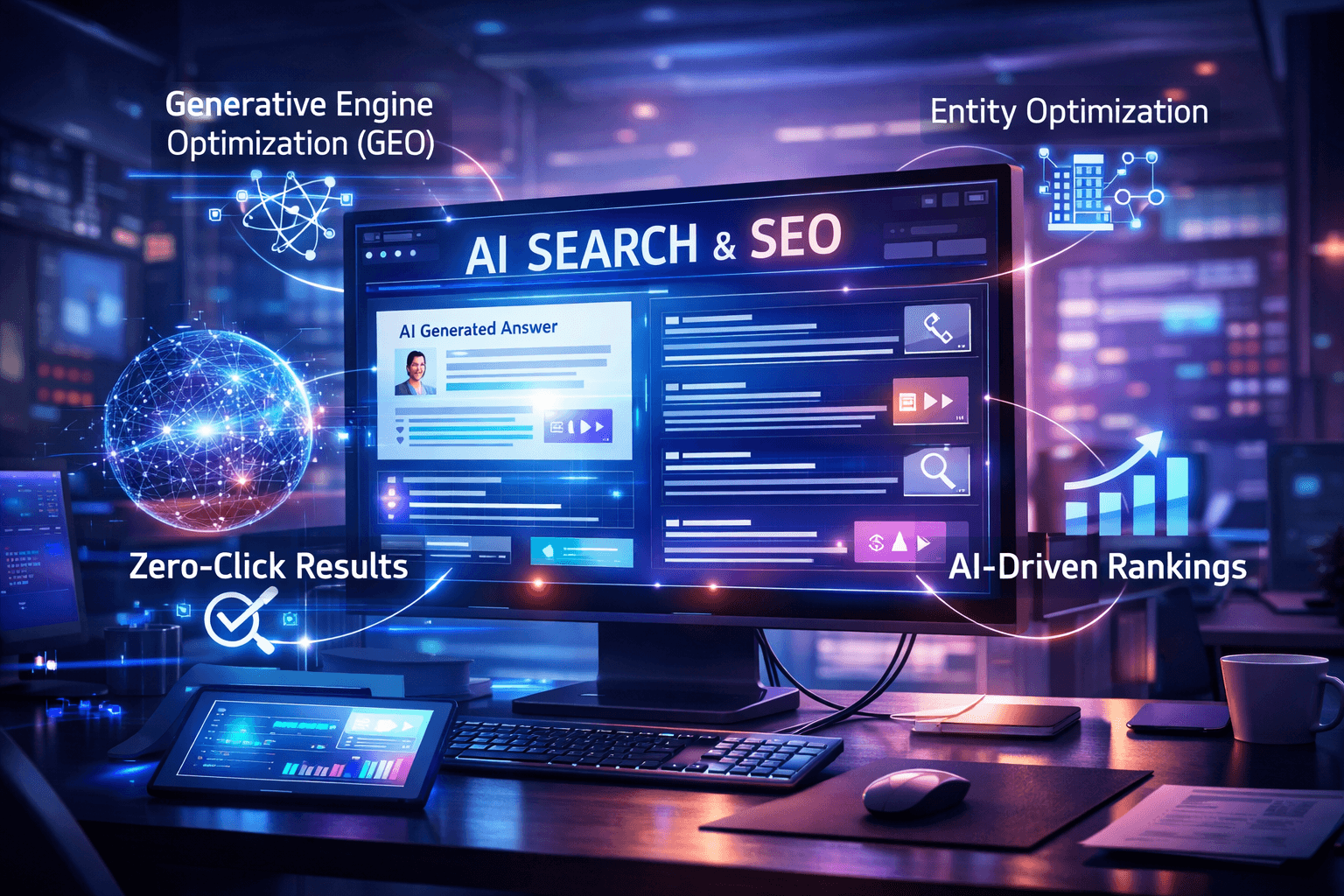
How AI Search Is Changing SEO (And What Businesses Should Do Now)
Short answer: AI answers are changing how people use Google, and the evidence so far shows fewer clicks on traditional results when an AI summary appears. But Google’s own guidance says there is no separate trick for appearing in AI features: the fundamentals of helpful, accessible, well-structured content still apply. Last reviewed: 23 October 2026.
To place this in context, start with Generative Engine Optimization (GEO), the practice of making a brand easy for AI-driven search tools to understand and reference. This guide covers what is measured, what Google says, and what a business should do about it.
What is AI search?
AI search means search experiences that generate an answer instead of only listing links. In Google this includes AI Overviews and AI Mode, and outside Google it includes chat assistants that browse the web. Google’s documentation describes AI Overviews and AI Mode as features that show a generated summary with links to supporting pages.
What the evidence shows
- Clicks fall when an AI summary appears. Pew Research Center (22 July 2025) tracked the browsing of 900 US adults in March 2025. Users clicked a traditional result link in 8% of visits that showed an AI summary, against 15% of visits without one.
- Many searches already ended without a visit to a website before AI summaries. SparkToro’s 2024 clickstream study reported that for every 1,000 US Google searches, 374 clicks went to the open web (360 in the EU).
- Limits of this data. Both studies measure US (and, for SparkToro, EU) users. We have not found comparable published data for Egypt or the GCC, so treat these as direction of travel, not a forecast for your market. Your own Search Console data (impressions versus clicks) is the better guide.
What Google says about AI features
Google’s guidance on AI features states that no special optimization is required to appear in them. A page needs to be indexed and eligible to show with a snippet, and the usual Search guidance applies: helpful, reliable content made for people, good page experience, and technical accessibility. Optimizing for AI Overviews therefore overlaps almost entirely with good SEO.
Our view: be skeptical of any provider that promises guaranteed placement in AI answers. Nobody outside the platform controls that. What can be controlled is how clearly your site states who you are, what you do, where you operate and why you can be trusted.
From keywords to entities
Search systems increasingly interpret meaning, not just matching words. Google’s ranking systems guide lists AI systems such as BERT, RankBrain and neural matching that connect the concepts in a query to the concepts on a page. In practice this makes it worth stating plainly:
- who your business is, with a consistent name, address and description across your site and profiles
- what services you provide, one clear page per service
- where you operate and who you serve
- who wrote the content and why they are qualified
This is the practical meaning of entity optimization. It is an interpretation of how these systems behave, not a documented ranking factor, so treat it as good hygiene rather than a guarantee.
What businesses should do now
- Secure the basics. Pages must be crawlable, indexable and fast. A site built with professional website development removes the technical blockers first.
- Answer real questions with original content. Use clear headings, short definitions and specific, dated facts that a summary can draw on and that a reader can verify.
- Build topical depth. Cover your core services with connected pages and internal links instead of isolated posts.
- Add structured data that matches visible content, so search engines can read your organization, services and authors accurately.
- Measure what changed. In Search Console, track impressions, clicks and click-through rate by query. If impressions rise while clicks fall, AI features may be answering part of the demand; the right response is to make sure your brand and offer are present and that you can convert the visits you do get.
- Use paid search where demand is commercial. When organic clicks shrink, PPC advertising can cover high-intent queries while organic authority builds.
Conclusion
AI search raises the bar on clarity and credibility, but it does not replace SEO. The businesses best placed are those with a technically sound site, original content on their core services, and a consistent, verifiable identity. Related reading: zero-click optimization and what Google confirms about ranking.
Sources (accessed 23 October 2026)
- Pew Research Center, Google users are less likely to click on links when an AI summary appears in the results (22 July 2025).
- SparkToro, 2024 Zero-Click Search Study.
- Google Search Central, AI features and your website.
- Google Search Central, A guide to Google Search ranking systems (last updated 10 December 2025).