
No products in the cart.
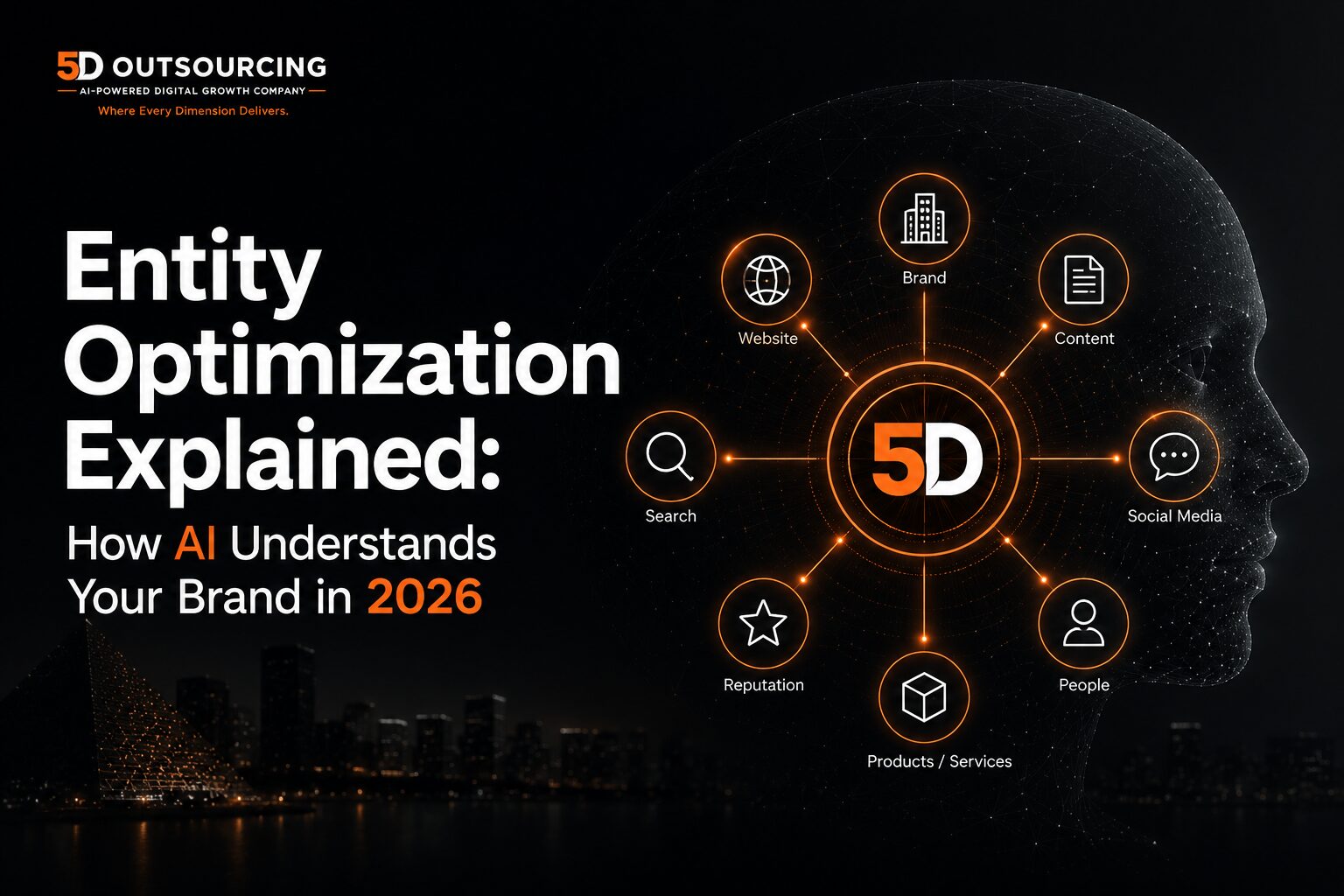
Entity Optimization Explained: How AI Understands Your Brand in 2026
Search has fundamentally changed. Traditional SEO was built around matching keywords to search queries, but modern search engines and AI systems now focus on understanding real-world entities, their relationships, and the context behind every search. Instead of simply indexing webpages, platforms like Google Search, Google AI Overviews, ChatGPT, Gemini, and Perplexity are working to understand businesses, brands, products, services, and the expertise behind them.
This shift has made Entity Optimization one of the most important components of modern SEO. If search engines clearly understand who your business is, what services you provide, where you operate, and why you are an authority in your industry, they are far more likely to recommend your brand in both traditional search results and AI-generated answers.
For businesses, this means ranking is no longer only about optimizing pages for keywords. Success now depends on building a recognizable digital identity that search engines and AI systems can understand, trust, and confidently recommend to potential customers.
Entity Optimization works alongside Search Engine Optimization (SEO), Generative Engine Optimization (GEO), structured data, topical authority, and high-quality content to improve visibility across the entire search ecosystem. Businesses that invest in entity-based optimization today are preparing not only for Google’s current algorithms but also for the future of AI-powered search.
If you’re new to AI-first SEO, we recommend reading our complete guide to Generative Engine Optimization (GEO), followed by our articles on How AI Search Is Changing SEO Forever and How to Optimize for Google AI Overviews (AIO). Together, these guides explain how AI is transforming search and why entity optimization has become essential.
What Is Entity Optimization?
Entity Optimization is the process of helping search engines and AI systems understand your business as a real-world entity rather than simply a collection of webpages. An entity is anything that can be uniquely identified, such as a company, person, product, service, location, organization, or concept.
Unlike traditional keyword optimization, which focuses primarily on matching search terms with webpage content, entity optimization focuses on establishing clear relationships between your brand and the topics, services, industries, and locations that define your expertise.
For example, when Google understands that 5D Outsourcing is strongly associated with AI-first SEO, Google Ads management, website development, Conversion Rate Optimization (CRO), digital marketing, and businesses in Maadi, Cairo, and Egypt, your company becomes a recognized entity within those topics. The stronger these associations become, the more confidence AI systems have in recommending your business to users searching for those services.
Modern AI search engines rely on entities because they provide meaning. While keywords explain what is written on a page, entities explain who the content is about, what it represents, and how it relates to other entities across the web.
This is why entity optimization has become a core pillar of AI SEO, Generative Engine Optimization (GEO), semantic search, and Google’s Knowledge Graph. It enables search engines to move beyond simple keyword matching and develop a deeper understanding of businesses and their expertise.
Keyword SEO vs. Entity Optimization
Traditional SEO and entity optimization are not competing strategies—they complement each other. Traditional SEO helps search engines understand the content of individual pages, while entity optimization helps them understand the business behind those pages. The most successful digital marketing strategies combine both approaches.
| Traditional SEO | Entity Optimization |
|---|---|
| Focuses on keywords and phrases | Focuses on businesses, brands, people, products, and services |
| Optimizes individual webpages | Builds a connected digital identity |
| Ranks pages | Establishes authority and trust |
| Measures keyword relevance | Measures relationships between entities |
| Targets search rankings | Targets AI understanding and recommendation |
| Primarily serves traditional search | Supports Google AI Overviews, ChatGPT, Gemini, Perplexity, and other AI search systems |
Rather than replacing keyword optimization, entity optimization expands it. Strong content, technical SEO, internal linking, and authoritative backlinks remain important, but they now work together to strengthen your business as a trusted entity within Google’s broader understanding of the web.
Businesses that embrace both approaches are better positioned to rank in traditional search results while also increasing their visibility across AI-powered search experiences.
How Google Understands Your Business as an Entity
Google does not rely on a single signal to understand your business. Instead, it combines hundreds of data points from your website and across the web to build an entity profile. Every consistent signal strengthens Google’s confidence in who you are, what you offer, and how your business relates to other entities.
This entity profile is continuously refined using structured data, website content, internal linking, external mentions, customer reviews, Google Business Profile information, social profiles, author expertise, topical authority, and countless other trust signals. The more consistent these signals are, the easier it becomes for Google and AI systems to recognize your business as an authority within your niche.
In the next section, we’ll explore how Google’s Knowledge Graph connects these signals and why relationships between entities have become one of the strongest ranking and AI visibility factors in modern search.
The Google Knowledge Graph: The Foundation of Entity SEO
One of the biggest reasons entity optimization has become so important is Google’s Knowledge Graph. Introduced to help Google understand real-world things instead of simply matching keywords, the Knowledge Graph stores billions of entities and the relationships between them.
Rather than asking, “Which page contains this keyword?”, Google increasingly asks, “Which trusted entity best answers this question?” That shift changes how businesses should approach SEO.
For example, Google may recognize that a business specializes in AI SEO, website development, Google Ads management, Conversion Rate Optimization (CRO), and digital marketing. Even if those exact words are not repeated together on every page, Google’s understanding of the relationships between those services allows it to recommend the business when users search for related topics.
This is why modern SEO is no longer only about ranking pages. It is about helping Google build confidence in your business as an authoritative entity within your industry.
To understand how this fits into AI-powered search, read our complete guide to Generative Engine Optimization (GEO), where we explain how AI systems use entities instead of simple keyword matching.
How AI Search Engines Understand Your Brand
AI search engines such as Google AI Overviews, ChatGPT, Gemini, Claude, and Perplexity do not “read” websites the same way humans do. Instead, they analyze relationships, authority signals, structured information, and contextual relevance to determine whether a business deserves to be recommended.
When AI evaluates your company, it looks for consistency across hundreds of signals, including your website, structured data, Google Business Profile, author profiles, customer reviews, citations, social media profiles, backlinks, topical authority, and internal linking.
Every consistent signal strengthens your digital identity. Every conflicting signal weakens it. If one page describes your company as an SEO agency while another focuses primarily on unrelated services without clear relationships, AI has less confidence in understanding your expertise.
For businesses, the objective is simple: make it as easy as possible for search engines to answer three questions.
- Who are you?
- What do you specialize in?
- Why should users trust you?
When AI systems can confidently answer those questions, your business becomes significantly more likely to appear in search results, AI-generated summaries, and conversational search experiences.
Why Entity Relationships Matter More Than Individual Keywords
Search engines no longer evaluate pages in isolation. They analyze how entities connect to one another across your entire website and the wider internet. These relationships help AI understand the depth of your expertise and the scope of your services.
Imagine your business as the center of a network. Every service, article, product, category, location, and piece of content becomes another connection that strengthens your digital identity.
| Primary Entity | Related Entity | Relationship |
|---|---|---|
| 5D Outsourcing | AI SEO | Provides |
| 5D Outsourcing | Generative Engine Optimization (GEO) | Expertise |
| 5D Outsourcing | Google Ads Management | Provides |
| 5D Outsourcing | Website Development | Provides |
| 5D Outsourcing | Conversion Rate Optimization | Supports |
| 5D Outsourcing | Maadi, Cairo, Egypt | Located In |
The more clearly these relationships are demonstrated throughout your website, the stronger your entity becomes. This is one reason why internal linking is so important. Every contextual link reinforces how your services, articles, and products relate to one another.
For example, this article naturally connects with our guides on AI SEO Strategy, How AI Search Is Changing SEO Forever, How to Measure AI Search Visibility, and How to Optimize for Google AI Overviews. Together, these articles build topical authority around AI-first search optimization.
Why Entity Optimization Is Essential for Generative Engine Optimization (GEO)
Generative Engine Optimization (GEO) extends traditional SEO by optimizing content for AI-powered search experiences. While traditional SEO focuses on improving rankings in search engine results pages, GEO focuses on increasing the likelihood that AI systems will understand, trust, and reference your business when generating answers.
Entity optimization is one of the strongest foundations of GEO because AI models rely heavily on entities and their relationships. Rather than retrieving individual pages, they assemble information from trusted entities to generate complete answers.
Businesses that invest in entity optimization improve far more than their rankings. They increase the likelihood of appearing in Google AI Overviews, conversational AI assistants, zero-click search experiences, and future AI-powered search technologies.
If your goal is long-term digital visibility, entity optimization should be implemented alongside professional SEO services, Google Ads management, conversion-focused website development, and a comprehensive AI-first content strategy.
The Complete Entity Optimization Checklist
Entity optimization is not achieved through a single SEO tactic. It is the result of building a consistent, trustworthy, and well-connected digital presence that allows search engines and AI systems to understand exactly who you are and what your business represents.
Use the following checklist to strengthen your business entity and improve your visibility across Google Search, Google AI Overviews, ChatGPT, Gemini, Perplexity, and other AI-powered search platforms.
- Use one consistent business name across every online platform.
- Keep your business address, phone number, email, and website consistent.
- Maintain a fully optimized Google Business Profile.
- Implement Organization, LocalBusiness, WebSite, Article, FAQ, and Breadcrumb schema where appropriate.
- Create comprehensive service pages for every major service.
- Publish authoritative articles that demonstrate expertise.
- Build strong internal links between related articles, products, services, and categories.
- Strengthen topical authority by covering subjects in depth instead of publishing isolated articles.
- Earn mentions and backlinks from trusted, relevant websites.
- Use consistent branding across your website and social media profiles.
- Regularly update content to reflect current search trends and AI developments.
- Monitor your AI search visibility and continuously refine your entity signals.
Businesses that consistently follow these practices make it easier for AI systems to understand their expertise, resulting in stronger visibility across both traditional search engines and AI-generated search experiences.
Common Entity Optimization Mistakes That Hurt AI Visibility
Many businesses unknowingly weaken their entity by sending inconsistent signals across their digital presence. Even excellent content may struggle to build authority if search engines cannot clearly understand the business behind it.
- Using different company names across platforms.
- Publishing thin or duplicate content.
- Creating isolated articles with little internal linking.
- Offering services without dedicated landing pages.
- Ignoring structured data implementation.
- Using inconsistent branding across social profiles.
- Failing to demonstrate real expertise through high-quality content.
- Building backlinks without strengthening topical authority.
- Neglecting Google Business Profile optimization.
- Publishing content without a clear content cluster strategy.
Entity optimization is built on consistency. Every page, every article, every service, and every external mention should reinforce the same message about who your business is and what it specializes in.
Entity Optimization vs. Brand Authority
Although the terms are often used interchangeably, entity optimization and brand authority are not the same.
| Entity Optimization | Brand Authority |
|---|---|
| Helps search engines understand who you are. | Helps search engines trust your expertise. |
| Focuses on identity and relationships. | Focuses on credibility and reputation. |
| Built through structured information and consistency. | Built through expertise, reviews, backlinks, and quality content. |
| Creates semantic understanding. | Creates confidence in recommendations. |
A strong entity creates recognition. Strong authority creates trust. Businesses that combine both are significantly more likely to appear in Google AI Overviews, AI-generated answers, and highly competitive search results.
The Future of SEO Is Built on Entities, Not Just Keywords
As AI continues to reshape search, entity optimization will become one of the defining factors of long-term online visibility. Search engines are moving away from simply matching keywords toward understanding businesses, expertise, relationships, and real-world authority.
This does not mean keywords have become irrelevant. Instead, keywords now provide context, while entities provide meaning. Businesses that combine technical SEO, structured data, topical authority, internal linking, and entity optimization will be better positioned for the next generation of AI-powered search.
At 5D Outsourcing, we help businesses build complete AI-first digital growth systems that combine SEO, Generative Engine Optimization (GEO), Google Ads management, website development, conversion optimization, and content strategy to improve both traditional rankings and AI search visibility.
Frequently Asked Questions About Entity Optimization
What is an entity in SEO?
An entity is a uniquely identifiable person, business, product, service, location, or concept that search engines understand independently of keywords.
Is entity optimization different from traditional SEO?
Yes. Traditional SEO focuses on optimizing webpages for keywords, while entity optimization helps search engines understand the business and relationships behind those pages.
Why is entity optimization important for AI search?
AI systems rely heavily on entities to generate trustworthy answers. Strong entity signals improve your chances of being referenced in AI-generated responses.
Does entity optimization help Google AI Overviews?
Yes. A clearly defined business entity supported by authoritative content, structured data, and topical expertise increases the likelihood of appearing in Google AI Overviews.
How long does entity optimization take?
Entity optimization is an ongoing process. As your content, authority, and digital footprint grow, search engines gain greater confidence in understanding and recommending your business.
Can small businesses benefit from entity optimization?
Absolutely. Small businesses can build strong entity signals by creating consistent, authoritative content, optimizing their website, implementing structured data, and developing topical authority within their niche.
Ready to Strengthen Your Business Entity and Improve AI Search Visibility?
If your business wants to appear more often in Google Search, Google AI Overviews, ChatGPT, Gemini, and other AI-powered search experiences, building a strong entity strategy is no longer optional. It has become a core part of sustainable digital growth.
Our team helps businesses build AI-first SEO strategies that combine entity optimization, technical SEO, Generative Engine Optimization (GEO), conversion-focused website development, Google Ads management, and authoritative content marketing to improve long-term visibility and lead generation.
Start a WhatsApp conversation with our team today and discover how Entity Optimization can help your business become easier for search engines and AI systems to understand, trust, and recommend.
Leave a Reply