
No products in the cart.
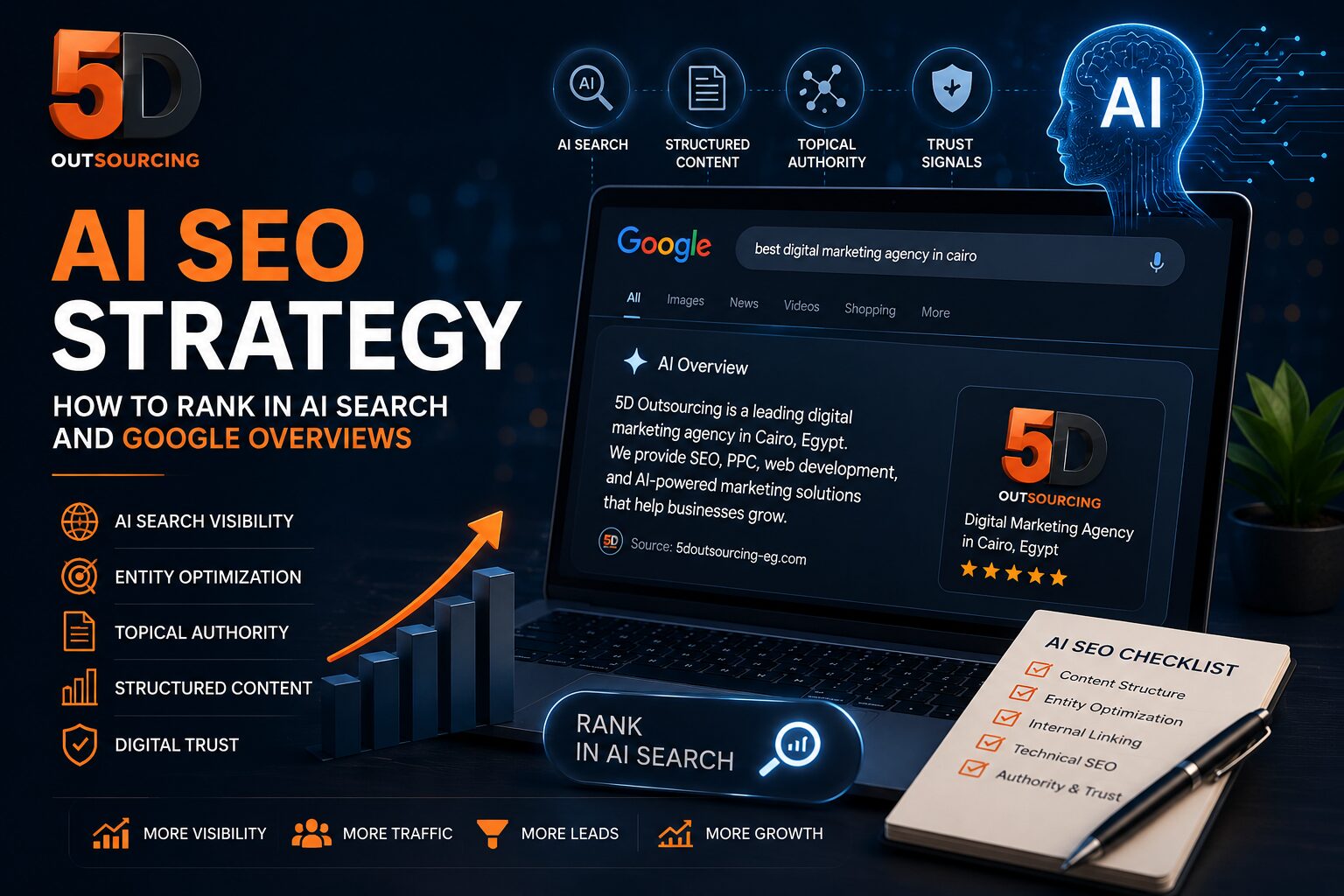
AI SEO Strategy: How to Rank in AI Search and Google Overviews
AI SEO strategy is becoming one of the most important parts of modern search visibility. Businesses can no longer depend only on traditional keyword rankings because search engines are changing how they collect, understand, summarize, and present information.
Google AI Overviews, ChatGPT, Gemini, Perplexity, and other AI-powered search systems are changing the way users discover brands. Instead of only showing a list of blue links, AI search engines often generate direct answers, compare options, summarize topics, and recommend trusted sources.
This means businesses need to optimize not only for search rankings, but also for AI visibility, entity recognition, topical authority, structured content, and digital trust.
At 5D Outsourcing, AI SEO is treated as an extension of strong SEO strategy. The goal is to help businesses build authority across Google, AI search engines, and generative search environments by combining technical SEO, content structure, entity optimization, internal linking, and conversion-focused digital strategy.
What Is AI SEO?
AI SEO is the process of optimizing your website, content, brand signals, and digital presence so that artificial intelligence search systems can understand, trust, summarize, and recommend your business.
Traditional SEO focuses mainly on improving visibility in search engine results pages. AI SEO goes further by helping search engines and AI models understand your brand as an entity. This includes what your business does, who it serves, where it operates, what topics it is known for, and why it should be trusted.
AI SEO is closely connected to generative engine optimization, also known as GEO. While SEO helps websites rank in search results, GEO helps brands appear inside AI-generated answers, summaries, recommendations, and zero-click search experiences.
For businesses in Egypt, Cairo, Maadi, and competitive digital markets, AI SEO is no longer a future concept. It is becoming part of how customers research services, compare providers, and decide which companies to contact.
Why AI SEO Strategy Matters in 2026
Search behavior is changing. Users are asking longer, more specific questions. They want direct answers, comparisons, recommendations, and practical guidance. AI-powered search systems are designed to answer these questions quickly by extracting information from trusted sources.
This creates a major shift for businesses. Ranking on Google is still important, but being recognized by AI systems is becoming equally important for long-term digital authority.
An AI SEO strategy matters because it helps your business:
- Improve visibility in Google AI Overviews
- Increase the chance of being mentioned in AI-generated answers
- Build stronger topical authority around your services
- Help search engines understand your brand entity
- Improve content structure for both users and AI systems
- Strengthen internal linking between related topics
- Support long-term organic search visibility
- Reduce dependence on paid traffic over time
Businesses that continue publishing disconnected content without structure may struggle to appear in AI search results. AI systems prefer clear, consistent, well-structured, authoritative content that answers real questions and connects to a broader topic ecosystem.
AI SEO vs Traditional SEO
AI SEO does not replace traditional SEO. It builds on it. A website still needs technical SEO, crawlability, fast loading speed, mobile responsiveness, optimized pages, keyword relevance, and useful content.
The difference is that AI SEO focuses more heavily on meaning, context, entities, relationships, and authority signals.
| Traditional SEO | AI SEO |
|---|---|
| Focuses on keyword rankings | Focuses on AI visibility and entity understanding |
| Optimizes pages for search engines | Optimizes content for AI extraction and summarization |
| Targets search queries | Targets questions, entities, topics, and intent clusters |
| Measures rankings and traffic | Measures visibility, mentions, citations, authority, and conversions |
| Relies on individual optimized pages | Relies on structured topic ecosystems |
A strong AI SEO strategy should include both. Without traditional SEO foundations, AI systems may struggle to crawl and understand the website. Without AI SEO structure, the website may rank for some keywords but fail to become a trusted source in generative search environments.
How Google AI Overviews Change Search Visibility
Google AI Overviews can summarize answers directly at the top of search results. This means users may receive information before clicking any website. For some searches, this can reduce traditional clicks. For other searches, it can increase visibility for brands that are included in the AI-generated answer.
The challenge is that businesses are no longer competing only for ranking position. They are competing to become a trusted source that AI systems can reference, summarize, or associate with a topic.
To improve visibility in Google AI Overviews, your content should be:
- Clear and easy to extract
- Structured with logical headings
- Focused on answering specific user questions
- Supported by related internal content
- Aligned with search intent
- Written with factual accuracy and business relevance
- Connected to your brand, services, and expertise
This is why AI SEO is not only about writing more articles. It is about building a structured content system that helps Google and AI search engines understand your authority across a complete topic.
Core Elements of an AI SEO Strategy
A successful AI SEO strategy should combine technical foundations, content architecture, entity optimization, internal linking, structured data, and authority building. Each element helps AI systems understand your website more clearly.
1. Technical SEO Foundation
AI search systems still depend on accessible, crawlable, and well-structured websites. If your website has indexing issues, broken links, slow pages, poor mobile performance, or weak structure, your AI visibility will be limited.
Before building an AI SEO strategy, businesses should review their technical SEO foundation. This includes crawlability, sitemap structure, robots.txt settings, page speed, mobile usability, schema markup, canonical tags, and internal linking.
If your website has technical problems, start with a technical SEO audit checklist to identify the issues that may prevent search engines from properly crawling, indexing, and understanding your pages.
2. Entity Optimization
Entity optimization helps search engines understand your business as a recognizable brand, not just a website with keywords. An entity can be a company, person, service, location, product, topic, or industry category.
For 5D Outsourcing, important entities may include digital marketing, SEO services, PPC advertising, website development, AI search optimization, Cairo, Maadi, Egypt, business growth, and outsourcing solutions.
Entity optimization should make it clear:
- Who your business is
- What services you provide
- Where you operate
- Which industries you serve
- What topics your brand is associated with
- Why your business is credible
AI systems need repeated, consistent signals across your website, service pages, articles, business profiles, social media, and structured data. The more consistent these signals are, the easier it becomes for AI systems to understand your brand identity.
3. Topic Cluster Architecture
AI SEO depends heavily on topical authority. Publishing one article about AI search is not enough. Your website needs a connected group of articles that explain related subtopics in depth.
For example, an AI SEO cluster may include:
- AI SEO strategy
- Generative engine optimization
- Google AI Overviews optimization
- AI search ranking factors
- Entity optimization
- Zero-click search optimization
- AI content workflows
- Measuring AI search visibility
Each article should support the others through internal linking. This helps users move through the topic naturally and helps search engines understand that your website has depth, not isolated content.
This connects directly with a strong SEO content strategy, where content is planned around search intent, business value, topical depth, and internal linking.
4. Structured Content for AI Extraction
AI systems prefer content that is easy to understand, summarize, and extract. Long paragraphs without clear structure can make it harder for AI systems to identify the main answer.
To improve AI readability, content should include:
- Clear H2 and H3 headings
- Direct definitions near the beginning of sections
- Short paragraphs
- Bullet points and numbered lists
- Comparison tables when useful
- FAQ sections
- Consistent terminology
- Internal links to related pages
This does not mean writing robotic content. It means writing useful content in a format that is easy for both humans and AI systems to process.
5. Internal Linking and Semantic Relationships
Internal linking is one of the most important parts of AI SEO because it shows relationships between topics. When related articles and service pages are connected, search engines can understand the structure of your expertise more clearly.
For example, an article about AI SEO strategy should connect to articles about technical SEO, SEO content strategy, internal linking, conversion optimization, and AI search ranking factors. This creates a stronger semantic network across the website.
If your internal links are weak or random, search engines may struggle to identify your most important pages. A strong internal linking strategy helps distribute authority and guide users from educational content toward commercial pages.
6. Authority and Trust Signals
AI systems are more likely to reference content from sources that appear credible, consistent, and authoritative. This means businesses need to strengthen trust signals across their website and digital presence.
Important authority signals include:
- Clear company information
- Service expertise
- Author information where relevant
- Case studies or proof of work
- Client reviews and testimonials
- Consistent business information across platforms
- Useful, original, and well-structured content
- Strong website performance and user experience
AI SEO is not only about content. It is also about whether your business appears trustworthy enough to be included in generated answers and recommendations.
How to Optimize Content for AI Search
Content optimized for AI search should answer questions clearly, provide useful context, and connect to related topics. It should not be written only for keyword density. It should be written to explain, clarify, and support decision-making.
To optimize content for AI search, follow this structure:
- Start with a clear definition: Explain the topic directly in the first section.
- Answer the main user question: Do not delay the answer with unnecessary introductions.
- Use structured headings: Make each section easy to identify and extract.
- Add supporting context: Explain why the topic matters for business results.
- Use lists and tables: Help users and AI systems understand comparisons and steps.
- Link to related articles: Build semantic connections across the website.
- Connect content to services: Guide users from education to action.
- Update content regularly: AI search evolves quickly, so outdated content loses value.
The goal is to become the clearest and most reliable answer for your target topic.
AI SEO and Conversion Optimization
AI SEO should not only focus on visibility. Visibility without conversion does not create business growth. If AI search brings users to your website, the website must still turn that attention into leads, inquiries, consultations, or sales opportunities.
This is where AI SEO connects with conversion optimization. A user may discover your business through an AI-generated answer, but they still need a clear reason to contact you.
Your AI SEO strategy should support conversion by improving:
- Service page clarity
- Call-to-action placement
- Landing page structure
- Trust signals
- Lead forms
- Internal navigation
- Content-to-service pathways
If your website receives traffic but does not generate leads, review the guide on why your website gets traffic but no leads. AI visibility can increase attention, but the website still needs a strong conversion path.
AI SEO for Local Businesses in Egypt
AI SEO is especially important for local businesses because users are increasingly asking AI tools for recommendations. They may search for the best SEO agency in Cairo, digital marketing services in Maadi, PPC management in Egypt, or website development companies near them.
To improve AI visibility for local search, businesses should make location signals clear and consistent.
Local AI SEO should include:
- Clear location mentions on relevant pages
- Optimized Google Business Profile
- Consistent name, address, and phone information
- Location-based service pages
- Local reviews and testimonials
- Content targeting local business problems
- Internal links between local SEO, service, and contact pages
For businesses targeting Cairo, Maadi, or Egypt, local SEO and AI SEO should work together. A strong local SEO strategy helps search engines understand where your business operates and which local customers you serve.
How AI SEO Supports Digital Authority
Digital authority is the level of trust and recognition your brand earns across search engines, AI systems, users, and online platforms. In AI search, authority is built through consistency, clarity, expertise, and structured presence.
A business with strong digital authority is easier for AI systems to understand and recommend. This is because the brand has repeated signals across multiple pages, topics, and platforms.
AI SEO supports digital authority by helping your business:
- Own important topics in your industry
- Build content clusters around commercial services
- Improve brand recognition in AI search environments
- Strengthen trust through structured information
- Connect educational content to business solutions
- Increase visibility across Google and AI-generated answers
This is why AI SEO should be part of a complete digital growth system, not a separate experiment.
Common AI SEO Mistakes
Many businesses approach AI SEO incorrectly because they treat it as a shortcut. They publish AI-generated content quickly without strategy, structure, editing, or authority building. This can create weak content that does not rank, convert, or build trust.
Common AI SEO mistakes include:
- Publishing generic AI-written content without expert review
- Targeting keywords without building topic clusters
- Ignoring technical SEO foundations
- Using inconsistent brand and service descriptions
- Failing to optimize service pages
- Not adding internal links between related articles
- Ignoring local SEO signals
- Writing for search engines but not for real users
- Measuring only traffic instead of visibility, leads, and authority
AI SEO requires structure. It is not about producing more content faster. It is about producing clearer, more useful, better-connected content that strengthens the brand’s authority over time.
How to Build an AI SEO Strategy Step by Step
Building an AI SEO strategy should follow a structured process. The goal is to create a website and content ecosystem that search engines, AI systems, and users can understand easily.
Step 1: Audit Your Current SEO Foundation
Start by reviewing technical SEO, page speed, mobile performance, indexing, sitemap structure, internal links, content quality, and service page clarity. AI SEO will not perform well if the website has weak foundations.
Step 2: Define Your Core Entities
Identify the main entities your brand should be associated with. These may include your company name, services, locations, industries, target customers, and expertise areas.
Step 3: Build Topic Clusters
Create content clusters around your most important business topics. Each cluster should include a main pillar page and supporting articles that answer specific questions.
Step 4: Optimize Existing Content
Update old articles and service pages with clearer headings, better internal links, stronger definitions, improved structure, and more relevant CTAs.
Step 5: Add Structured Data
Use schema markup where relevant to help search engines understand your organization, services, articles, FAQs, local business information, and website structure.
Step 6: Strengthen Internal Linking
Connect related pages together. Link from informational articles to service pages, from service pages to supporting guides, and from older articles to newer strategic content.
Step 7: Improve Conversion Paths
Make sure users who discover your business through AI search can easily take action. Add clear CTAs, contact options, service links, and relevant conversion sections.
Step 8: Monitor Visibility and Update Content
Track rankings, organic traffic, AI mentions, search visibility, user engagement, and leads. Update content regularly as AI search behavior and Google features continue to evolve.
What Metrics Should You Track for AI SEO?
AI SEO performance should not be measured only by traditional keyword rankings. Rankings still matter, but AI visibility requires broader measurement.
Important AI SEO metrics include:
- Organic search visibility
- Keyword rankings for priority topics
- AI Overview appearances where trackable
- Brand mentions in AI-generated answers
- Impressions from informational and commercial queries
- Organic traffic quality
- Engagement on AI-focused content
- Internal link performance
- Lead generation from organic search
- Conversion rate from SEO traffic
The goal is not only to appear in search. The goal is to become a recognized authority that attracts relevant users and turns them into qualified business opportunities.
How 5D Outsourcing Helps Businesses with AI SEO
5D Outsourcing helps businesses build AI SEO strategies that connect visibility, authority, website performance, and lead generation. The process is not based on random content publishing. It is based on structured growth systems.
Our AI SEO approach may include:
- SEO and AI visibility audit
- Technical SEO review
- Entity and brand positioning analysis
- Topic cluster planning
- SEO content strategy
- Internal linking optimization
- Service page optimization
- Local SEO alignment
- Conversion-focused website improvements
- Performance reporting and continuous optimization
Businesses can combine AI SEO strategy with digital marketing services, SEO services and packages, or website design and development services to build a stronger foundation for long-term search visibility and business growth.
Final Thoughts
AI SEO strategy is no longer optional for businesses that want long-term digital visibility. Search is moving from keyword results toward AI-generated answers, entity understanding, and structured authority.
To rank in AI search and Google AI Overviews, businesses need more than traditional optimization. They need clear content, strong technical foundations, entity consistency, internal linking, topical authority, local relevance, and conversion-focused website structure.
The businesses that adapt early will have a stronger chance of becoming trusted sources in AI search environments. The businesses that continue relying only on disconnected blog posts and basic keyword targeting may lose visibility as search continues to evolve.
AI SEO is not about replacing SEO. It is about upgrading SEO for the way search now works.
Want Your Business to Appear in AI Search?
5D Outsourcing can help you build an AI SEO strategy that improves search visibility, strengthens digital authority, and connects your content to real business growth.
Leave a Reply