
No products in the cart.
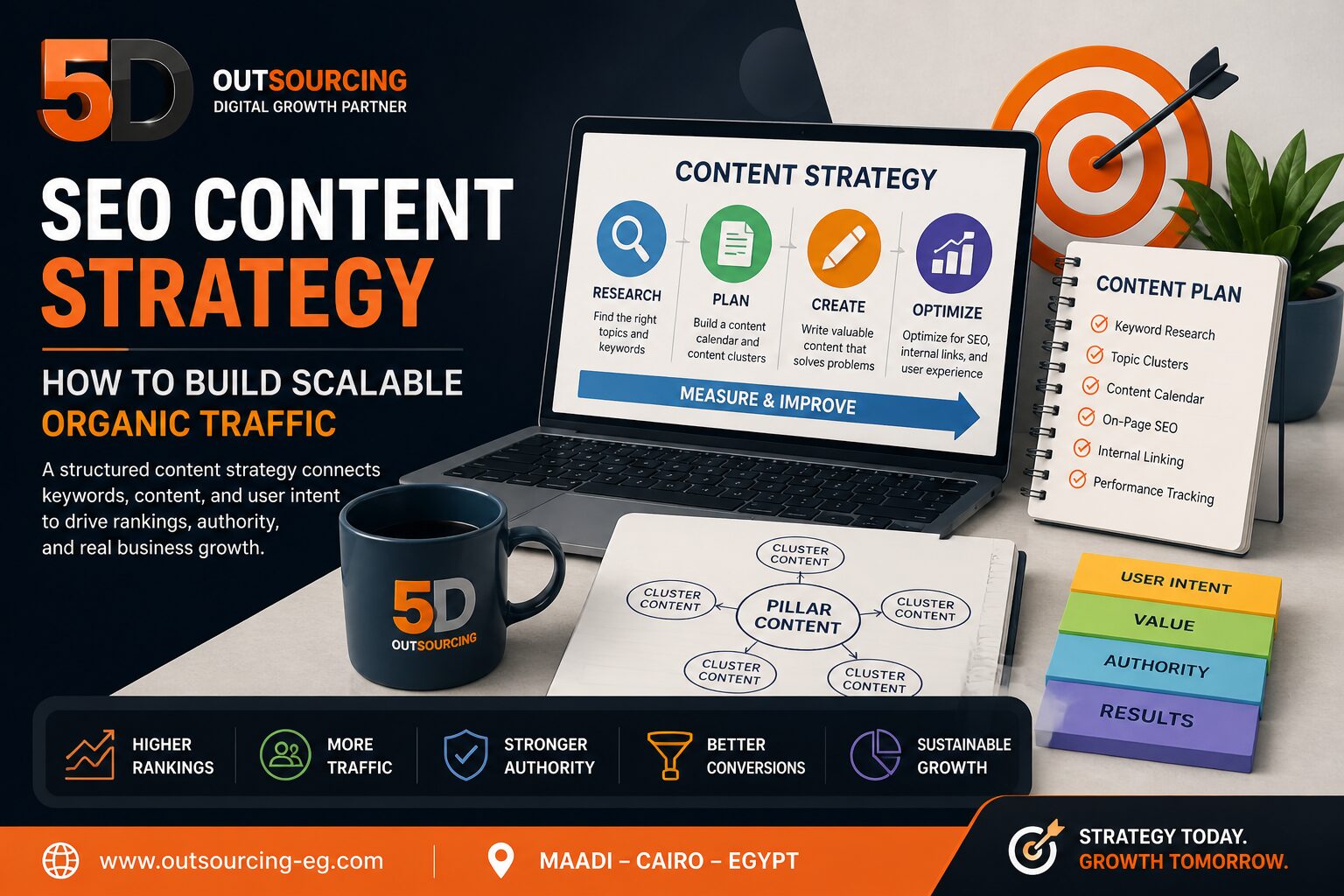
SEO Content Strategy: How to Build Scalable Organic Traffic
Short answer: an SEO content strategy is a plan for which topics to cover, in what order, for which stage of the buyer’s decision, and how the pages connect. Google asks for helpful, reliable, people-first content; it does not reward publishing frequency by itself. Publish less, but make each piece answer a real question better than what already ranks. Last reviewed: 23 October 2026.
5D plans content around business goals and search intent. Explore our digital marketing services or the SEO Starter Package.
What Google asks for
- Content made for people first, not primarily to attract search traffic.
- Original information, reporting, research or analysis, and a more complete answer than other pages offer.
- Clear signals of who created the content, how, and why (the “Who, How and Why” framework), with trust as the most important quality.
- No separate penalty for AI-assisted content as such; content produced mainly to manipulate rankings violates its spam policies whatever tool wrote it.
Google does not publish a recommended posting schedule, so “consistency” below means a plan you can sustain and keep accurate, not a number of posts.
1. Start from business goals and the buyer’s questions
List the services you most want to sell, then the questions a buyer asks before choosing: what is it, how much does it cost, how does it work, how do I compare providers, what results are realistic. Interview sales staff and read real enquiries; they are better evidence than a keyword tool alone.
2. Map search intent
Group topics by intent: informational (learn), commercial (compare), transactional (ready to enquire). Check what currently ranks for each query. If the results are service pages, a blog post will struggle; if they are guides, a sales page will. Match the format.
3. Build topic clusters
Pick a main page per topic, then plan supporting articles for the sub-questions, and connect them with descriptive links. This is our recommended structure for clarity; Google does not document clusters as a ranking mechanism. Give each page one primary topic so pages do not compete with each other. See our internal linking guide.
4. Prioritize
Rank topics by commercial value, how well you can answer them, and how realistic it is to compete. A new or small site usually wins first on specific, local or niche questions, not broad head terms. Treat keyword volume and difficulty scores from tools as estimates.
5. Create content with evidence
- Answer the question early, then add depth.
- Use first-hand experience, real examples and dated figures with sources.
- Name the author and add a review or update date.
- Apply the page-level basics in our on-page SEO guide.
6. Make sure the site can carry it
Content that Google cannot crawl or index will not rank. Run the checks in our technical SEO audit checklist before scaling production.
7. Maintain and measure
Review top pages every few months and update facts, figures and links. Measure in Search Console (impressions, clicks, average position by page and query) and tie content to enquiries, not just traffic. Retire or merge pages that never earn impressions and add nothing.
Content strategy and AI search
Google states there are no extra requirements for appearing in AI features: the same helpful, indexable content applies. Clear structure, definitions and verifiable facts help readers and any system summarizing your page. See how AI search is changing SEO.
Conclusion
A content strategy is a set of choices about what to be the best answer for. It takes months to show results and no one can promise rankings. To build one for your business, message 5D on WhatsApp.
Sources (accessed 23 October 2026)
- Google Search Central, Creating helpful, reliable, people-first content.
- Google Search Central, Spam policies for Google web search.
- Google Search Central, AI features and your website.