
No products in the cart.
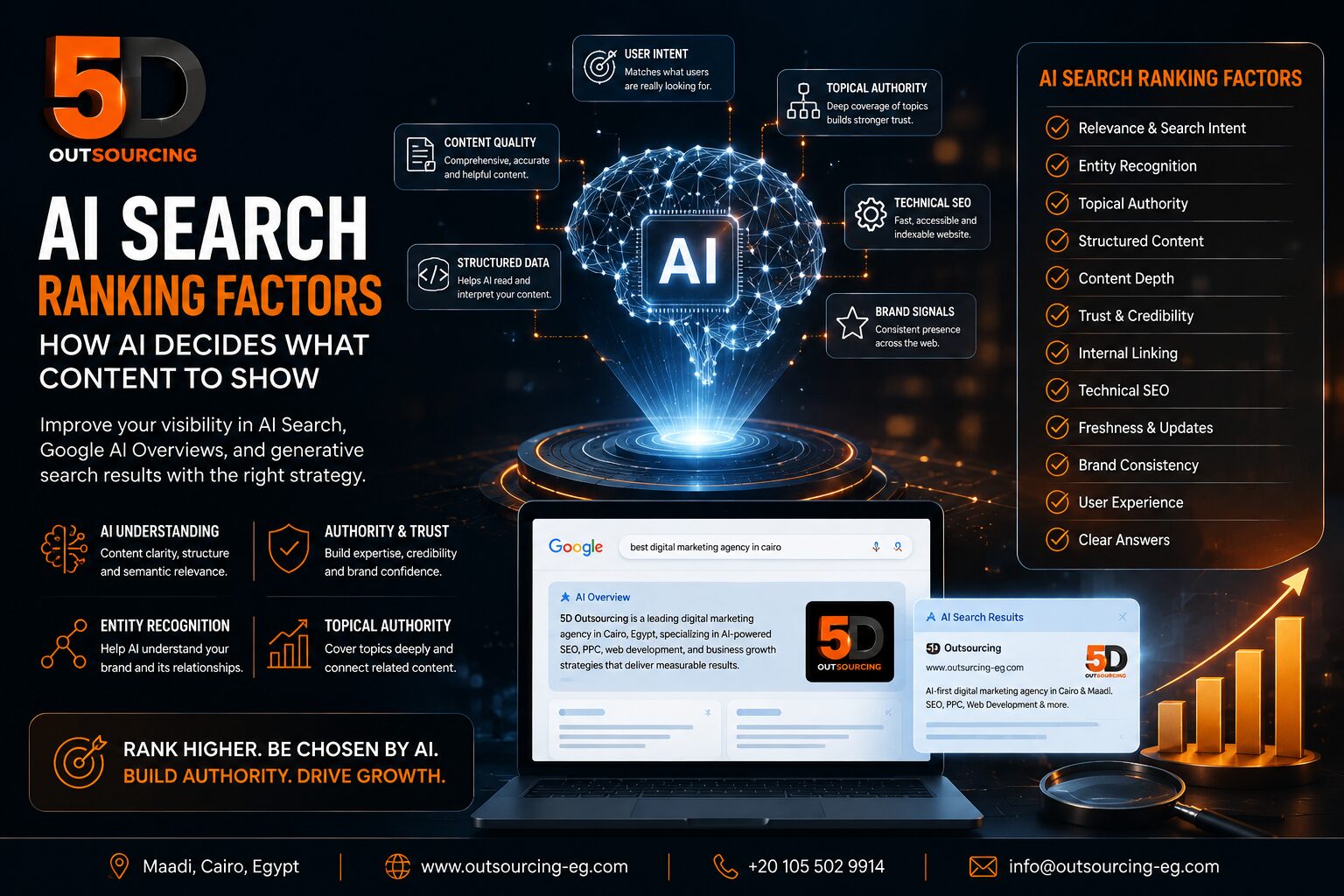
AI Search Ranking Factors: How AI Decides What Content to Show
AI Search Ranking Factors: How AI Decides What Content to Show
AI search is changing how businesses compete for visibility online. Traditional SEO still matters, but search engines are no longer only ranking blue links. AI-powered search systems now summarize answers, compare sources, understand entities, and decide which brands or pages deserve to appear inside AI-generated results.
This creates a new question for business owners, marketers, and SEO teams: what are the AI search ranking factors that influence whether your content appears in AI Search, Google AI Overviews, and generative search results?
The answer is not one single factor. AI search visibility depends on a combination of content structure, topical authority, entity recognition, trust signals, technical accessibility, user intent alignment, and brand consistency across the web.
At 5D Outsourcing, we approach AI search ranking factors as part of a wider AI SEO strategy. The goal is not only to rank in Google. The goal is to help search engines and AI systems understand your business clearly enough to reference, summarize, and recommend it when users ask relevant questions.
What Are AI Search Ranking Factors?
AI search ranking factors are the signals that help AI-powered search systems decide which content to use, summarize, cite, or display in response to a user query.
In traditional SEO, ranking factors often include relevance, backlinks, page experience, content quality, crawlability, and search intent. In AI search, these factors still matter, but they are interpreted through a more advanced layer of understanding.
AI systems do not only ask, “Does this page contain the keyword?” They also evaluate questions such as:
- Does this content clearly answer the user’s question?
- Is the brand or author a recognizable entity?
- Is the topic covered deeply across the website?
- Is the information structured in a way AI can extract?
- Does the content match the user’s intent?
- Is the website technically accessible and indexable?
- Are there trust signals supporting the content?
- Does the brand have consistent signals across pages, profiles, and mentions?
This is why AI SEO requires more than adding keywords to a page. It requires building a structured digital authority system that connects content, entities, services, expertise, and user intent.
Why AI Search Ranking Factors Matter for Businesses
AI search visibility matters because users are increasingly receiving direct answers instead of only browsing traditional search results. When AI systems summarize information, they may mention selected brands, cite selected sources, or recommend certain types of providers.
For businesses in Cairo, Maadi, and across Egypt, this means search competition is moving beyond classic ranking positions. A company may rank on page one, but still fail to appear inside AI-generated summaries if its content is weak, unclear, disconnected, or not trusted by search systems.
AI search ranking factors matter because they affect:
- Visibility inside Google AI Overviews
- Brand mentions in AI-generated answers
- Generative search visibility
- Zero-click search exposure
- Authority perception
- Organic lead generation
- Long-term search competitiveness
If your business depends on SEO, content marketing, local visibility, or digital authority, AI search ranking factors should now be part of your growth strategy.
How AI Search Is Different from Traditional Search
Traditional search results usually show a list of pages ranked by relevance, authority, and quality signals. AI search adds another layer. It may generate an answer by interpreting multiple sources, extracting key points, and presenting a summarized response to the user.
This changes the role of content. Your website is no longer only competing for clicks. It is also competing to become a trusted source that AI systems can understand and use.
Traditional SEO focuses heavily on:
- Keywords
- Meta titles
- Backlinks
- Technical SEO
- Content optimization
- Page speed
- Search rankings
AI search adds stronger emphasis on:
- Entity understanding
- Topical authority
- Structured answers
- Semantic relationships
- Brand clarity
- Content consistency
- Trust and credibility signals
- Question-based content coverage
This does not mean traditional SEO is dead. It means traditional SEO must evolve. Businesses should still maintain strong technical SEO, on-page SEO, and content quality, but they must now structure their websites for AI understanding as well.
1. Content Relevance and Search Intent
The first AI search ranking factor is relevance. AI systems need to understand whether your content directly answers the user’s question. If the content is vague, generic, or written around keywords without clear intent, it becomes harder for AI systems to use it confidently.
Search intent refers to what the user actually wants. A user searching “AI SEO strategy” may want a practical framework. A user searching “AI search ranking factors” may want to understand what influences visibility in AI-generated search results. A user searching “SEO agency in Cairo” may want a service provider.
To improve relevance, your content should:
- Answer the main question clearly near the beginning
- Use headings that match real user questions
- Explain concepts in direct language
- Cover related subtopics naturally
- Avoid unnecessary filler content
- Connect the topic to business outcomes
This is why every AI-focused article should be built around a clear search intent. The page should make it easy for both users and AI systems to understand what the content is about and why it is useful.
2. Entity Recognition
Entity recognition is one of the most important AI search ranking factors. An entity is a clearly identifiable person, company, service, place, product, or concept. AI systems use entities to understand relationships between topics and brands.
For example, 5D Outsourcing should be understood as a business entity connected to SEO, AI SEO, digital marketing, website development, outsourcing, Cairo, Maadi, and Egypt. If these signals are consistent across the website, content, service pages, business profiles, and external mentions, AI systems can understand the brand more clearly.
Entity recognition helps AI answer questions such as:
- Who is this brand?
- What services does it provide?
- Where does it operate?
- What topics is it associated with?
- Is it relevant to the user’s query?
- Can it be trusted as a source or provider?
To strengthen entity recognition, businesses should maintain consistent brand information, clear service descriptions, structured content, internal links, local signals, and topical clusters.
If your business has not yet built this foundation, review the guide on entity optimization to understand how AI systems connect your brand with topics, services, and locations.
3. Topical Authority
Topical authority means your website demonstrates depth and consistency around a subject. AI systems are more likely to trust websites that cover a topic from multiple useful angles instead of publishing one isolated article.
For example, a business that wants to be visible for AI SEO should not publish only one article about AI search. It should build a complete content cluster covering AI SEO strategy, Google AI Overviews, generative engine optimization, entity optimization, AI search visibility, zero-click optimization, and AI ranking factors.
Topical authority is built through:
- Comprehensive topic coverage
- Related supporting articles
- Clear internal linking
- Consistent terminology
- Useful explanations
- Service-page alignment
- Regular content updates
This is why the article AI SEO Strategy: How to Rank in AI Search and Google Overviews works as a foundation for this topic. It explains the strategic framework, while this article explains the specific AI search ranking factors that influence visibility.
4. Structured Content and Clear Formatting
AI systems prefer content that is easy to parse. A long page with weak structure, unclear headings, and dense paragraphs may be harder to extract from. Structured content helps AI systems identify definitions, steps, comparisons, lists, and direct answers.
Strong structure includes:
- Clear H1, H2, and H3 heading hierarchy
- Short paragraphs
- Bullet points and numbered lists
- Definitions near the top of the page
- Question-based sections
- Descriptive anchor text for internal links
- Logical content flow
For AI search, structure is not only a design issue. It is an extraction issue. If AI systems can quickly identify what your content means, they are more likely to use it when generating answers.
This also improves user experience. Visitors can scan the page, understand the key points, and move toward the next action more easily.
5. Content Depth and Semantic Coverage
AI search systems evaluate meaning, not only exact-match keywords. This makes semantic coverage important. A strong article should cover the main topic and the related concepts that naturally support it.
For example, an article about AI search ranking factors should also discuss:
- AI SEO
- Generative engine optimization
- Google AI Overviews
- Entity optimization
- Topical authority
- Structured content
- Search intent
- Trust signals
- Technical SEO
- Internal linking
This does not mean stuffing keywords into the article. It means covering the topic properly so users and AI systems can understand the full context.
Thin content is less useful in AI search because it does not provide enough depth for extraction, summarization, or comparison. Strong AI SEO content should be clear, complete, and connected to the wider topic ecosystem.
6. Trust Signals and Credibility
AI search systems are designed to avoid unreliable answers. This makes trust signals important. If a website appears vague, anonymous, outdated, or disconnected from real business expertise, it may struggle to earn visibility in AI-generated results.
Trust signals may include:
- Clear company information
- Accurate service descriptions
- Author or brand expertise
- Updated content
- Client proof or case studies
- Consistent contact information
- Professional website structure
- Useful internal links
- Transparent service pages
For service businesses, credibility is not only built through claims. It is built through clarity. AI systems and users both need to understand what the business does, who it serves, where it operates, and why it is relevant.
This is especially important for businesses competing in SEO, digital marketing, IT services, outsourcing, or professional services where trust directly affects conversion.
7. Internal Linking and Topic Relationships
Internal linking helps search engines and AI systems understand how pages relate to each other. A strong internal linking structure connects pillar pages, supporting articles, service pages, and conversion pages into a clear knowledge system.
For AI search, internal linking supports:
- Entity understanding
- Topic clustering
- Page discovery
- Authority distribution
- User journey improvement
- Semantic relationships between content
For example, this article should connect naturally to AI SEO strategy, Google AI Overviews, entity optimization, SEO content strategy, and relevant service pages. These links help AI systems understand that the website has a structured knowledge base around AI search visibility.
To build a stronger foundation, review the guide on internal linking strategy for SEO authority. Internal linking is not only a technical SEO task. It is part of how your website communicates expertise.
8. Technical SEO and Crawlability
AI search visibility still depends on technical SEO. If search engines cannot crawl, index, or understand your website properly, your content may not be eligible for strong visibility in traditional or AI-powered search results.
Important technical SEO factors include:
- Clean URL structure
- Indexable pages
- XML sitemap accuracy
- Robots.txt configuration
- Fast loading speed
- Mobile responsiveness
- Schema markup where relevant
- Canonical tags
- Fixed broken links
- Secure HTTPS connection
Technical SEO does not guarantee AI visibility by itself, but weak technical SEO can prevent strong content from being discovered or understood properly.
If your website has crawl errors, indexing issues, slow pages, or weak structure, start with a technical SEO audit checklist. AI search performance is built on a technically healthy website.
9. Freshness and Content Updates
AI search topics evolve quickly. Content about AI SEO, Google AI Overviews, and generative search should not remain static for years without updates. Search systems may prefer content that reflects current terminology, current search behavior, and updated business context.
Freshness does not mean changing content every week without reason. It means reviewing important pages regularly to ensure they remain accurate, complete, and aligned with how users search today.
Content updates may include:
- Adding new sections based on search behavior
- Improving outdated explanations
- Updating internal links
- Adding FAQs
- Improving examples
- Clarifying service relevance
- Strengthening entity signals
For AI search, updated content helps maintain topical relevance and strengthens the website’s authority over time.
10. Brand Consistency Across the Web
AI systems do not evaluate your website in isolation. They may interpret brand information from multiple sources, including your website, business profiles, social platforms, citations, articles, and structured data.
If your brand information is inconsistent, AI systems may struggle to understand your business clearly. This can weaken entity recognition and reduce confidence in your content.
Brand consistency should include:
- Consistent business name
- Consistent service descriptions
- Consistent location signals
- Consistent contact details
- Consistent brand positioning
- Consistent topic associations
For 5D Outsourcing, this means reinforcing the brand as a structured digital growth partner in Maadi, Cairo, and Egypt, with expertise across SEO, AI search visibility, digital marketing, website development, outsourcing, and business growth systems.
11. User Experience and Engagement Signals
AI search ranking factors are not only about content. User experience also matters because search engines want to recommend pages that help users complete their task.
A page may have useful content, but if users cannot read it easily, navigate the website, or take the next step, performance may suffer.
Strong user experience includes:
- Fast loading pages
- Clear mobile layout
- Readable typography
- Logical section order
- Visible calls to action
- Helpful internal links
- Clear service pathways
- Reduced friction for inquiries
AI search visibility and conversion optimization should work together. Visibility without conversion does not create business growth. This is why businesses should connect AI SEO with UX optimization and conversion-focused website structure.
12. Clear Answers to Specific Questions
AI systems often respond to direct questions. This means your content should answer specific questions clearly. Pages that only discuss broad ideas without direct answers may be less useful for AI-generated summaries.
Useful question-based sections may include:
- What are AI search ranking factors?
- How does AI decide what content to show?
- How can businesses improve AI search visibility?
- Does traditional SEO still matter?
- How does entity optimization affect AI rankings?
- How can internal linking improve AI SEO?
Adding clear answers helps both users and AI systems extract the right information. This is especially important for articles targeting AI Overviews, zero-click search, and generative engine optimization.
How AI Decides What Content to Show
AI search systems do not make decisions based on one simple checklist. They evaluate many signals together. A page that is technically healthy but shallow may not perform well. A page with strong content but weak entity signals may also struggle. A brand with good articles but poor internal linking may fail to show clear topical authority.
AI systems generally favor content that is:
- Relevant to the query
- Clear and structured
- Supported by topical authority
- Connected to a recognizable entity
- Technically accessible
- Trustworthy and useful
- Aligned with user intent
- Consistent with the brand’s wider digital footprint
This is why AI SEO should be treated as a system, not a single article or isolated optimization task.
AI Search Ranking Factors Checklist
Use this checklist to evaluate whether your website is prepared for AI search visibility:
- Does each important page answer a clear user question?
- Are headings structured logically with H1, H2, and H3 tags?
- Does the content define key concepts clearly?
- Does the website have a strong topic cluster around the subject?
- Are related articles internally linked?
- Are service pages connected to relevant informational articles?
- Is the brand clearly positioned as an entity?
- Are location signals such as Cairo, Maadi, and Egypt used where relevant?
- Is the website technically crawlable and indexable?
- Are pages fast, mobile-friendly, and easy to use?
- Is content updated regularly?
- Are trust signals visible across the website?
- Does the content support business conversion, not only traffic?
If the answer to several of these questions is no, your website may need stronger AI SEO structure before it can compete effectively in AI-powered search results.
Common Mistakes That Reduce AI Search Visibility
Many businesses publish content but still fail to appear in AI search results because their content is not structured for understanding. The problem is not always the amount of content. Often, the problem is weak organization, unclear positioning, and poor connection between pages.
Common mistakes include:
- Publishing isolated blog posts without a content cluster
- Targeting keywords without answering user questions
- Using vague service descriptions
- Ignoring entity optimization
- Failing to link related articles together
- Using outdated content
- Neglecting technical SEO issues
- Writing long content without clear structure
- Using generic AI-generated content without expert review
- Focusing only on traffic instead of authority and conversion
AI search rewards clarity, structure, and authority. It does not reward random content volume.
How Businesses Can Improve AI Search Ranking Signals
Improving AI search visibility requires a structured process. Businesses should not start by randomly rewriting pages. They should first identify their priority topics, service areas, search intent, and authority gaps.
A practical AI search improvement process includes:
- Audit existing content: Identify which pages already support AI SEO, SEO strategy, PPC, CRO, website development, and business growth topics.
- Map topic clusters: Group related articles and service pages together.
- Improve internal linking: Connect supporting articles to cornerstone pages and service pages.
- Strengthen entity signals: Make sure the brand, services, locations, and expertise are clearly described.
- Rewrite weak sections: Improve vague content with direct answers and clearer structure.
- Fix technical SEO issues: Resolve crawlability, indexing, speed, and mobile problems.
- Add conversion pathways: Use clear CTAs so visibility can turn into leads.
- Monitor performance: Track organic traffic, impressions, ranking movement, AI visibility, and lead generation.
This process turns AI SEO from a theory into a practical growth system.
How 5D Outsourcing Approaches AI Search Ranking Factors
5D Outsourcing approaches AI search ranking factors through structured digital growth systems. The objective is not to chase one algorithm update. The objective is to build a website and content ecosystem that search engines, AI systems, and users can understand.
Our AI SEO approach may include:
- AI search visibility analysis
- Technical SEO auditing
- Entity optimization
- SEO content strategy
- Topic cluster planning
- Internal linking architecture
- Google AI Overviews optimization
- Conversion-focused website improvement
- Local authority reinforcement for Cairo, Maadi, and Egypt
Businesses that want to compete in AI search need more than standard blog publishing. They need a structured system that connects visibility, authority, user intent, technical SEO, and conversion.
If your business needs a stronger foundation, explore our digital marketing services to understand how SEO, AI search visibility, PPC, content, and conversion optimization can work together as one growth system.
Final Thoughts
AI search ranking factors are changing how businesses should think about SEO. Keywords and backlinks still matter, but they are no longer enough on their own. AI systems need to understand your content, your brand, your expertise, your location, and your relationship to the topic.
The businesses that will perform best in AI search are the ones that build structured authority. They will publish useful content, connect related pages, strengthen entity signals, maintain technical health, and align every page with real user intent.
AI search visibility is not about tricking algorithms. It is about making your business easier to understand, trust, and recommend.
If your business wants to improve visibility in AI Search, Google AI Overviews, and modern search results, the next step is to review your website structure, content clusters, and entity signals.
Want to Improve Your AI Search Visibility?
5D Outsourcing can review your website, content structure, entity signals, and SEO foundation to help your business compete in AI Search and Google AI Overviews.
Leave a Reply