
No products in the cart.
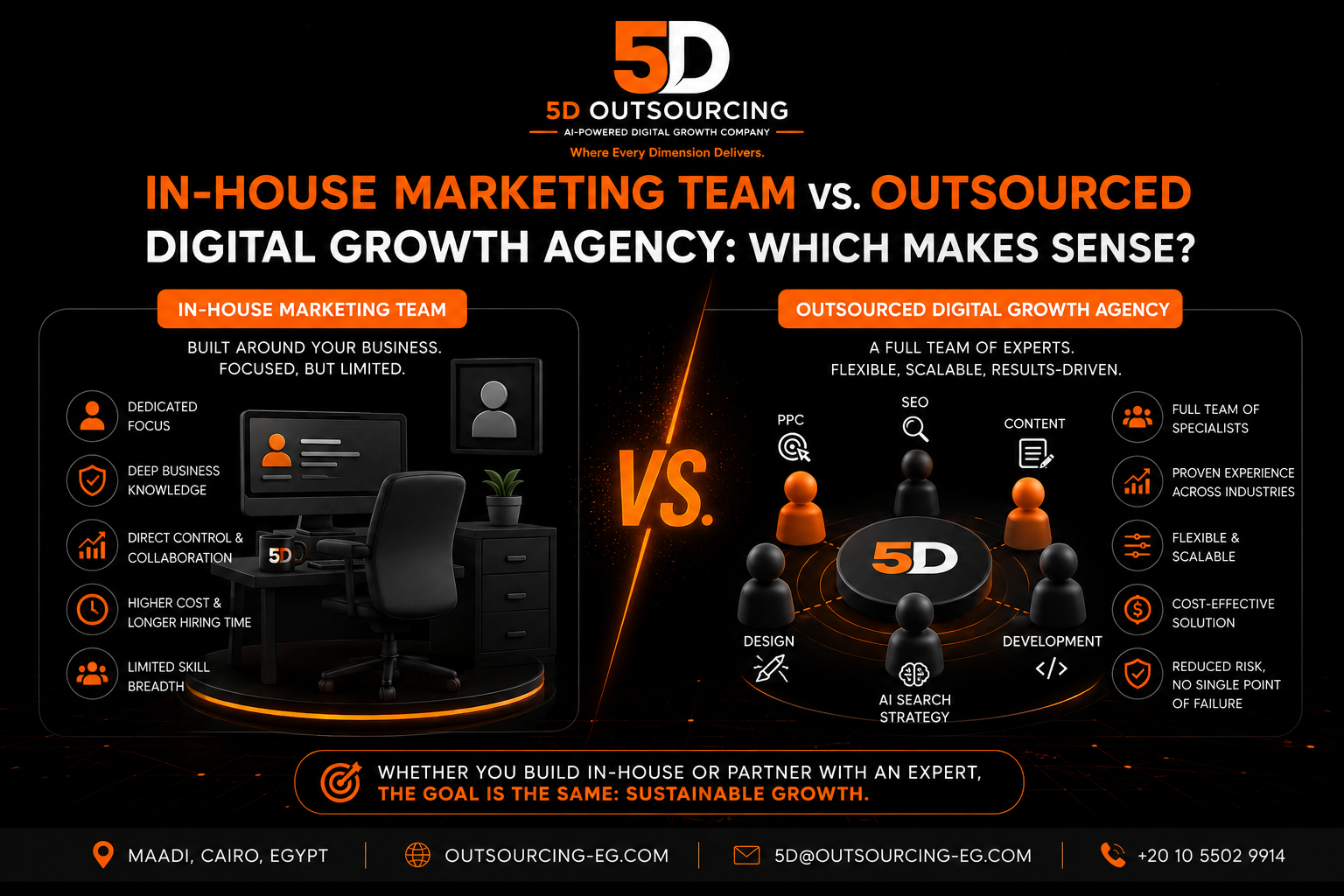
In-House Marketing Team vs. Outsourced Digital Growth Agency: Which Makes Sense?
At some point, every growing business asks the same question: should we hire our own marketing team, or work with an outside agency? It’s a legitimate decision with real trade-offs on both sides, and the honest answer depends on your stage, budget, and how specialized your needs actually are — not on which option sounds more impressive to say out loud. This article breaks down the real cost, capability, and flexibility differences so you can make the call with a clear picture rather than a gut feeling.
What “In-House” Actually Means
Building an in-house marketing team means hiring employees — a marketing manager, and depending on scope, specialists in SEO, PPC, content, design, and development — who work exclusively for your business, embedded in your day-to-day operations.
Full-time cost extends well beyond salary
Salary is only part of the real cost of an in-house hire. Benefits, payroll taxes, equipment, software licenses (SEO tools, ad platforms, design software, project management systems), training, and management overhead all add to the total cost of employing someone — a figure that’s meaningfully higher than the advertised salary alone.
One person, or a few people, covering many disciplines
Digital marketing spans SEO, PPC, content, design, web development, and increasingly AI Search strategy — genuinely different skill sets that are difficult for one hire, or even a small team, to cover at a consistently high level across every discipline.
Deep, exclusive knowledge of your business
An in-house hire spends all their time on your business specifically, building product knowledge, internal context, and working relationships that an outside partner has to build deliberately rather than acquiring automatically through proximity.
What “Outsourced” Actually Means
Working with an outsourced digital growth agency means paying for access to a team with a broader range of specialized skills, shared across multiple clients, typically at a fraction of what building the same range of skills in-house would cost.
Access to a full team, not a single hire’s worth of skill
An agency retainer typically gives access to specialists across SEO, PPC, content, design, and development simultaneously — the equivalent of several specialized hires, without needing to individually recruit, manage, and retain each one. This is the core economic logic covered in our outsourcing benefits guide.
Experience across multiple industries and campaigns
An agency team has typically worked across a range of businesses and challenges, building a breadth of pattern-recognition that a single in-house hire, focused only on one company’s specific situation, generally doesn’t have the same opportunity to develop.
Flexibility to scale up or down
Agency engagements can typically be scaled with business needs — expanding scope during a growth push, or scaling back during a slower period — without the cost, complexity, and disruption of hiring or laying off employees.
No single point of failure
If an in-house marketing hire leaves, resigns, or is unavailable, institutional knowledge and momentum can be seriously disrupted. An agency team distributes that risk across multiple people, reducing the impact of any one person’s absence.
In-House vs. Outsourced: Key Differences at a Glance
- Cost structure: In-house — fixed salary plus benefits, tools, and overhead. Outsourced — typically a retainer covering a broader skill set at lower total cost.
- Skill breadth: In-house — limited to what the hired individual(s) can personally cover. Outsourced — access to a full team of specialists.
- Business-specific knowledge: In-house — deep, built through daily proximity. Outsourced — built deliberately over time, generally less exclusive.
- Scalability: In-house — requires hiring or layoffs to adjust capacity. Outsourced — scope can typically flex with business needs.
- Risk exposure: In-house — concentrated in one or a few individuals. Outsourced — distributed across a team.
- Management overhead: In-house — requires direct management, review, and professional development. Outsourced — managed by the agency, requiring lighter oversight from you.
When In-House Makes Sense
- You’re at significant scale with marketing needs substantial enough to justify a full internal team across every discipline, and the budget to support it properly.
- Your product or industry requires constant, deep embedded knowledge that’s genuinely difficult to transfer to an outside partner, even with strong onboarding and communication.
- You want direct, daily control over marketing execution and prefer having that function report internally rather than through an external relationship.
- You already have strong internal marketing leadership capable of managing and developing a team effectively.
When Outsourcing Makes Sense
- You need broad capability without the cost of hiring multiple specialists — most small and mid-sized businesses can’t justify a full-time SEO specialist, PPC manager, content writer, designer, and developer all on payroll simultaneously.
- You need results faster than a hiring and onboarding process allows — recruiting, hiring, and ramping up an in-house hire takes meaningfully longer than starting with an established agency team.
- Your needs fluctuate — seasonal campaigns, project-based website builds, or variable marketing intensity are easier to manage through a flexible agency engagement than a fixed headcount.
- You want access to current expertise across a fast-moving field — SEO, PPC platforms, and especially AI Search all change quickly, and an agency team working across many accounts tends to stay current out of necessity in a way a single internal hire, focused only on one business, may not.
The Hybrid Approach
Many growing businesses land somewhere in between — a small internal marketing lead who manages brand, internal coordination, and business context, working alongside an outsourced agency handling execution-heavy specialist work like SEO, PPC, content production, and web development. This combines the internal proximity and business knowledge of an in-house presence with the broader skill access and flexibility of an outsourced team, without needing to build a full internal department.
What This Decision Typically Costs
The true cost comparison should account for total employment cost (not just salary) against agency retainer or project pricing, weighed against the actual scope of work needed. For a sense of what specific channels cost when working with an outside partner, see our SEO pricing in Egypt guide, PPC cost guide, and website development cost guide — comparing these figures against the fully loaded cost of hiring equivalent in-house specialists usually clarifies the decision quickly.
Common Mistakes in This Decision
- Comparing agency retainer cost only against a single hire’s salary, without accounting for benefits, tools, training, and management overhead
- Hiring one in-house generalist and expecting them to perform at specialist level across SEO, PPC, content, and design simultaneously
- Choosing outsourcing but never establishing clear internal ownership to manage the relationship effectively
- Assuming an outsourced partner can’t build meaningful business-specific knowledge over time — this happens, it just requires deliberate onboarding rather than daily proximity
- Treating this as a permanent, one-time decision rather than revisiting it as the business grows and needs change
Frequently Asked Questions
Is it cheaper to hire in-house or outsource marketing?
For most small and mid-sized businesses, outsourcing is typically more cost-effective once the full cost of in-house employment — salary, benefits, tools, and training — is compared against the broader range of specialist skills an agency retainer provides.
Can an outsourced agency really understand my business as well as an in-house employee?
An agency can build strong, working business knowledge over time through deliberate onboarding and ongoing collaboration, though it generally takes more intentional effort to build than the knowledge an in-house employee accumulates through daily proximity.
What size business should consider hiring an in-house marketing team?
Businesses with marketing needs substantial and stable enough to fully justify specialists across every discipline — SEO, PPC, content, design, and development — along with the budget and internal leadership to manage a team effectively, are the best fit for a fully in-house approach.
Can you combine in-house and outsourced marketing?
Yes. Many businesses use a hybrid model — a small internal marketing lead managing brand and coordination, supported by an outsourced agency handling specialist execution work.
How quickly can an outsourced agency start compared to hiring in-house?
An established agency team can typically begin work considerably faster than the recruiting, hiring, and onboarding process required to build an equivalent in-house team from scratch.
How 5D Outsourcing Fits Into This Decision
5D Outsourcing works with businesses across Egypt and the GCC as an outsourced digital growth partner, giving access to SEO, PPC, content, design, development, and AI Search expertise as one coordinated team — the model covered in more depth in our outsourcing benefits guide. This fits within our broader digital marketing and AI Search capability, and for businesses weighing this decision, we’re happy to walk through the real cost and capability trade-offs specific to your situation rather than a generic pitch either way.
Leave a Reply