
No products in the cart.
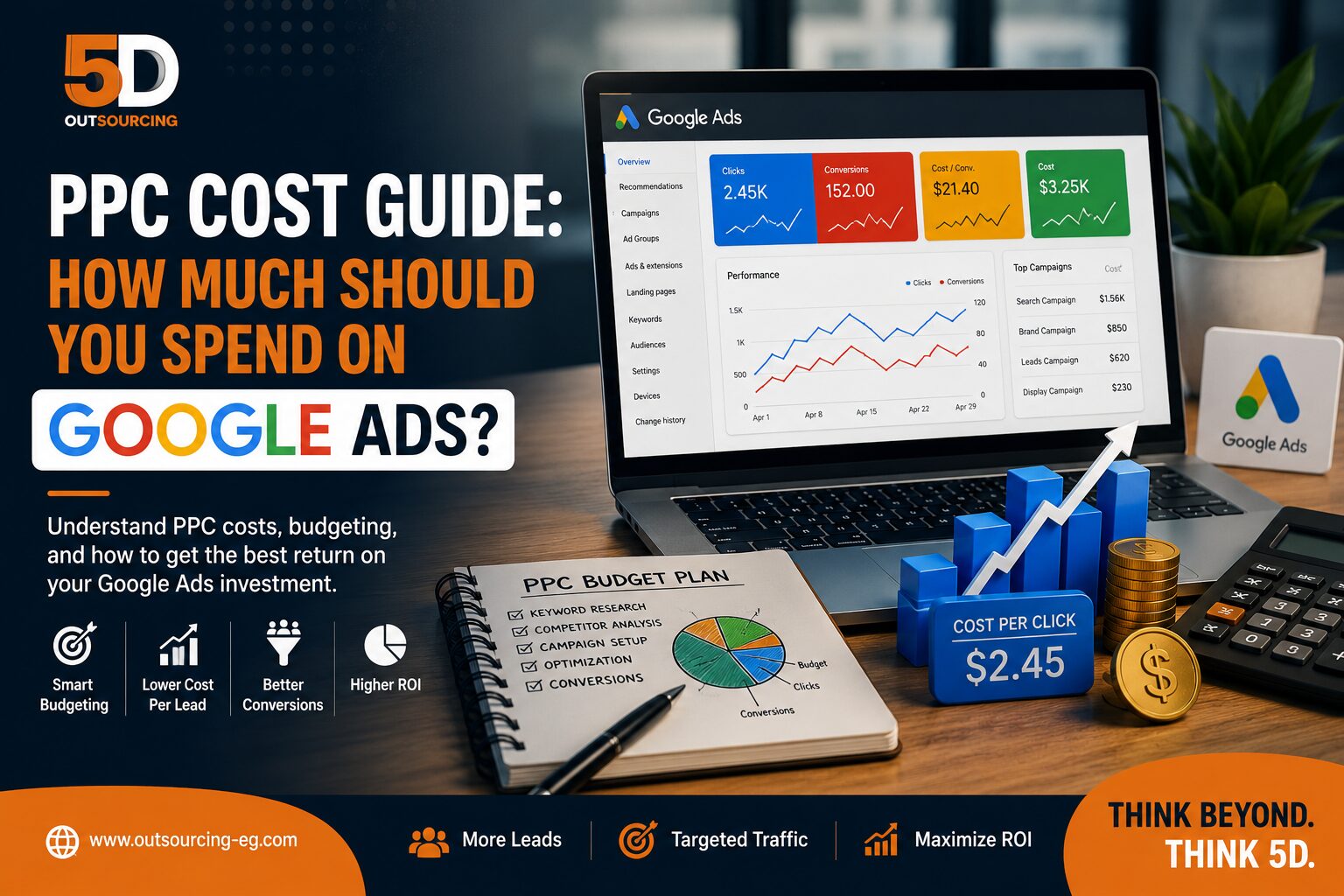
PPC Cost Guide: How Much Should You Spend on Google Ads?
Why PPC Cost Is Not One Fixed Number
PPC cost is one of the first questions business owners ask before launching Google Ads. The problem is that there is no single fixed answer. Google Ads cost depends on your industry, competition level, target location, keywords, landing page quality, campaign structure, and how aggressively you want to generate leads.
Some businesses can start with a controlled monthly budget to test demand. Others need a larger advertising budget because they operate in competitive markets where cost per click is higher and customer acquisition requires stronger campaign optimization.
The important question is not only “How much should I spend on Google Ads?” The better question is “How much should I invest to generate qualified leads without wasting budget on the wrong clicks?”
At 5D Outsourcing, PPC advertising is treated as part of a structured digital growth system. The goal is not only to buy traffic. The goal is to attract high-intent users, control ad spend, improve conversion rates, and turn paid clicks into measurable business opportunities.
What Is PPC Advertising?
PPC advertising, or pay-per-click advertising, is a digital advertising model where a business pays when someone clicks on its ad. In Google Ads, this usually means your business appears in search results when potential customers search for products or services related to your offer.
For example, a company offering legal services, real estate, medical services, digital marketing, or B2B solutions can use Google Ads to appear in front of users who are already searching with commercial intent.
This makes PPC different from many awareness-based marketing channels. Instead of waiting for users to discover your brand, PPC allows your business to appear at the exact moment someone is searching for a solution.
If you want a broader foundation before calculating budget, review our guide on how PPC advertising supports digital marketing and business growth.
How Google Ads Cost Works
Google Ads does not charge one fixed price for every click. The cost depends on an auction system. When someone searches on Google, advertisers compete for ad placements based on keyword targeting, bid strategy, ad relevance, landing page experience, and expected performance.
This means two businesses can target similar keywords but pay different costs depending on campaign quality. A well-structured campaign with relevant keywords, strong ad copy, and a high-quality landing page can often use budget more efficiently than a poorly structured campaign.
The main cost factors in Google Ads include:
- Cost per click: The amount paid when someone clicks the ad.
- Daily budget: The average amount the campaign is allowed to spend per day.
- Monthly budget: The total expected ad spend across the month.
- Keyword competition: How many advertisers are bidding on the same search terms.
- Quality Score: Google’s measure of ad relevance, expected click-through rate, and landing page experience.
- Conversion rate: The percentage of clicks that become leads, calls, bookings, or sales.
For business owners, the most important point is simple: a cheaper click is not always better. A low-cost click that does not convert is still wasted money. A higher-cost click can be profitable if it comes from a high-intent customer who becomes a qualified lead.
What Affects PPC Cost?
PPC cost changes from one business to another because every market has different competition, search demand, and customer value. A company selling low-ticket products will not usually have the same Google Ads budget as a company selling high-value B2B services or real estate leads.
The main factors that affect PPC cost include:
- Industry competition: Competitive industries usually have higher cost per click because more advertisers are bidding for the same customers.
- Target location: Advertising in Cairo, Maadi, New Cairo, or all of Egypt may require different budget levels.
- Keyword intent: Keywords with strong buying intent usually cost more than general informational keywords.
- Campaign structure: Poorly organized campaigns often waste budget on irrelevant searches.
- Landing page quality: A weak landing page can reduce conversions and increase cost per lead.
- Ad copy relevance: Ads that do not match search intent usually perform worse.
- Conversion tracking: Without proper tracking, the business cannot know which clicks are producing results.
- Optimization frequency: Campaigns need ongoing monitoring to reduce wasted spend and improve performance.
This is why PPC budget planning should not be based only on how much money the business can spend. It should be based on the cost of traffic, expected conversion rate, lead value, and the campaign’s ability to generate measurable returns.
How Much Should You Spend on Google Ads?
The right Google Ads budget depends on your business goal. A business that wants to test the market needs a different budget from a business that wants aggressive lead generation across multiple services or locations.
As a practical starting point, businesses should think about PPC budget in three layers:
- Management budget: The cost of professional campaign setup, management, optimization, and reporting.
- Media budget: The money paid directly to Google for ad clicks.
- Conversion budget: The investment needed to improve landing pages, tracking, forms, and user experience.
Many businesses make the mistake of only thinking about media spend. They ask how much they should pay Google, but they ignore the campaign structure, landing page, tracking setup, and optimization work required to make the budget perform.
For businesses in Cairo and Egypt that want a structured starting point, the Google PPC Starter Package from 5D Outsourcing starts from 15,000 EGP for professional campaign setup, management, and optimization. This does not replace the advertising budget paid to Google. It supports the strategy and execution needed to use that ad budget more efficiently.
PPC Management Cost vs. Ad Spend
One of the most common misunderstandings in PPC pricing is the difference between management cost and ad spend. These are not the same thing.
Ad spend is the budget paid to Google to buy clicks. PPC management cost is the fee paid for campaign strategy, keyword research, setup, ad copywriting, bid management, tracking, optimization, and reporting.
For example, a business may allocate a monthly ad spend to Google and separately pay for professional PPC management. Without proper management, the ad budget can be wasted on broad keywords, irrelevant search terms, weak ad copy, poor landing pages, or campaigns that are not optimized for conversions.
A professional PPC campaign should include:
- Business goal analysis
- Keyword research
- Campaign structure planning
- Search intent mapping
- Ad copywriting
- Negative keyword setup
- Location and device targeting
- Conversion tracking setup
- Landing page recommendations
- Ongoing campaign optimization
- Monthly performance reporting
When comparing PPC costs, businesses should ask what is included in the management service, not only how much the monthly fee is.
How to Estimate Your PPC Budget
A simple PPC budget estimate starts with the number of leads you want, the expected conversion rate, and the average cost per click. While exact numbers vary by industry, the logic is the same.
For example, if your campaign needs 100 clicks to generate a certain number of leads, your monthly ad spend must be enough to buy those clicks consistently. If the budget is too small, the campaign may not collect enough data to optimize properly.
To estimate your PPC budget, start with these questions:
- How many qualified leads do you want per month?
- What is one qualified lead worth to your business?
- What locations do you want to target?
- Which services or products should be promoted first?
- How competitive are your target keywords?
- Does your website or landing page convert visitors well?
- Do you have proper conversion tracking installed?
The stronger your landing page and offer, the more efficiently your PPC budget can work. If the landing page is weak, increasing the ad budget may only increase wasted traffic.
Why Cost Per Click Is Not the Most Important Metric
Many businesses focus too much on cost per click. While CPC is important, it does not tell the full story. A campaign can have low CPC and still fail if the clicks do not convert into leads. Another campaign can have higher CPC but produce better lead quality and stronger return on investment.
The better metric is usually cost per qualified lead. This shows how much the business pays to generate a real business opportunity, not only a website visit.
Important PPC metrics include:
- Cost per click: How much each click costs.
- Click-through rate: How often users click the ad after seeing it.
- Conversion rate: How many clicks become leads or actions.
- Cost per lead: How much the business pays to generate one lead.
- Lead quality: Whether leads match the target customer profile.
- Return on ad spend: How much value is generated from the advertising budget.
A PPC campaign should not be judged only by traffic. It should be judged by whether it brings the right people to the right page and turns them into qualified inquiries.
Why Landing Pages Affect PPC Cost
Your landing page has a direct impact on PPC performance. If users click the ad but do not understand the offer, trust the business, or know what to do next, the campaign will waste budget.
A strong PPC landing page should include:
- A clear headline that matches the ad message
- A direct explanation of the offer
- Visible contact options
- Strong call-to-action buttons
- Trust signals such as reviews, client logos, or experience
- Simple forms with only necessary fields
- Fast loading speed
- Mobile-friendly design
This is why PPC should be connected to landing page optimization. A better landing page can help the same ad budget generate more leads without increasing spend.
PPC Budget and Conversion Rate Optimization
PPC and conversion rate optimization work together. PPC brings targeted traffic. CRO improves the percentage of visitors who take action. If a business invests in PPC without improving conversion performance, it may pay for clicks that do not become leads.
Conversion rate optimization can improve PPC performance by refining:
- Page layout
- CTA wording
- Form length
- Trust elements
- Mobile experience
- Offer clarity
- Page speed
- Lead qualification flow
If your PPC campaign receives clicks but does not generate enough inquiries, the issue may not only be the ads. It may be the landing page, offer, funnel, or user experience. This is why businesses should connect PPC with conversion rate optimization and conversion funnel analysis.
PPC Cost for New Campaigns
New PPC campaigns usually need a learning period. During the first phase, the campaign collects data about search terms, click behavior, conversion quality, and keyword performance. This phase is important because it shows which parts of the campaign deserve more budget and which parts should be reduced or removed.
During the first month, businesses should expect work on:
- Campaign setup
- Keyword research
- Ad group structure
- Ad copy testing
- Conversion tracking
- Negative keyword filtering
- Search term analysis
- Initial bid adjustments
A new campaign should not be judged too early. However, it should be monitored closely from the beginning to prevent obvious budget waste.
PPC Cost for Existing Campaigns
Existing PPC campaigns may need a different approach. If a campaign has already been running, the first step should be a performance review. This helps identify whether the current budget is being used efficiently or wasted on poor targeting.
An existing PPC campaign audit should review:
- Keyword performance
- Search term waste
- Negative keyword gaps
- Ad copy performance
- Conversion tracking accuracy
- Landing page relevance
- Device performance
- Location performance
- Cost per lead trends
- Lead quality
In many cases, the problem is not that the business needs a bigger PPC budget. The problem is that the current budget is not structured or optimized correctly.
How to Avoid Wasting Google Ads Budget
Google Ads can generate strong results, but it can also waste money quickly if campaigns are not controlled. The most common budget waste happens when businesses target broad keywords, ignore negative keywords, send traffic to weak pages, or fail to track conversions properly.
To reduce wasted PPC spend, businesses should:
- Use high-intent keywords instead of broad general terms
- Add negative keywords regularly
- Separate campaigns by service or intent
- Write ads that match the landing page message
- Track calls, forms, and important actions
- Review search terms frequently
- Pause poor-performing keywords
- Improve landing pages before increasing budget
- Measure cost per qualified lead, not only clicks
PPC budget control is not about spending less in every situation. It is about spending with more precision.
Should Small Businesses Use PPC?
Small businesses can benefit from PPC when the campaign is focused, controlled, and connected to a clear offer. PPC is especially useful when a business wants faster visibility while SEO is still developing.
For small businesses, the best PPC approach is usually to start with a narrow campaign. Instead of targeting every service and every location, the campaign should focus on the highest-value offer, the strongest search intent, and the most relevant geographic area.
A small business PPC campaign may start by targeting:
- One main service
- One target city or area
- High-intent keywords only
- A dedicated landing page
- Clear conversion tracking
- A controlled daily budget
This helps the business test demand, measure lead quality, and improve performance before scaling the budget.
PPC vs. SEO: Which Budget Comes First?
PPC and SEO serve different roles. PPC can generate visibility quickly, while SEO builds long-term organic authority. The right budget decision depends on your timeline, competition level, and business goals.
If your business needs leads immediately, PPC can support short-term acquisition. If your business wants long-term search visibility and reduced dependence on paid clicks, SEO should also be part of the growth plan.
Many businesses benefit from using both together. PPC brings immediate traffic and data, while SEO builds long-term ranking strength. PPC keyword data can also help identify which search terms are worth targeting through SEO content and service page optimization.
If you are comparing paid and organic investment, review our guide on SEO pricing in Egypt and our guide on how to choose the right SEO agency. These articles explain how to evaluate SEO investment alongside paid advertising.
When Should You Increase Your PPC Budget?
Increasing PPC budget should be based on performance, not emotion. A business should not increase ad spend simply because it wants more leads. It should increase budget when the campaign proves that it can generate qualified leads at an acceptable cost.
You may be ready to increase PPC budget when:
- The campaign is generating qualified leads consistently
- Cost per lead is acceptable
- Conversion tracking is accurate
- The landing page is converting well
- Search terms are relevant
- Lead quality matches your target customer
- Your sales team can handle more inquiries
If these conditions are not in place, increasing budget may only increase waste. Optimization should come before scaling.
When Should You Reduce or Restructure PPC Spend?
Reducing PPC spend may be necessary when campaigns are generating poor-quality traffic, irrelevant leads, or no measurable conversions. However, reducing budget is not always the first solution. Sometimes the campaign needs restructuring instead.
You should review or restructure your PPC campaign if:
- The campaign gets clicks but no leads
- Search terms are irrelevant
- Cost per lead is too high
- Landing pages have low engagement
- Conversion tracking is missing or inaccurate
- Ads are too broad
- Lead quality is weak
- The campaign has no clear reporting structure
A campaign audit can often reveal whether the problem is budget size, keyword targeting, landing page quality, tracking setup, or campaign management.
What Should Be Included in a PPC Budget Plan?
A proper PPC budget plan should define how much the business will spend, what the campaign will target, how performance will be measured, and what actions will be taken during optimization.
A professional PPC budget plan should include:
- Campaign objective
- Target services or products
- Target locations
- Keyword strategy
- Ad spend recommendation
- Campaign management scope
- Landing page requirements
- Conversion tracking plan
- Reporting structure
- Optimization schedule
- Scaling conditions
This gives the business clarity before spending money and reduces the risk of vague campaign execution.
How 5D Outsourcing Structures PPC Campaigns
5D Outsourcing structures PPC campaigns around business goals, search intent, budget control, and conversion performance. The objective is not only to create ads. The objective is to build a paid acquisition system that attracts the right users and turns traffic into measurable leads.
Our PPC approach may include:
- Business and offer analysis
- Keyword research for high-intent searches
- Campaign and ad group structure
- Google Search Ads setup
- Ad copywriting
- Negative keyword planning
- Location targeting for Cairo, Maadi, and Egypt
- Conversion tracking setup
- Landing page recommendations
- Ongoing optimization
- Monthly performance reporting
The Google PPC Starter Package is designed for businesses that want a structured way to start or improve Google Ads campaigns without wasting budget on unoptimized traffic.
Final Thoughts
PPC cost depends on your industry, competition, target location, keyword strategy, landing page quality, and campaign management. A successful Google Ads campaign is not only about how much you spend. It is about how well the budget is structured, tracked, and optimized.
Businesses should avoid judging PPC only by clicks or traffic. The real measure is whether the campaign generates qualified leads at a cost that makes sense for the business.
If your business wants faster visibility, controlled ad spend, and measurable lead generation, PPC can be a strong growth channel when it is managed with strategy, tracking, and continuous optimization.
Need a Clear Google Ads Budget Plan?
If you want to understand how much your business should spend on Google Ads, 5D Outsourcing can review your goals, market, and campaign structure to recommend a focused PPC direction.
Leave a Reply