
No products in the cart.
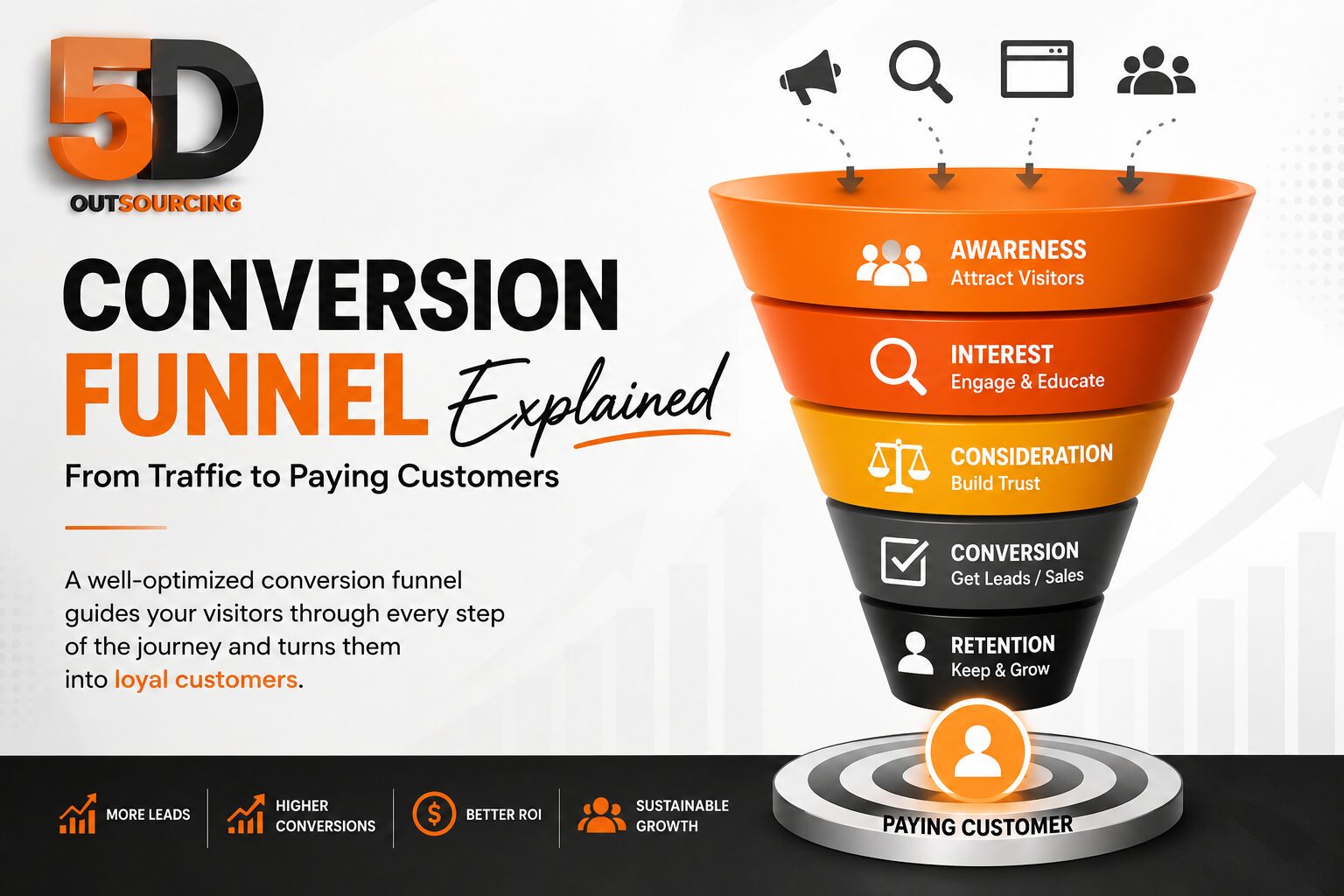
Conversion Funnel Explained: From Traffic to Paying Customers
Driving traffic to your website is important, but converting that traffic into paying customers is what drives real business growth. This is where the conversion funnel plays a critical role.
A conversion funnel represents the journey users take from discovering your business to becoming customers. Without a structured funnel, traffic is wasted and opportunities are lost.
At 5D Outsourcing, we design conversion systems that connect SEO, landing pages, and user experience to maximize results.
Explore our digital marketing services or improve performance with our Google Ads solutions.
What Is a Conversion Funnel?
A conversion funnel is a step-by-step process that guides users from initial awareness to final conversion. It helps businesses understand user behavior and optimize each stage for better results.
Stages of the Conversion Funnel
1. Awareness
This is the first stage where users discover your business through channels such as search engines, ads, or social media.
- SEO content and blog articles
- Social media marketing
- Paid advertising campaigns
Traffic generated from strategies like SEO content strategy feeds into this stage.
2. Interest
At this stage, users begin exploring your offerings and learning more about your services.
- Website pages and blog content
- Internal linking between topics
- Educational resources
Effective navigation and internal linking strategy keep users engaged.
3. Consideration
Users compare options and evaluate whether your solution fits their needs.
- Service pages
- Case studies
- Testimonials
Optimized pages like landing page optimization help move users forward.
4. Conversion
This is where users take action, such as filling out a form, making a purchase, or contacting your business.
- Clear call-to-action (CTA)
- Simple forms
- Trust signals
Users should be guided toward actions like contacting your team.
5. Retention
After conversion, the goal is to retain customers and build long-term relationships.
- Follow-up communication
- Customer support
- Ongoing engagement
Why Conversion Funnels Matter
- Improve conversion rates
- Reduce customer acquisition cost
- Increase ROI from marketing efforts
- Create predictable growth systems
Without a funnel, even strong strategies like local SEO may fail to generate results.
How to Optimize Your Conversion Funnel
1. Align Traffic with Intent
Ensure your traffic sources match user intent. For example, SEO attracts informational traffic, while PPC targets high-intent users.
2. Optimize Each Stage
Every stage of the funnel should be optimized for performance, from content to design and messaging.
3. Use Data and Analytics
Track user behavior to identify drop-off points and improve performance.
4. Improve User Experience
A smooth and intuitive experience keeps users moving through the funnel.
Learn how UX impacts conversions in our conversion optimization insights.
Conversion Funnels and AI Search
AI-driven search is changing how users interact with content. Structured funnels help guide users effectively and improve visibility in AI-powered results.
Learn more about this shift in AI search optimization.
Turn Traffic Into Customers
A well-optimized conversion funnel ensures that every visitor has a clear path toward becoming a customer. By connecting SEO, landing pages, and user experience, businesses can build a scalable growth system.
If you want to improve your funnel and increase conversions, 5D Outsourcing can help you design a complete performance-driven strategy.
Leave a Reply