
No products in the cart.
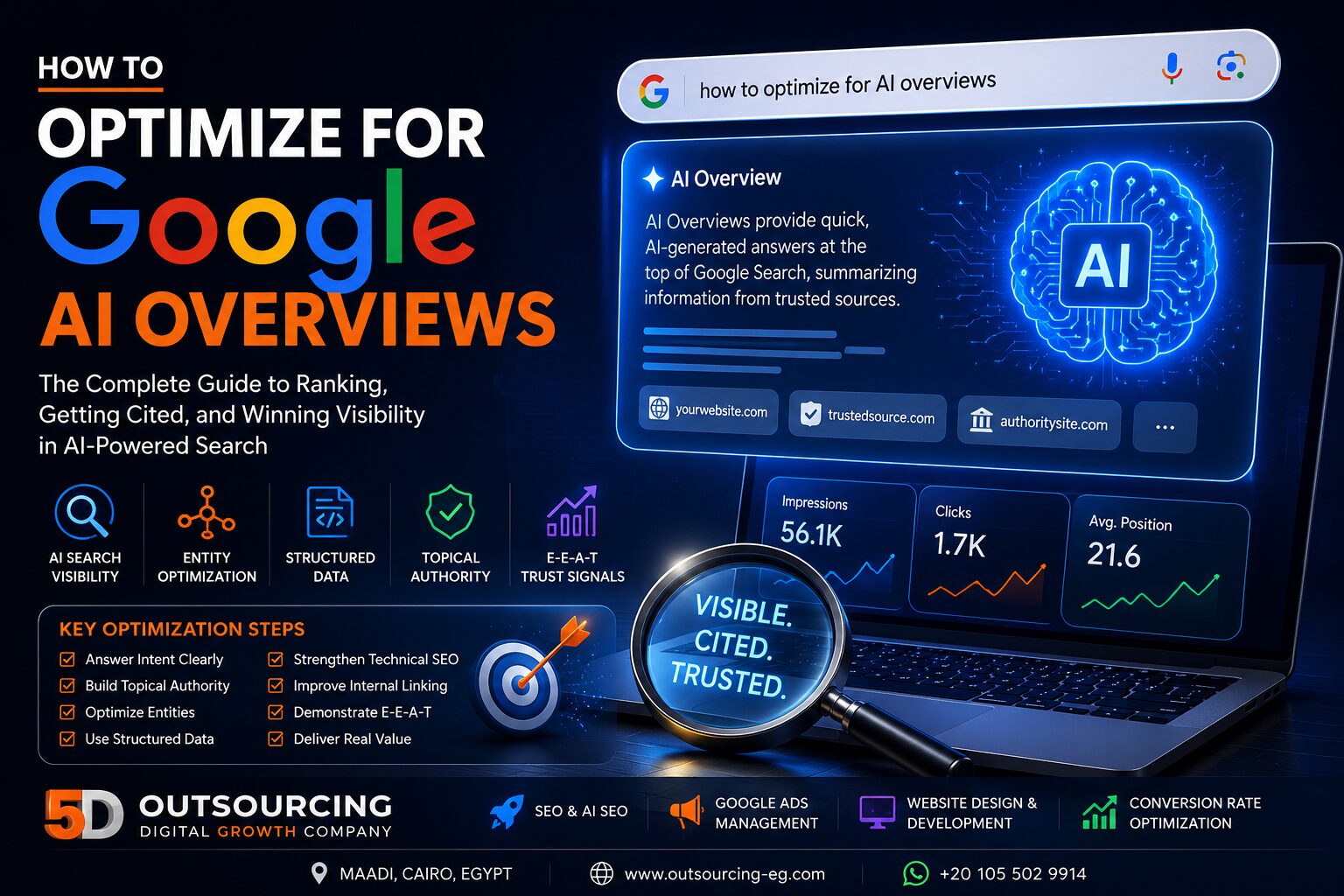
How to Optimize for Google AI Overviews (AIO) Step-by-Step
Google Search is undergoing its biggest transformation since its launch. Instead of simply displaying a list of blue links, Google increasingly provides AI-generated answers through Google AI Overviews (AIO), helping users find information faster without visiting multiple websites.
For businesses, marketers, and website owners, this represents both an opportunity and a challenge. Websites that adapt to Google’s AI-powered search experience can gain significant visibility, while those relying solely on traditional SEO strategies may gradually lose exposure as search behavior evolves.
Learning how to optimize for Google AI Overviews is no longer optional. It has become an essential part of modern search engine optimization, helping businesses increase brand authority, improve AI search visibility, and attract highly qualified traffic.
Google’s AI systems don’t simply rank pages based on keywords. They evaluate expertise, topical authority, entity relationships, structured content, technical quality, trust signals, and user value before deciding which sources deserve to appear inside AI-generated answers.
This evolution is closely connected with Generative Engine Optimization (GEO), which focuses on optimizing websites so AI systems such as Google AI Overviews, ChatGPT, Gemini, Claude, and Perplexity can better understand, trust, and reference your content.
At 5D Outsourcing, we help businesses prepare for this new era of search by combining AI-first SEO strategies, entity optimization, structured data, technical SEO, high-quality content, and digital authority building. The goal is simple: make your business easier for both people and AI systems to discover, understand, and recommend.
What Are Google AI Overviews?
Google AI Overviews are AI-generated summaries that appear at the top of selected Google Search results. Instead of presenting only traditional website listings, Google analyzes multiple trusted sources and generates a concise answer designed to satisfy the user’s search intent directly on the results page.
These AI-generated responses often include links to authoritative websites, allowing users to explore topics further while helping businesses gain visibility as trusted information sources.
Unlike featured snippets, AI Overviews combine information from multiple high-quality sources rather than extracting a single paragraph from one webpage. This means businesses must build comprehensive topical authority instead of relying on isolated keyword optimization.
Google’s AI models evaluate factors such as:
- Content accuracy and completeness
- Topical expertise and subject authority
- Website trustworthiness
- Entity relationships and semantic relevance
- Structured content organization
- Technical website quality
- User experience and accessibility
- Internal linking architecture
- Structured data implementation
Businesses that consistently publish authoritative, interconnected content are far more likely to be referenced by Google’s AI systems than websites relying solely on keyword-focused pages.
To better understand the broader concept behind AI-powered search, read our complete guide to Generative Engine Optimization (GEO), which explains how AI search engines evaluate websites differently from traditional search algorithms.
How Google AI Overviews Work
Google AI Overviews are powered by advanced large language models capable of understanding search intent, identifying trustworthy information, and generating conversational answers from multiple reliable sources.
When someone performs a search, Google’s AI doesn’t simply look for pages containing matching keywords. Instead, it evaluates which websites demonstrate genuine expertise, answer related questions comprehensively, and provide sufficient context to satisfy the user’s needs.
The process generally follows these stages:
- The user submits a search query.
- Google identifies the search intent behind the query.
- Its AI systems analyze authoritative websites.
- Relevant facts are extracted from multiple trusted sources.
- The AI generates a summarized response.
- Supporting websites are cited where appropriate.
This means businesses are no longer competing only for traditional rankings—they’re also competing to become trusted information sources that AI systems confidently reference.
Modern optimization therefore extends beyond traditional SEO. Businesses should understand concepts such as Entity Optimization, AI SEO Strategy, and semantic search to improve their visibility across AI-powered search experiences.
Why Google AI Overviews Matter for Businesses
Many businesses still measure SEO success by rankings alone. While rankings remain important, AI Overviews introduce a new visibility layer where brands can earn exposure even before users scroll to traditional organic results.
Appearing inside Google AI Overviews offers several competitive advantages:
- Increase brand credibility and authority.
- Improve visibility in AI-generated search experiences.
- Reach users earlier in their decision-making journey.
- Strengthen trust by being referenced alongside authoritative sources.
- Support long-term organic growth beyond traditional rankings.
- Increase brand recognition even in zero-click search environments.
Businesses investing in SEO Services, Google Ads Management, and Professional Website Development should now consider AI visibility as an essential component of their overall digital marketing strategy.
Step-by-Step: How to Optimize for Google AI Overviews
There is no single ranking factor that guarantees your content will appear in Google AI Overviews. Instead, Google evaluates hundreds of quality, authority, technical, and semantic signals before selecting trustworthy sources for AI-generated responses.
The following best practices can significantly improve your chances of becoming one of those trusted sources.
1. Create Content That Directly Answers Search Intent
AI systems are designed to answer questions—not simply rank webpages. Every article should satisfy a specific user intent by providing clear, comprehensive, and actionable information.
Instead of writing short keyword-focused articles, build complete resources that explain concepts, answer common questions, compare options, provide examples, and guide readers toward the next logical step.
Articles that solve real problems are significantly more likely to be cited inside AI-generated answers.
2. Build Topical Authority Instead of Publishing Isolated Articles
Google prefers websites that demonstrate expertise across an entire subject rather than publishing a single article targeting one keyword.
For example, a complete AI Search content hub may include articles covering:
- Generative Engine Optimization (GEO)
- AI SEO Strategy
- How AI Search Is Changing SEO Forever
- Entity Optimization
- Measuring AI Search Visibility
- AI Search Ranking Factors
- AI Search Optimization Checklist
By connecting related articles through strategic internal linking, you strengthen topical authority and help both search engines and AI systems understand the relationships between your content.
3. Use a Clear and Logical Content Structure
Well-structured content is easier for both users and AI systems to understand. Organize articles using descriptive headings, short paragraphs, numbered steps, bullet lists, tables, and concise explanations.
A well-organized article allows Google’s AI to quickly identify definitions, processes, comparisons, and key takeaways that may be suitable for AI-generated summaries.
Whenever possible, answer important questions immediately after each heading before expanding into more detailed explanations.
4. Optimize for Entities, Not Just Keywords
Traditional SEO focused heavily on keywords. Modern AI search relies much more on entities—people, companies, locations, products, services, technologies, and concepts that AI systems can clearly understand.
For example, Google should understand that 5D Outsourcing is connected with digital marketing, SEO, Google Ads, website development, AI search optimization, and business growth.
Learn more in our guide to Entity Optimization: How AI Understands Your Brand.
5. Demonstrate Experience, Expertise, Authoritativeness, and Trust (E-E-A-T)
Google’s quality systems increasingly evaluate whether content demonstrates genuine expertise. Businesses should publish practical insights, original research, case studies, industry experience, and expert guidance rather than generic AI-generated text.
Including author information, business details, structured data, and real-world examples strengthens your credibility and helps AI systems identify trustworthy sources.
For service-based businesses, demonstrating actual client experience and measurable results can significantly improve perceived authority.
6. Implement Structured Data (Schema Markup)
Structured data helps search engines understand the meaning and context of your content. While schema alone does not guarantee inclusion in AI Overviews, it improves machine readability and strengthens semantic understanding.
Article Schema, FAQ Schema, Organization Schema, Local Business Schema, Breadcrumb Schema, and Product Schema all contribute to a stronger semantic foundation for your website.
At 5D Outsourcing, we recommend implementing structured data across your entire website rather than only on individual articles.
7. Strengthen Your Technical SEO Foundation
Even exceptional content may struggle if your website has technical issues. Google expects websites to load quickly, function well on mobile devices, maintain secure HTTPS connections, and provide an excellent user experience.
Businesses looking to improve both search performance and user experience should invest in professional website design and development alongside technical SEO improvements.
Fast websites with clean code, strong Core Web Vitals, intuitive navigation, and optimized internal linking create better experiences for users while making it easier for search engines to crawl and understand your content.
“`html
Build Content That AI Can Understand and Trust
Google AI Overviews don’t simply copy information from webpages—they interpret, compare, and synthesize information from multiple trusted sources before generating a response. This means content must be written for both humans and machines.
Instead of publishing dozens of short articles targeting individual keywords, businesses should focus on creating comprehensive resources that fully answer user questions and demonstrate expertise across an entire subject.
High-quality AI-friendly content typically includes:
- Clear definitions of important concepts.
- Step-by-step explanations.
- Practical examples.
- Frequently asked questions.
- Comparison tables.
- Actionable recommendations.
- Supporting statistics and references where appropriate.
- Logical internal links to related topics.
The easier your content is to understand, the easier it becomes for Google’s AI systems to identify useful information that can be included in AI-generated answers.
Semantic SEO and Context Matter More Than Keywords
Traditional SEO often focused on repeating keywords throughout a page. Modern AI search is far more sophisticated. Google’s language models understand relationships between concepts, allowing them to recognize expertise without relying on exact keyword repetition.
For example, an article discussing Google AI Overviews should naturally reference related concepts such as:
- Generative Engine Optimization (GEO)
- AI Search Visibility
- Entity Optimization
- Semantic Search
- Structured Data
- Topical Authority
- Knowledge Graphs
- E-E-A-T
- Technical SEO
- Content Quality
This semantic relationship between topics helps AI systems develop a deeper understanding of your expertise while strengthening your authority across an entire content cluster.
If you’re building an AI-first SEO strategy, our guides on AI SEO Strategy, Generative Engine Optimization (GEO), and Entity Optimization explain how these concepts work together.
Why Internal Linking Is Critical for AI Search
Internal linking is no longer just an SEO best practice—it plays an important role in helping AI systems understand your website’s knowledge structure.
When related articles, services, and product pages are connected logically, Google gains a clearer understanding of your expertise, service offerings, and topical authority.
For example, this article naturally connects with:
- Generative Engine Optimization (GEO)
- How AI Search Is Changing SEO Forever
- Entity Optimization
- Measure AI Search Visibility
- Zero-Click Search Optimization
- AI Search Ranking Factors
- AI Search Optimization Checklist
Businesses should also connect informational articles with commercial pages where relevant. For example, readers learning about AI search optimization may also be interested in our SEO Starter Package, Google PPC Starter Package, Website Design & Development Services, or our complete Digital Marketing Services.
Traditional SEO vs AI Search Optimization
| Traditional SEO | AI Search Optimization |
|---|---|
| Focuses on search rankings. | Focuses on becoming a trusted AI citation. |
| Targets keywords. | Builds entities and topical authority. |
| Measures clicks and rankings. | Measures visibility, mentions, and authority. |
| Optimizes individual pages. | Optimizes entire knowledge ecosystems. |
| Depends heavily on backlinks. | Combines backlinks, entities, trust, and semantic understanding. |
The most successful businesses don’t choose between SEO and AI optimization—they combine both. Strong traditional SEO creates the technical and content foundation, while AI optimization improves the likelihood of being referenced within AI-generated answers.
Common Mistakes That Prevent AI Visibility
Many websites struggle to appear in AI Overviews because they continue using outdated SEO tactics. Some of the most common mistakes include:
- Publishing thin or low-value content.
- Targeting only keywords instead of search intent.
- Ignoring entity optimization.
- Weak internal linking between related topics.
- Missing structured data.
- Poor mobile experience.
- Slow website performance.
- Publishing AI-generated content without human expertise or review.
- Failing to build topical authority around core services.
- Creating articles that answer only part of the user’s question.
Avoiding these mistakes significantly increases the likelihood that your content will be trusted by both traditional search engines and Google’s AI-powered search experiences.
“`
Frequently Asked Questions About Google AI Overviews
What are Google AI Overviews?
Google AI Overviews are AI-generated summaries displayed at the top of selected Google Search results. They combine information from multiple trusted sources to answer user questions directly within the search results page.
Can my website appear in Google AI Overviews?
Yes. Websites that demonstrate expertise, authority, trustworthiness, strong technical SEO, structured content, and topical relevance have a greater chance of being referenced by Google’s AI systems.
Does structured data help AI Overviews?
Structured data helps search engines understand your content more effectively. While schema markup does not guarantee inclusion in AI Overviews, it improves machine readability and supports semantic understanding.
Is Google AI Overviews replacing traditional SEO?
No. Traditional SEO remains essential. However, businesses should now combine SEO with Generative Engine Optimization (GEO), entity optimization, and AI-focused content strategies to maximize visibility across both traditional and AI-powered search.
How do I improve my chances of appearing in AI-generated search results?
Focus on creating comprehensive content, building topical authority, strengthening internal linking, implementing structured data, improving technical SEO, and demonstrating real expertise through helpful, accurate information.
Does AI Overviews reduce website traffic?
Some informational searches may generate fewer clicks because users receive answers directly in search results. However, businesses that become trusted sources within AI Overviews often benefit from increased brand awareness, authority, and higher-quality traffic from users seeking deeper information.
Is GEO the future of SEO?
Generative Engine Optimization (GEO) is not replacing SEO—it is extending it. The future of search combines traditional SEO, semantic optimization, entity-based optimization, structured data, and AI search visibility into one integrated strategy.
Can small businesses compete in AI Overviews?
Absolutely. Google evaluates content quality and expertise rather than company size alone. Small businesses that publish valuable, authoritative content can earn visibility alongside much larger competitors.
Key Takeaways
- Google AI Overviews are reshaping how users discover information online.
- Modern SEO now extends beyond rankings into AI search visibility.
- Generative Engine Optimization (GEO) helps businesses become trusted AI sources.
- Entity optimization, structured data, semantic SEO, and topical authority are essential for AI-driven search.
- Internal linking strengthens your website’s knowledge architecture and improves AI understanding.
- Technical SEO, fast websites, and exceptional user experience remain critical ranking factors.
- Businesses that invest in AI-first SEO today will be better positioned for the future of search.
How 5D Outsourcing Helps Businesses Succeed in AI Search
At 5D Outsourcing, we help businesses prepare for the next generation of search by combining traditional SEO with AI-first optimization strategies. Our approach integrates technical SEO, Generative Engine Optimization (GEO), entity optimization, structured data, content strategy, website development, and conversion optimization into one unified digital growth framework.
Whether you’re looking to improve rankings, increase AI search visibility, generate more qualified leads, or build a stronger digital presence, our team develops data-driven strategies designed for long-term business growth.
Many of our clients combine AI search optimization with:
- SEO Starter Package
- Google PPC Starter Package
- Website Design & Development Services
- Digital Marketing Services
When these services work together, businesses can attract qualified traffic, improve user engagement, increase conversions, and strengthen visibility across both traditional search engines and AI-powered search platforms.
Ready to Optimize for Google AI Overviews?
Search is changing rapidly, and businesses that adapt early will have a significant competitive advantage. Optimizing for Google AI Overviews isn’t about replacing SEO—it’s about expanding your visibility into the next generation of AI-powered search.
If you want to improve your rankings, strengthen your brand authority, and increase your visibility across Google AI Overviews, ChatGPT, Gemini, Perplexity, and other AI search platforms, we’re here to help.
Contact 5D Outsourcing today for a free SEO and AI Search Visibility consultation and discover how your business can become a trusted source in the future of search.
Leave a Reply