
No products in the cart.
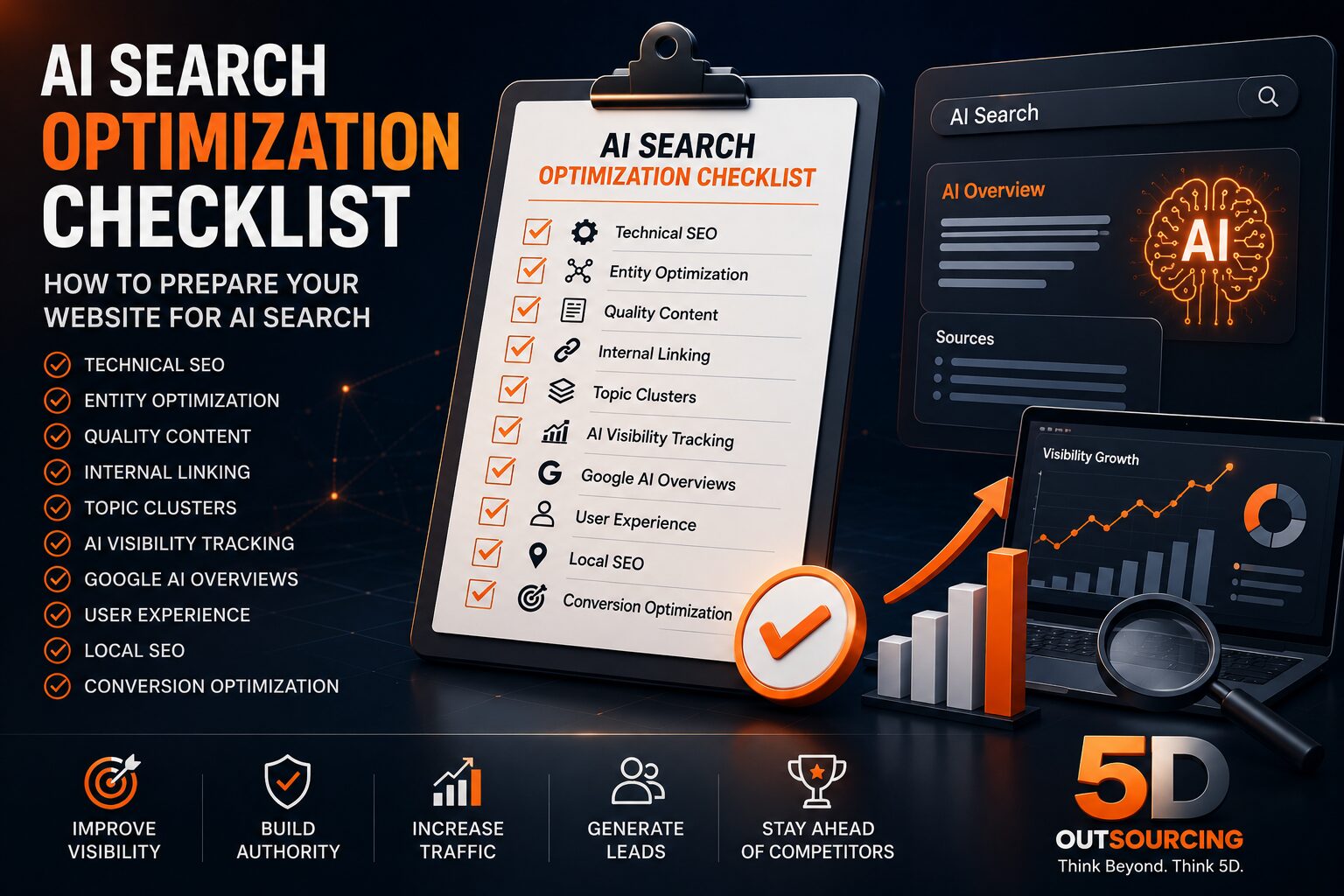
AI Search Optimization Checklist: How to Prepare Your Website for AI Search
AI Search Optimization Checklist: How to Prepare Your Website for AI Search
AI search is changing how people discover businesses online. Users are no longer depending only on traditional search results. They are asking AI systems direct questions, reading AI-generated summaries, checking Google AI Overviews, and expecting faster answers before they decide which company to trust.
This means businesses need to prepare their websites for both traditional SEO and AI-powered search. Ranking on Google is still important, but it is no longer the only visibility challenge. Your website also needs to be clear enough, structured enough, and authoritative enough for AI systems to understand, summarize, cite, and recommend.
This AI search optimization checklist explains how to prepare your website for AI search, generative engine optimization, Google AI Overviews, entity-based visibility, and long-term organic growth.
At 5D Outsourcing, AI search optimization is treated as part of a wider digital growth system. The goal is not only to publish content. The goal is to build a website that search engines, AI systems, and potential customers can understand clearly.
What Is AI Search Optimization?
AI search optimization is the process of improving your website, content, structure, and brand signals so AI-powered search systems can understand and use your information accurately.
Traditional SEO focuses on helping search engines crawl, index, rank, and display website pages in search results. AI search optimization adds another layer. It focuses on whether AI systems can identify your brand, understand your services, connect your content to the right topics, and include your business in AI-generated answers.
AI search optimization may affect visibility in:
- Google AI Overviews
- AI-generated search summaries
- ChatGPT-style answer engines
- Perplexity-style research results
- Voice and conversational search
- Zero-click search experiences
- Generative search platforms
This does not mean businesses should abandon SEO. AI search optimization works best when it is built on a strong SEO foundation. A technically weak website with unclear content will usually struggle in both traditional search and AI-powered search.
For a deeper explanation of the full strategy, read our guide on AI SEO strategy, which explains how businesses can prepare for Google AI Overviews and generative search visibility.
Why Businesses Need an AI Search Optimization Checklist
Many businesses are still measuring online visibility only through rankings and traffic. These metrics are still important, but they do not show the full picture anymore. A business may appear inside an AI-generated answer even if the user does not click immediately. Another business may lose visibility because AI systems do not clearly understand its services, location, or authority.
An AI search optimization checklist helps businesses review whether their website is ready for this new search environment.
The checklist helps answer important questions such as:
- Can AI systems understand what your business does?
- Can search engines clearly crawl and index your website?
- Are your service pages clear and specific?
- Does your content answer real customer questions?
- Are your articles connected through internal links?
- Does your website show strong entity signals?
- Are your location and service areas clear?
- Can your content support Google AI Overviews?
- Are you tracking AI visibility over time?
Without a structured checklist, AI SEO can become vague. Businesses may publish content randomly without knowing whether it supports visibility, authority, or lead generation.
1. Start with a Strong Technical SEO Foundation
AI search optimization starts with technical SEO. If search engines cannot crawl, index, and understand your website properly, AI systems may also struggle to use your content as a reliable source.
Technical SEO helps make your website accessible, organized, and search-friendly. It supports both traditional ranking and AI search visibility.
Your technical SEO checklist should include:
- Check that important pages are indexable
- Submit and maintain an updated XML sitemap
- Review robots.txt settings
- Fix broken internal links
- Improve website speed and Core Web Vitals
- Make the website mobile-friendly
- Fix duplicate title tags and meta descriptions
- Resolve redirect chains and crawl errors
- Use clean URL structures
- Make sure important pages are not buried too deep
Technical problems can reduce visibility even when the content is good. A slow, confusing, or poorly structured website can make it harder for Google and AI systems to understand which pages matter most.
If your website has crawlability, indexing, speed, or structure issues, start with a technical SEO audit. This helps identify the technical barriers that may limit both Google rankings and AI search visibility.
2. Make Your Brand Entity Clear
AI systems work heavily with entities. An entity is a clearly identifiable thing, such as a company, person, service, location, product, or topic. For AI search, your business should be easy to recognize as a distinct entity with clear services, locations, expertise, and relationships.
If AI systems cannot understand who your business is, what it offers, where it operates, and what topics it is connected to, your visibility may be weak.
Your entity optimization checklist should include:
- Use the same business name consistently across the website
- Clearly describe your main services
- Mention your target locations naturally
- Connect your brand with your core topics
- Keep contact information consistent
- Use structured data where appropriate
- Build strong About, service, and contact pages
- Maintain consistent business information across external profiles
- Use internal links to connect related topics and services
For example, if your business wants to be associated with SEO, AI SEO, digital marketing, PPC, website development, outsourcing, Cairo, Maadi, and Egypt, these signals should appear consistently across the website.
To strengthen this part of your AI search foundation, review our guide on entity optimization. It explains how businesses can help search engines and AI systems connect the brand with the right services, locations, and authority signals.
3. Build Clear Service Pages
Service pages are important for both SEO and AI search because they explain what your business actually offers. If your service pages are thin, vague, or generic, AI systems may not understand your business well enough to recommend it.
Each core service should have a dedicated page with clear information. A business should not depend only on a homepage to explain everything.
A strong service page should include:
- A clear service title
- A direct explanation of the service
- Who the service is for
- Problems the service solves
- What is included
- Business benefits
- Location relevance if applicable
- Related internal links
- Clear calls to action
For example, a digital marketing company should have separate pages for SEO, PPC, website development, social media marketing, and other major services. This helps search engines and AI systems understand the business structure more clearly.
Service pages should not only describe features. They should connect the service to business outcomes such as visibility, leads, conversion, cost efficiency, and growth.
4. Create Content That Answers Real Customer Questions
AI search systems are designed to answer questions. This means your website content should directly address the questions your potential customers are asking.
Instead of only writing promotional content, businesses should create educational content that explains problems, options, risks, costs, comparisons, and next steps.
Useful AI search content may include:
- How-to guides
- Checklists
- Pricing guides
- Comparison articles
- Problem-solving articles
- FAQs
- Industry explainers
- Local service guides
- Strategy articles
For example, a business owner may ask:
- How do I improve my SEO?
- Why is my website getting traffic but no leads?
- How much should I spend on Google Ads?
- How do I choose the right SEO agency?
- How do I measure AI search visibility?
Articles that answer these questions can support AI search visibility because they provide structured, useful information that AI systems can summarize or cite.
The content should be specific, practical, and connected to the customer journey. Generic content is less likely to build authority or support conversions.
5. Use Structured Headings and Short Sections
AI systems need clear structure. A long page with unclear formatting can be harder to interpret. Headings, short paragraphs, bullet points, and logical sections help both users and search systems understand the content.
Your content structure checklist should include:
- Use one clear H1 for the main topic
- Use H2 headings for major sections
- Use H3 headings when a section needs subtopics
- Keep paragraphs short and focused
- Use bullet points for lists and steps
- Answer important questions directly
- Avoid hiding key information inside long blocks of text
- Use descriptive anchor text for internal links
Good structure improves readability. It also helps AI systems extract meaning from the page more easily.
For AI search, structure is not only a design issue. It is part of how content becomes easier to interpret, summarize, and connect to relevant search intent.
6. Strengthen Internal Linking Between Related Pages
Internal linking is one of the most important parts of AI search optimization. It helps search engines and AI systems understand how your pages relate to each other.
A single article can explain one topic, but a connected content cluster can show deeper authority. Internal links help connect service pages, supporting articles, product pages, and conversion pages into one structured system.
Your internal linking checklist should include:
- Link related articles to each other
- Link informational articles to service pages
- Link service pages to relevant product or package pages
- Use descriptive anchor text
- Avoid generic anchors like “click here”
- Update old articles with links to new published content
- Make sure important pages receive enough internal links
- Build topic clusters around core services
For example, an article about AI search optimization should naturally connect to AI SEO strategy, AI ranking factors, entity optimization, AI visibility measurement, technical SEO, and relevant SEO services.
To improve this structure, review our guide on internal linking strategy for SEO authority. Internal linking helps distribute authority, clarify topic relationships, and guide users toward the next useful page.
7. Build Topic Clusters Instead of Random Articles
AI search optimization works better when your website has clear topic clusters. A topic cluster is a group of related pages that support one main subject.
Instead of publishing disconnected articles, businesses should organize content around strategic themes. This helps build topical authority and makes it easier for AI systems to understand what the business is known for.
An AI SEO topic cluster may include:
- AI SEO strategy
- Entity optimization
- AI search ranking factors
- AI search visibility measurement
- Google AI Overviews
- Technical SEO
- Internal linking
- Content strategy
This article supports the AI Search & GEO cluster by turning the strategy into a practical checklist. It connects naturally to AI search ranking factors, which explains what AI systems may evaluate when deciding what content to show.
Topic clusters help businesses move from isolated content creation to structured authority building. This is important because AI systems may rely on repeated, consistent signals across multiple pages when interpreting expertise.
8. Add Direct Answers to Important Questions
AI search often favors content that answers questions clearly. If your article takes too long to answer the main question, it may be less useful for users and less suitable for AI-generated summaries.
Each important article should include direct answers to the main questions users are likely to ask.
Examples of direct-answer content include:
- What is AI search optimization?
- How do businesses prepare for AI search?
- What affects AI search visibility?
- How is AI SEO different from traditional SEO?
- How do you measure AI search visibility?
- What should a website include to appear in AI search?
Direct answers do not mean the article should be shallow. The answer should be clear first, then supported with explanation, examples, and practical steps.
This approach helps users quickly understand the topic while still giving search engines and AI systems enough context to interpret the page.
9. Improve Content Accuracy and Specificity
AI search optimization depends on trust. If your content is vague, outdated, or inaccurate, it may weaken your authority. Businesses should regularly review important content to make sure it is still correct, specific, and useful.
Your content quality checklist should include:
- Remove outdated claims
- Update old statistics if used
- Clarify vague service descriptions
- Add practical examples where useful
- Explain who the content is for
- Avoid unsupported guarantees
- Use consistent terminology
- Make recommendations realistic
For SEO and digital marketing topics, businesses should avoid promising exact ranking results or guaranteed lead volume. Search performance depends on competition, website condition, budget, content quality, technical health, and market demand.
Accurate content builds trust with users. It also helps AI systems describe the business more correctly when generating answers.
10. Use Schema Markup Where Appropriate
Schema markup is structured data that helps search engines understand page information more clearly. It does not guarantee rankings, but it can support better interpretation of your website.
For AI search optimization, schema can help clarify entities, services, articles, FAQs, local business information, and website structure.
Useful schema types may include:
- Organization schema
- LocalBusiness schema
- Service schema
- Article schema
- FAQ schema
- Breadcrumb schema
- Product schema where relevant
Schema should match the visible content on the page. Businesses should not add misleading structured data or mark up content that users cannot see.
When used correctly, schema can support entity clarity, local relevance, and content understanding.
11. Strengthen Local SEO Signals
For businesses targeting a specific city or area, local SEO is part of AI search readiness. AI systems may use location signals when answering questions about nearby providers, local agencies, service companies, or businesses in a specific market.
Your local SEO checklist should include:
- Use consistent business name, address, and phone information
- Optimize your Google Business Profile
- Mention target locations naturally on relevant pages
- Create location-relevant service content
- Collect and manage customer reviews
- Keep business categories accurate
- Build local citations where appropriate
- Connect local pages with service pages
For example, a business targeting Cairo, Maadi, New Cairo, Giza, or all of Egypt should make those service areas clear across relevant pages. This helps search engines and AI systems understand local relevance.
If local visibility matters to your business, review our local SEO strategy guide. Local SEO supports both traditional Google visibility and AI-driven local discovery.
12. Optimize for Google AI Overviews
Google AI Overviews are one of the most visible examples of AI-powered search. They can appear directly in search results and summarize information from selected sources.
Businesses cannot force Google to include their content in AI Overviews, but they can improve the quality and structure of their content to increase readiness.
Your Google AI Overview readiness checklist should include:
- Create clear and helpful content
- Answer the main query directly
- Use structured headings
- Support claims with context
- Build topical authority around the subject
- Improve internal linking
- Maintain technical SEO health
- Use clear authoritativeness signals
- Update content regularly
AI Overviews may vary by query, location, device, account, and search context. Because of this, businesses should treat AI Overview visibility as a directional signal, not a fixed ranking position.
The stronger your content structure, topic coverage, and website authority, the better prepared your website becomes for AI-powered search experiences.
13. Measure AI Search Visibility Regularly
AI search optimization should be measured. Without measurement, businesses cannot know whether their efforts are improving visibility.
AI search visibility measurement should include both manual review and traditional SEO data.
Your AI visibility tracking checklist should include:
- Track whether AI systems mention your brand
- Check whether your website is cited as a source
- Monitor which competitors appear in AI answers
- Review whether AI descriptions of your business are accurate
- Track Google AI Overview visibility for important topics
- Monitor organic impressions and clicks
- Review branded search growth
- Track conversions from organic and direct traffic
To build a practical tracking process, read our guide on how to measure AI search visibility. It explains how GEO tracking can help businesses monitor brand mentions, citations, competitor presence, topic association, and conversion impact.
14. Connect AI Search Optimization to Lead Generation
AI search visibility is valuable only when it supports business outcomes. A website may appear in search results or AI answers, but if users do not trust the website or know what to do next, visibility may not turn into leads.
Your conversion checklist should include:
- Clear calls to action on important pages
- Visible contact options
- Fast-loading landing pages
- Strong service explanations
- Trust signals such as reviews, case studies, or experience
- Easy WhatsApp or form contact options
- Internal links from articles to service pages
- Internal links from service pages to relevant packages
AI search optimization should not stop at visibility. It should guide users from awareness to consideration and then to inquiry.
If your website gets traffic but does not generate enough leads, the issue may be conversion structure, page experience, weak CTAs, unclear offers, or poor trust signals. In that case, review our article on why your website gets traffic but no leads.
15. Review Your Website Design and User Experience
Website design affects AI search indirectly by influencing user experience, conversion performance, page speed, content structure, and trust. A website that is slow, confusing, or poorly organized can reduce the value of SEO and AI visibility.
Your website readiness checklist should include:
- Clear navigation
- Mobile-friendly design
- Fast page loading
- Readable typography
- Clear service pages
- Strong homepage positioning
- Easy contact options
- Logical page hierarchy
- Conversion-focused landing pages
If your website structure is outdated or not conversion-focused, SEO improvements may have limited impact. Businesses that need a stronger foundation can review website design and development services from 5D Outsourcing to build a faster, clearer, and more search-ready website.
16. Keep Updating Old Content
AI search optimization is not only about publishing new content. Updating old content is also important. Older articles may have weak structure, outdated information, missing internal links, or limited depth compared with newer content.
Your content update checklist should include:
- Add links to newer related articles
- Improve headings and structure
- Update outdated examples
- Expand thin sections where needed
- Add clearer answers to common questions
- Improve meta titles and descriptions
- Check image alt text
- Improve calls to action
- Remove duplicate or weak content
Updating old articles helps keep the website consistent. It also strengthens internal linking and improves the overall authority of the content cluster.
For businesses building long-term SEO and AI visibility, content maintenance should be part of the monthly process, not a one-time task.
17. Avoid Common AI Search Optimization Mistakes
Many businesses make mistakes when trying to optimize for AI search because they treat it as a shortcut instead of a structured visibility system.
Common mistakes include:
- Publishing generic AI-written content without strategy
- Ignoring technical SEO problems
- Using vague service descriptions
- Not building topic clusters
- Failing to update old articles
- Ignoring entity optimization
- Using weak internal linking
- Not tracking AI visibility
- Focusing only on traffic instead of leads
- Expecting instant results from AI SEO
AI search optimization requires consistency. It depends on technical health, clear content, entity signals, internal linking, topical authority, and conversion structure.
Businesses that approach AI SEO as a long-term system are more likely to build sustainable visibility than businesses looking for quick tricks.
Complete AI Search Optimization Checklist
Use this checklist to review whether your website is prepared for AI search:
- Technical SEO issues are reviewed and fixed
- Important pages are indexable
- The website loads quickly on mobile and desktop
- The brand entity is clear and consistent
- Core services have dedicated pages
- Service pages explain problems, benefits, and next steps
- Content answers real customer questions
- Articles use clear H1, H2, and H3 structure
- Internal links connect related articles and services
- Topic clusters are organized around business priorities
- Entity optimization signals are strengthened
- Schema markup is used where appropriate
- Local SEO signals are clear
- Google Business Profile is optimized if local visibility matters
- Content is accurate, specific, and updated
- AI visibility is measured through GEO tracking
- Competitor AI visibility is monitored
- Conversion paths are clear
- Old articles are updated with new internal links
- SEO and AI visibility are connected to lead generation
If several items are missing, your website may not be fully prepared for AI search. The next step should be to fix the foundation before expecting stronger AI visibility.
How 5D Outsourcing Helps Businesses Prepare for AI Search
5D Outsourcing helps businesses prepare for AI search by connecting SEO, content strategy, technical optimization, website structure, and conversion planning into one growth system.
Our AI search optimization approach may include:
- Technical SEO review
- Keyword and topic research
- Entity optimization
- AI SEO content planning
- Internal linking improvement
- Service page optimization
- Google AI Overview readiness
- AI visibility tracking
- Website structure improvement
- Conversion pathway review
If your business needs a structured SEO foundation before building deeper AI visibility, the SEO Starter Package from 5D Outsourcing can help improve keyword targeting, on-page SEO, technical SEO, SEO content, internal linking, and monthly reporting.
For businesses that need a wider digital growth system, our digital marketing services can align SEO, PPC, website development, content, analytics, and conversion optimization into one structured strategy.
Final Thoughts
AI search optimization is no longer a future concept. It is becoming part of how customers discover, compare, and trust businesses online.
To prepare for AI search, businesses need more than random content. They need a technically healthy website, clear entity signals, strong service pages, useful content, structured headings, internal links, topic clusters, local SEO signals, and measurable visibility tracking.
The businesses that prepare early will have a stronger chance of being understood, cited, summarized, and recommended by AI-powered search systems.
AI search optimization should not replace SEO. It should expand SEO into a more complete visibility system that supports Google rankings, AI-generated answers, brand authority, and qualified lead generation.
If your business wants to compete in Google, AI Overviews, and generative search results, the right starting point is a clear checklist, a strong SEO foundation, and a structured plan for long-term authority.
Want to Prepare Your Website for AI Search?
5D Outsourcing can review your website, SEO foundation, content structure, entity signals, and AI visibility readiness to help your business compete in Google and AI-powered search.
Leave a Reply