
No products in the cart.
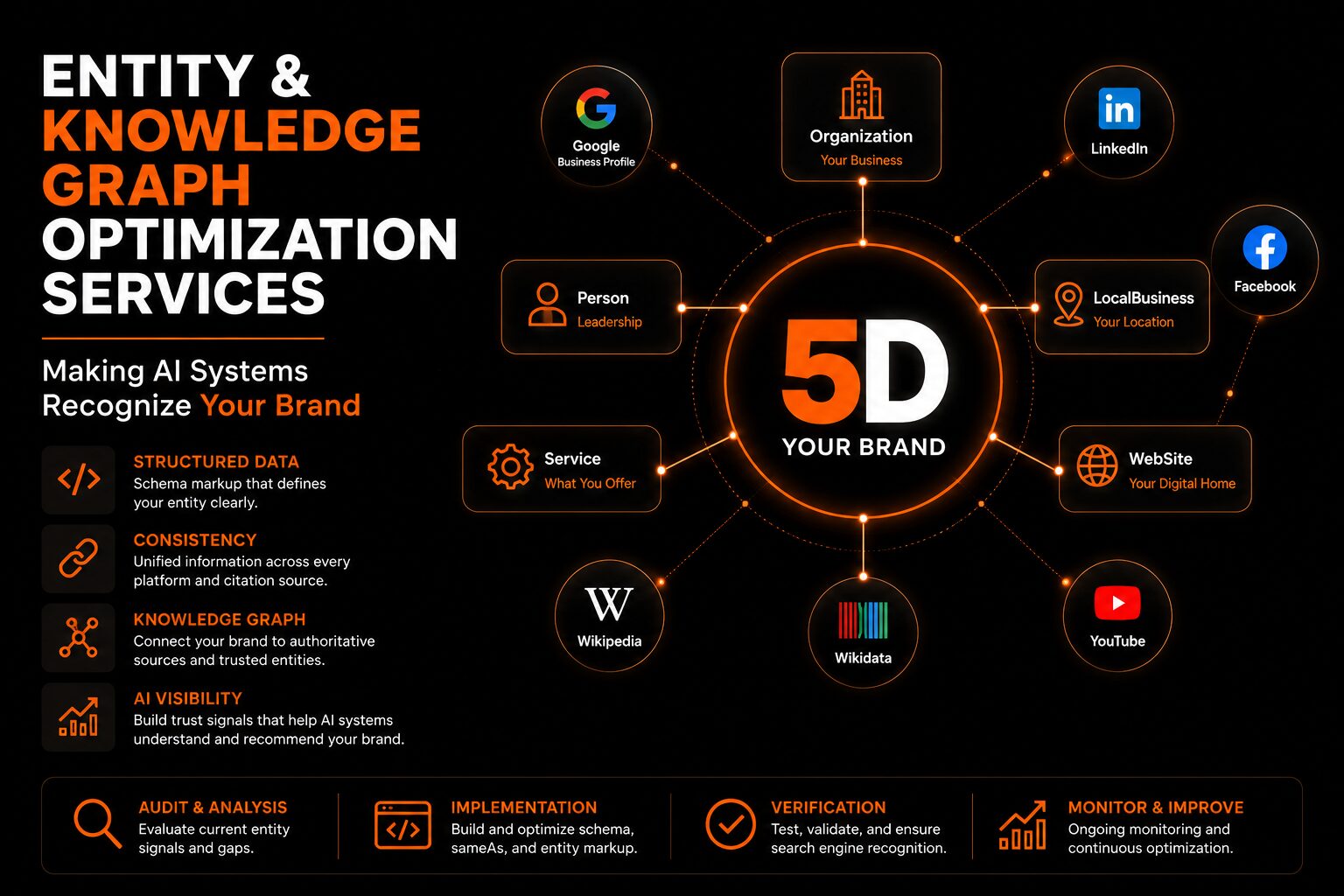
Entity & Knowledge Graph Optimization Services: Making AI Systems Recognize Your Brand
Understanding entity optimization is one thing. Implementing it correctly across a business’s schema markup, structured data, and knowledge graph signals is another entirely — and it’s the part most businesses never get past. Our guide to entity optimization explains why AI systems increasingly evaluate brands as entities rather than keyword-matched pages. This article is the execution side of that concept: what actually goes into implementing entity and knowledge graph optimization as a technical service, not just understanding why it matters.
This sits within our broader AI Search consulting services and connects to our AI Search audit services for businesses that want a full picture of their current AI visibility before committing to implementation work. This article explains what entity and knowledge graph optimization actually involves as a delivered service, and why the technical implementation matters as much as the strategic understanding.
Why Entity Optimization Requires Technical Execution, Not Just Understanding
Knowing that AI systems evaluate entities rather than keywords is the starting point, not the finish line. Actually building the entity signals that search engines and AI systems recognize requires structured data implementation, cross-platform consistency work, and ongoing verification — technical execution most businesses don’t have the internal expertise or time to carry out correctly on their own.
Schema markup has to be implemented precisely, not just theoretically understood
Organization, LocalBusiness, Person, WebSite, and Service schema all need to be correctly structured, cross-referenced by `@id`, and validated — a single malformed reference or missing required field can prevent structured data from being read correctly at all. This is detail-level implementation work, not a concept that can be applied loosely.
Consistency has to be verified across every platform a brand appears on
An entity’s name, address, description, and core information need to match exactly across the website, Google Business Profile, social platforms, and any directory or citation source. Inconsistencies — even minor ones like an abbreviated street name in one place and the full name in another — weaken the confidence AI systems place in the entity, and finding these inconsistencies requires an active audit, not an assumption that everything already matches.
Knowledge graph presence has to be actively pursued, not assumed
For established brands, this can include working toward Wikidata and Wikipedia presence, verified sameAs links connecting the entity across authoritative sources, and Google Knowledge Panel eligibility — none of which happen automatically simply because a business exists and has a website.
What Entity & Knowledge Graph Optimization Actually Includes
Structured data implementation and audit
This starts with a full audit of existing schema markup — what’s currently implemented, what’s missing, and what’s implemented incorrectly — followed by building out Organization, LocalBusiness, Person, Service, and WebSite schema properly cross-referenced through the `@graph`/`@id` pattern, so search engines and AI systems can resolve the relationships between them rather than treating each piece of markup in isolation.
Entity consistency audit and correction
A systematic review of how the business’s core information appears across its website, Google Business Profile, social platforms, and any third-party citations or directories, followed by correcting inconsistencies wherever they’re found. This connects directly to the local search foundations covered in our Google Business Profile optimization guide and local SEO strategy guide, extended into a broader entity-consistency context beyond just local search.
sameAs linking and authoritative source connection
Connecting a brand’s schema to its verified profiles — social platforms, industry directories, and where applicable Wikidata — through `sameAs` properties helps AI systems corroborate the entity’s identity across multiple independent sources rather than relying on a single website’s claims about itself.
Knowledge graph and disambiguation work
For brands with naming that could be confused with other entities, or businesses working toward Knowledge Panel eligibility, this includes the specific disambiguation and verification work Google and AI systems look for — a more advanced, longer-term component of entity work than schema implementation alone.
Topical entity mapping
Beyond the business itself as an entity, this includes mapping the services, topics, and concepts a brand should be recognized as connected to — ensuring content, internal linking, and schema all reinforce the same set of topical associations rather than sending mixed signals about what the business actually specializes in.
Verification and ongoing monitoring
Structured data validation doesn’t end at implementation — testing tools, ongoing monitoring for markup that breaks after a site update, and periodic re-verification that cross-platform consistency hasn’t drifted are all part of keeping entity signals accurate over time, not a one-time project that’s finished once deployed.
How This Differs From Our AI Search Consulting and Audit Services
Our AI Search audit services diagnose where a business currently stands across AI search visibility broadly — entity recognition, content structure, technical SEO, and citation likelihood. Our AI Search consulting services build the overall strategy connecting content, technical SEO, and AI visibility together. Entity and knowledge graph optimization is the specific, hands-on execution layer underneath both — the actual schema implementation, consistency correction, and knowledge graph work that a strategy or audit identifies as necessary but doesn’t itself carry out.
Why This Matters for AI Search Visibility Specifically
As explained in our guides on how AI search is changing SEO and Generative Engine Optimization, AI systems like Google AI Overviews, ChatGPT, Gemini, and Perplexity rely heavily on entity recognition and structured data to determine which brands to cite confidently in generated answers. A business with strong content but weak or inconsistent entity signals is working with one hand behind its back — the content quality matters, but AI systems still need clear, structured, corroborated signals to trust that content is coming from a legitimate, recognizable source. Our guides on AI search ranking factors and optimizing for Google AI Overviews cover this relationship in more depth.
Entity Optimization for Multi-Location and GCC-Facing Businesses
Businesses operating across Egypt and expanding into the GCC face an additional layer of entity complexity — multiple location entities need to be correctly structured and connected to a parent organization entity, rather than treated as entirely separate, disconnected businesses in the eyes of search engines and AI systems. This is a common gap for growing businesses that add new locations or markets without revisiting their underlying entity structure to account for the expansion.
Measuring the Impact of Entity Optimization
Entity work should be measured against the same AI visibility indicators covered in our how to measure AI search visibility guide — brand mentions in AI-generated answers, source citations, and whether AI systems describe the business accurately. Structured data validation tools confirm technical correctness, but the real measure of success is whether AI systems demonstrably recognize and cite the entity more confidently after the work is implemented than before.
What Entity & Knowledge Graph Optimization Typically Costs
Scope and cost depend heavily on how many entity types need to be built (Organization, LocalBusiness, Person, Service, multiple location entities), how much cross-platform consistency correction is required, and whether Wikidata or Knowledge Panel work is part of the engagement. For a general framework on how AI Search-related investment is scoped, see our AI Search consulting services page, with entity implementation scoped as a distinct execution component within that broader engagement.
Common Mistakes in Entity & Knowledge Graph Optimization
- Implementing schema markup with malformed `@id` references that prevent search engines from resolving relationships between entities
- Inconsistent business information across the website, Google Business Profile, and directories that goes unnoticed without an active audit
- Treating entity optimization as a one-time project instead of an ongoing verification process
- Building location-based entities for a multi-branch business with no clear connection back to a parent organization entity
- Focusing only on schema markup while ignoring the content and topical signals that reinforce what the entity is actually known for
- No measurement process to confirm whether AI systems are actually citing or describing the brand more accurately after implementation
Frequently Asked Questions
What is entity optimization?
Entity optimization is the process of helping search engines and AI systems recognize a business as a clearly identifiable, corroborated entity — through structured data, cross-platform consistency, and knowledge graph signals — rather than just a website containing relevant keywords. See our full explanation in entity optimization explained.
Is entity optimization different from schema markup?
Schema markup is one of the primary tools used to implement entity optimization, but entity work also includes cross-platform consistency correction, sameAs linking to authoritative sources, and topical entity mapping — a broader scope than schema implementation alone.
Does entity optimization help with Google AI Overviews specifically?
Yes. AI systems including Google AI Overviews rely on entity recognition and structured data to determine which sources to cite confidently, making entity optimization a foundational component of AI Overview visibility rather than a separate, unrelated effort.
How is this different from a standard SEO service?
Standard on-page and technical SEO focus on individual page optimization and crawlability. Entity optimization focuses specifically on how a business is recognized as a corroborated, structured entity across the web — a complementary but distinct layer of work.
Do small businesses need entity and knowledge graph optimization?
Yes, though the scope differs. Even a small business benefits from consistent, correctly structured entity signals across its website and Google Business Profile — Wikidata and Knowledge Panel work is generally more relevant for larger, more established brands.
How 5D Outsourcing Delivers Entity & Knowledge Graph Optimization
5D Outsourcing implements entity and knowledge graph optimization for businesses in Egypt and across the GCC as a technical execution service within our broader AI Search work. Our entity optimization process typically includes:
- A full structured data audit and correction of existing schema markup
- Organization, LocalBusiness, Person, Service, and WebSite schema built and cross-referenced through the `@graph`/`@id` pattern
- Cross-platform entity consistency audit and correction
- sameAs linking to verified, authoritative sources
- Multi-location entity structuring for businesses operating across multiple branches or expanding into the GCC
- Ongoing verification and monitoring as part of our broader AI Search consulting services
This work connects to our AI Search audit services and our core digital marketing and AI Search capability, giving businesses the technical foundation that everything else in AI search visibility is built on top of.
Leave a Reply