
No products in the cart.
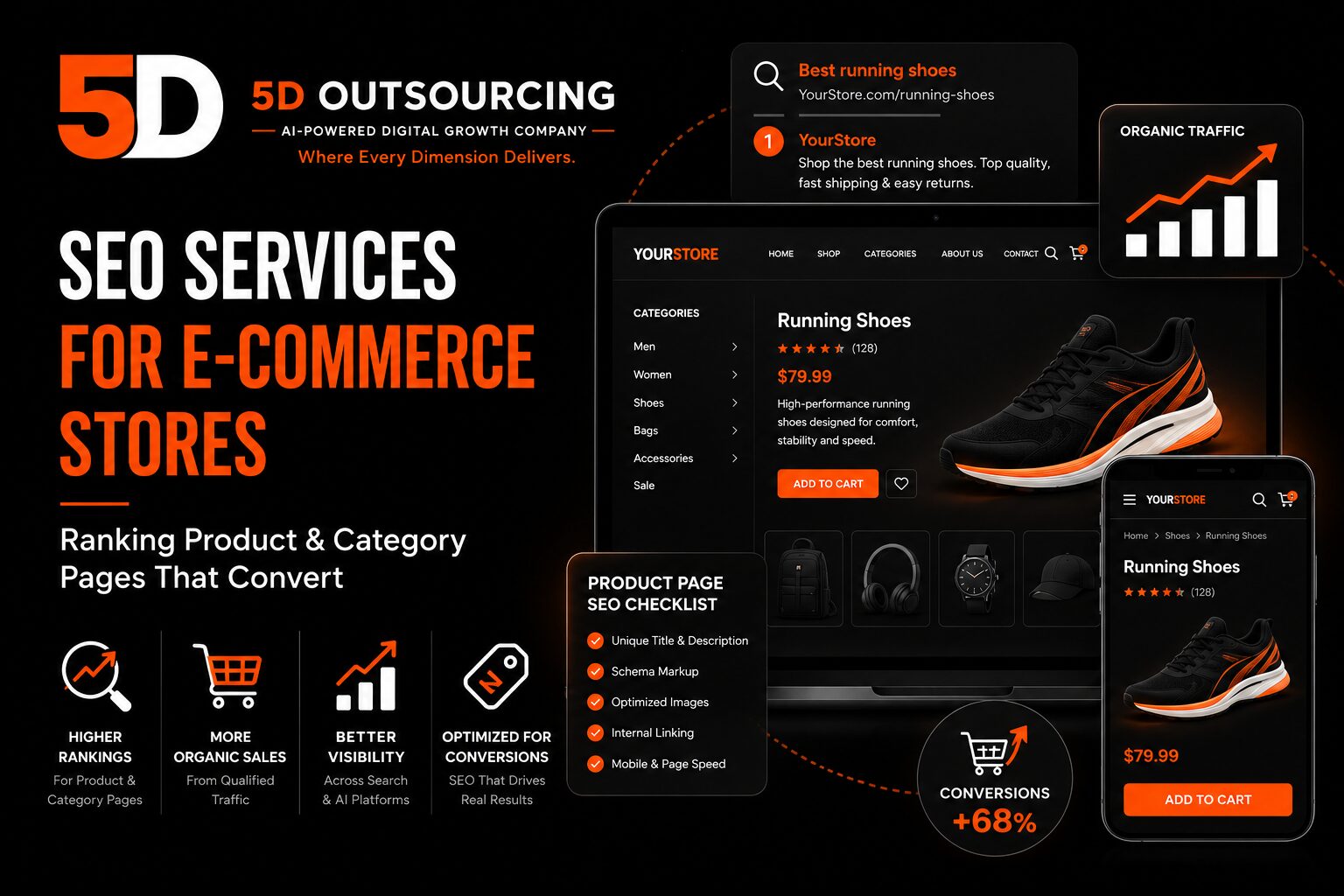
SEO Services for E-commerce Stores: Ranking Product & Category Pages That Convert
E-commerce SEO breaks most of the assumptions built into standard service-business SEO. A service company might have a few dozen pages to optimize carefully, one at a time. An online store can have hundreds or thousands of product pages, dozens of category pages, filtered navigation generating near-infinite URL combinations, and a catalog that changes weekly as stock, prices, and variants shift. Applying the same page-by-page optimization approach used for a service website to a store with that scale simply doesn’t work — the technical and content challenges are structurally different.
At 5D Outsourcing, we build digital marketing and AI Search systems for e-commerce brands operating in Egypt. This article explains what makes e-commerce SEO a genuinely distinct discipline from service-business SEO, and what a real SEO strategy for a growing online store needs to address.
Why E-commerce SEO Is a Different Discipline
The core SEO principles — relevance, technical health, authority, useful content — still apply to online stores. What’s different is the scale and structure those principles have to work within.
Duplicate and near-duplicate content at scale
Product variants (the same item in different colors or sizes), filtered category views, and manufacturer-supplied product descriptions used across multiple retailers all create duplicate or near-duplicate content problems that a service business rarely has to deal with. Search engines can struggle to know which version of a near-identical page to rank, or may not rank any of them well, if this isn’t managed deliberately through canonicalization and unique content strategy.
Faceted navigation and crawl budget
Filters for size, color, price range, and brand can generate a huge number of unique URLs from a relatively small underlying catalog. Left unmanaged, this can waste crawl budget on low-value filtered pages and dilute the SEO signal that should be concentrated on the category and product pages that actually matter. This is one of the most common technical SEO problems specific to e-commerce, and one that a standard technical SEO audit built for a service site won’t automatically catch.
Thin content on product pages
Many product pages, particularly for stores with large catalogs, end up with little more than a manufacturer’s spec sheet and a price — content that’s technically present but too thin to demonstrate the relevance and depth search engines look for. Category pages face a similar risk when they’re just a product grid with no supporting content explaining what the category covers.
Out-of-stock and discontinued product handling
What happens to a product page when an item goes out of stock or is discontinued has real SEO consequences. Deleting the page outright loses any accumulated ranking signal and creates broken links from anywhere else it was referenced; leaving it live with no stock and no guidance frustrates users. E-commerce SEO needs a deliberate policy for this — redirecting to a relevant category or replacement product, or keeping the page live with clear stock status and related alternatives — rather than leaving it to chance.
Site architecture that scales with the catalog
A service business site might have a flat structure — a handful of service pages linked from the homepage. An e-commerce store needs a category and subcategory hierarchy that both makes sense to shoppers and distributes SEO authority sensibly across a much larger number of pages, which is a fundamentally different architecture problem.
The Core Components of E-commerce SEO
Category page optimization
Category pages are often an e-commerce store’s strongest opportunity for ranking on broader, higher-volume commercial keywords — “men’s running shoes” ranks a category page, not an individual product. These pages need genuine on-page content, not just a product grid, along with clear internal linking to subcategories and top products, following the same on-page principles covered in our on-page SEO optimization guide, applied at category-page scale.
Product page optimization
Individual product pages need unique titles, unique descriptions where feasible, structured specifications, and genuine content beyond a manufacturer’s spec sheet — particularly for products where multiple competitors are selling the identical item and differentiation has to come from the page itself, not just the product.
Technical SEO built for catalog scale
Canonical tags to resolve variant and filter duplication, careful management of what filtered URLs are allowed to be indexed, clean XML sitemaps that reflect the current live catalog, and site speed that holds up across a large number of image-heavy pages are all technical SEO priorities specific to e-commerce. Our technical SEO audit checklist covers the general foundation this builds on, with e-commerce catalogs needing the added layer of canonicalization and faceted-navigation control.
Structured data for products
Product schema — price, availability, reviews, ratings — helps search engines and AI systems display richer results and interpret product information accurately, directly supporting visibility in both traditional search results and AI-generated shopping comparisons.
Site architecture and internal linking
A logical category and subcategory hierarchy, with internal links connecting related products, categories, and supporting content, helps both shoppers and search engines navigate a large catalog efficiently. This follows the same underlying logic as our internal linking strategy guide, scaled to hundreds or thousands of product and category pages rather than a handful of service pages.
Content that supports commercial pages
Buying guides, comparison content, and category-level educational content can rank for informational searches earlier in the buyer journey and funnel that traffic toward relevant category and product pages — extending the content-cluster approach covered in our SEO content strategy guide into a commerce context.
Local and Regional SEO for E-commerce in Egypt
Even for stores shipping nationally, local relevance still matters — from Google Business Profile presence for stores with a physical location or showroom, to content and structured data that signals delivery coverage across Cairo, Alexandria, and the rest of Egypt. Our local SEO strategy guide and Google Business Profile optimization guide cover the foundations this can build on for stores with any physical presence.
Measuring E-commerce SEO Performance
Organic traffic and keyword rankings matter, but for e-commerce the more meaningful measures are organic revenue, conversion rate from organic traffic, and category-page ranking performance for the terms that actually drive purchases — not just overall visibility. Tracking should distinguish performance across categories and product lines, since a large catalog rarely improves uniformly; some categories will respond to optimization faster than others depending on competition and existing authority.
Common Mistakes in E-commerce SEO
- Treating every product and category page like a one-off service page instead of planning for catalog-wide scale
- Unmanaged faceted navigation generating thousands of low-value indexable URLs
- Thin or duplicate product descriptions copied directly from manufacturers
- No clear policy for out-of-stock or discontinued product pages
- Category pages that are just a product grid with no supporting on-page content
- Missing product schema, limiting rich result and AI-comparison visibility
- Site speed issues caused by unoptimized product imagery across a large catalog
If your store already has significant organic traffic but conversion isn’t following, this is often a conversion issue layered on top of an SEO one — see our why your SEO isn’t working guide for how to distinguish between the two.
What E-commerce SEO Typically Costs in Egypt
E-commerce SEO campaigns generally require more scope than a standard service-business SEO engagement, given the additional technical work involved in faceted navigation management, product schema at scale, and category architecture planning. For a general framework on how SEO investment is structured and what affects cost, see our SEO pricing in Egypt guide — e-commerce campaigns should be scoped against that baseline with catalog size and technical complexity factored in.
How 5D Outsourcing Approaches E-commerce SEO
5D Outsourcing builds SEO strategies for e-commerce brands in Egypt as part of an integrated growth system, not an isolated ranking exercise. Our e-commerce SEO work typically includes:
- Category and product page optimization built for search intent and conversion
- Technical SEO addressing faceted navigation, canonicalization, and crawl budget at catalog scale
- Product schema implementation to support rich results and AI-generated shopping visibility
- Site architecture planning that scales sensibly as the catalog grows
- Content strategy connecting buying guides and comparison content to commercial category pages
- Local SEO integration for stores with a physical location or delivery-area targeting
This work sits within our broader digital marketing and AI Search system for e-commerce brands and connects to our core digital marketing and AI Search capability, giving online stores the same structured, integrated approach we apply across every industry we work with.
Leave a Reply