
No products in the cart.
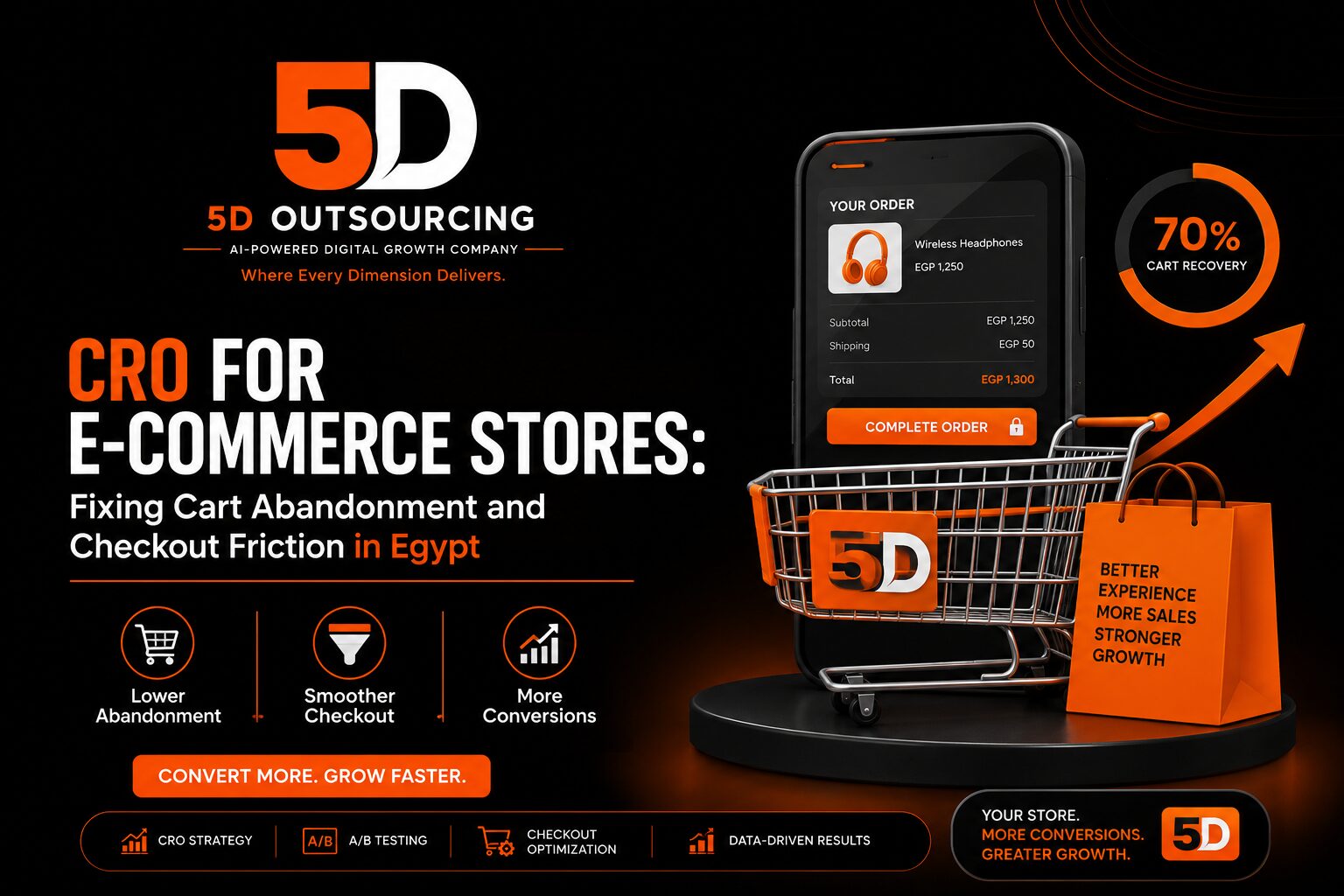
CRO for E-commerce Stores: Fixing Cart Abandonment and Checkout Friction in Egypt
An e-commerce store can rank well, run efficient Shopping campaigns, and still lose most of its revenue at a single point: checkout. Cart abandonment is one of the best-documented problems in online retail, and it happens for reasons that have almost nothing to do with SEO or PPC — unexpected shipping costs, a checkout flow that demands account creation, a payment method the shopper doesn’t trust, or a mobile checkout page that’s simply too fiddly to complete on a small screen. Conversion Rate Optimization for e-commerce is a genuinely different discipline from CRO for a lead-generation website, because the thing you’re optimizing isn’t a contact form — it’s a multi-step purchase and payment process with its own distinct failure points.
This completes the three-part e-commerce growth system we build at 5D Outsourcing, alongside our SEO services for e-commerce stores and Google Ads and PPC for e-commerce stores, all anchored to our digital marketing and AI Search work for e-commerce brands in Egypt. This article explains what makes e-commerce CRO structurally different from standard lead-generation CRO, where online stores lose the most revenue, and what a real optimization program actually needs to address.
Why E-commerce CRO Is a Different Problem Than Lead-Gen CRO
Standard CRO principles — clear value propositions, strong calls to action, reduced friction — still apply to online stores. What’s different is the shape of the conversion path itself. A service business is trying to move a visitor from browsing to a single form submission. An e-commerce store is trying to move a visitor through product discovery, product page evaluation, cart, and a multi-field, multi-step checkout that touches payment, shipping, and often account creation — each stage with its own distinct drop-off risk.
The conversion path has more stages, each with its own friction
A lead-gen funnel typically has two or three meaningful stages. An e-commerce funnel has, at minimum: product discovery, product page evaluation, add-to-cart, cart review, checkout information, payment, and order confirmation. A weakness at any single stage can undo strong performance everywhere else — a beautifully optimized product page means little if the checkout page that follows it is confusing or untrustworthy.
Cart abandonment is a distinct, measurable problem
Cart abandonment — adding a product to cart and then leaving without completing the purchase — is one of the most consistently high friction points across online retail globally, and it’s driven by a specific, well-understood set of causes rather than being a vague symptom of “poor UX.” Addressing it requires diagnosing which of those specific causes applies to your store, not a generic redesign.
Trust has to be re-established at the payment step
A lead-gen form asks for a name and phone number. An e-commerce checkout asks for payment information — a meaningfully higher-stakes request that triggers more hesitation, particularly for shoppers unfamiliar with a brand. Trust signals that matter earlier in a lead-gen funnel (testimonials, case studies) matter differently at checkout, where security badges, clear return policies, and recognizable payment options carry more weight.
Egyptian shoppers have specific payment and trust expectations
Cash on delivery (COD) remains a widely preferred payment method for online shoppers in Egypt, often because of lower trust in providing card details online to unfamiliar stores. A checkout that only offers card payment, with no COD option, can lose a meaningful share of otherwise-ready buyers for reasons that have nothing to do with the product or price — this is one of the clearest examples of how e-commerce CRO in Egypt specifically differs from generic international CRO advice.
Where E-commerce Stores Lose the Most Revenue
The product page: the last stop before “add to cart”
Product pages need to answer every question a shopper might have before they’ll add an item to cart — accurate sizing or specifications, genuine photography from multiple angles, honest stock and delivery information, and social proof through reviews. A product page that’s thin on this information pushes hesitant shoppers to search elsewhere for reassurance, often ending up on a competitor’s site instead of coming back.
The cart page: where hesitation sets in
The cart page is where a shopper often sees the full order for the first time, including shipping costs that weren’t visible earlier in the journey. Unexpectedly high or unclear shipping costs revealed at this stage are one of the most commonly cited reasons for cart abandonment across e-commerce generally — which is why shipping cost transparency earlier in the shopping journey, not just at the cart, is a meaningful CRO lever.
The checkout flow: the highest-friction stage of all
Checkout is where most conversion is won or lost. Common friction points include forced account creation instead of guest checkout, too many form fields, unclear error messages when a field is filled incorrectly, and a multi-page checkout with no visible progress indicator leaving shoppers unsure how much is left. Every additional required field or unnecessary step is a chance for a shopper who was ready to buy to reconsider.
Payment: where trust and convenience intersect
The payment step needs to offer the methods your specific audience actually trusts and uses — for many Egyptian shoppers, that means cash on delivery alongside card payment, not card payment alone. It also needs to be visibly secure, since a payment page that looks unfinished or unprofessional undermines trust at the exact moment it matters most.
Mobile checkout: where a large share of traffic actually converts (or doesn’t)
A significant share of e-commerce browsing and purchasing happens on mobile devices, and checkout flows that were designed and tested primarily on desktop often perform noticeably worse on mobile — small tap targets, forms that trigger the wrong keyboard type, and payment fields that are awkward to complete on a small screen all compound into meaningfully lower mobile conversion rates if not addressed directly.
The Core Components of an E-commerce CRO Program
Product page optimization for conversion, not just SEO
Product pages need to work for both search visibility (covered in our SEO services for e-commerce stores guide) and conversion simultaneously. That means clear pricing, honest availability, genuine reviews, and answers to the specific hesitations that stop a shopper from adding to cart — sizing uncertainty, delivery timing, return policy clarity.
Cart and checkout flow audit
A structured audit of the cart and checkout journey should map every field, every click, and every point where a shopper could plausibly hesitate or leave — identifying unnecessary friction (extra fields, forced registration, unclear shipping costs) that can be removed or simplified without losing anything the business actually needs from the transaction.
Guest checkout as standard, not optional
Forcing account creation before a shopper can complete a purchase is one of the most well-documented, avoidable sources of checkout abandonment. Guest checkout — with the option to create an account after the order is placed, not before — removes this friction entirely while still allowing the store to capture the customer relationship post-purchase.
Shipping cost transparency early in the journey
Showing estimated shipping costs on the product page or cart, rather than revealing them for the first time deep in checkout, reduces the shock that drives a meaningful share of abandonment. Where flat-rate or free-shipping-threshold shipping is used, communicating that clearly and early tends to perform better than surprising shoppers at the final step.
Payment method diversity built around local expectations
Offering cash on delivery alongside card payment and any relevant local payment options isn’t a nice-to-have for the Egyptian market — it directly affects how many otherwise-ready buyers actually complete their purchase. This should be treated as a core CRO decision, not a checkout-page afterthought.
Trust signals at the right moments
Security badges, clear return and refund policy links, and visible customer service contact information matter most at the payment step specifically, where hesitation is highest. Reviews and social proof matter most earlier, on product pages, where the decision to add to cart is actually being made.
Mobile-first checkout testing
Given how much e-commerce traffic and purchasing happens on mobile, checkout flows should be tested and optimized on mobile devices directly, not assumed to work simply because the desktop version performs well. This connects to the same principles covered in our UX optimization and conversion rates guide, applied specifically to the highest-stakes part of the e-commerce journey.
Cart abandonment recovery
Not every abandoned cart is lost permanently. Abandoned cart email sequences, and dynamic remarketing (covered in our Google Ads for e-commerce stores guide) that shows shoppers the exact products they left behind, both give a second opportunity to recover a sale that would otherwise be lost entirely.
A/B Testing for E-commerce CRO
E-commerce CRO should be validated through structured testing rather than assumption-driven redesigns. Common e-commerce A/B tests include comparing guest checkout against forced registration, testing shipping cost visibility at different points in the journey, testing single-page against multi-step checkout, and testing different placements and phrasing of trust signals near the payment step. Our A/B testing guide covers the underlying framework for running these tests properly — with enough traffic and a clear success metric before drawing conclusions.
Measuring E-commerce CRO Performance
The most useful e-commerce CRO metrics are cart abandonment rate, checkout completion rate, and revenue per visitor — not overall traffic or even overall conversion rate alone, since a store can have a reasonable conversion rate while still losing a large share of near-purchases at checkout specifically. Tracking should be granular enough to identify exactly which stage of the funnel — product page, cart, or checkout — is losing the most potential revenue, since the fix for each stage is different.
This connects to the same funnel-stage thinking covered in our conversion funnel guide, applied to the specific stages of an e-commerce purchase path rather than a generic lead-generation journey.
How E-commerce CRO Connects to SEO and PPC
CRO doesn’t operate in isolation from the rest of an e-commerce growth strategy. Traffic driven by our e-commerce SEO work and Shopping and Performance Max campaigns is only as valuable as the checkout experience it eventually reaches — a store investing heavily in traffic generation while ignoring checkout friction is leaving a meaningful share of that investment on the table. Equally, insights from CRO testing — which products convert best, where shoppers hesitate — can directly inform which product and category pages deserve the deepest SEO and PPC investment.
Common Mistakes in E-commerce CRO
- Forcing account creation before checkout can be completed, instead of offering guest checkout
- Revealing shipping costs for the first time deep in checkout rather than earlier in the journey
- Offering only card payment with no cash-on-delivery option, despite strong local preference for COD
- Testing and optimizing primarily on desktop while ignoring how the checkout performs on mobile
- Treating conversion rate as a single number instead of measuring drop-off at each specific funnel stage
- No cart abandonment recovery — no follow-up email sequence and no dynamic remarketing
- Redesigning checkout based on assumption rather than validating changes through structured A/B testing
If your store is seeing steady traffic without a corresponding increase in completed orders, the underlying issue is often exactly this kind of funnel-stage friction — the same pattern covered more broadly in our why your website gets traffic but no leads guide, applied to a purchase funnel rather than a lead-generation one.
What E-commerce CRO Typically Costs in Egypt
E-commerce CRO engagements generally involve a full funnel audit — product page, cart, and checkout — followed by structured testing over several weeks or months to validate changes before rolling them out permanently. This tends to require a broader scope than a standard landing-page CRO engagement for a service business, given the number of distinct stages involved. For general context on how CRO investment is scoped, see our broader Conversion Rate Optimization guide.
How 5D Outsourcing Approaches E-commerce CRO
5D Outsourcing builds CRO programs for e-commerce brands in Egypt within the same integrated growth system as our e-commerce SEO and Google Ads work. Our e-commerce CRO process typically includes:
- Full funnel audit across product pages, cart, and checkout to identify the highest-friction stages
- Guest checkout and reduced-field checkout implementation to remove unnecessary steps
- Shipping cost transparency and payment method review, including cash-on-delivery integration where relevant
- Mobile-first checkout testing, given how much purchasing happens on mobile
- Cart abandonment recovery through email sequences and dynamic remarketing
- Structured A/B testing to validate every significant checkout change before it’s rolled out permanently
This work completes the three-part e-commerce service set alongside our e-commerce SEO services and e-commerce Google Ads management, and connects to our broader CRO services and digital marketing and AI Search system for e-commerce brands — all coordinated through the same digital marketing and AI Search capability we apply across every industry we work with.
Leave a Reply