
No products in the cart.
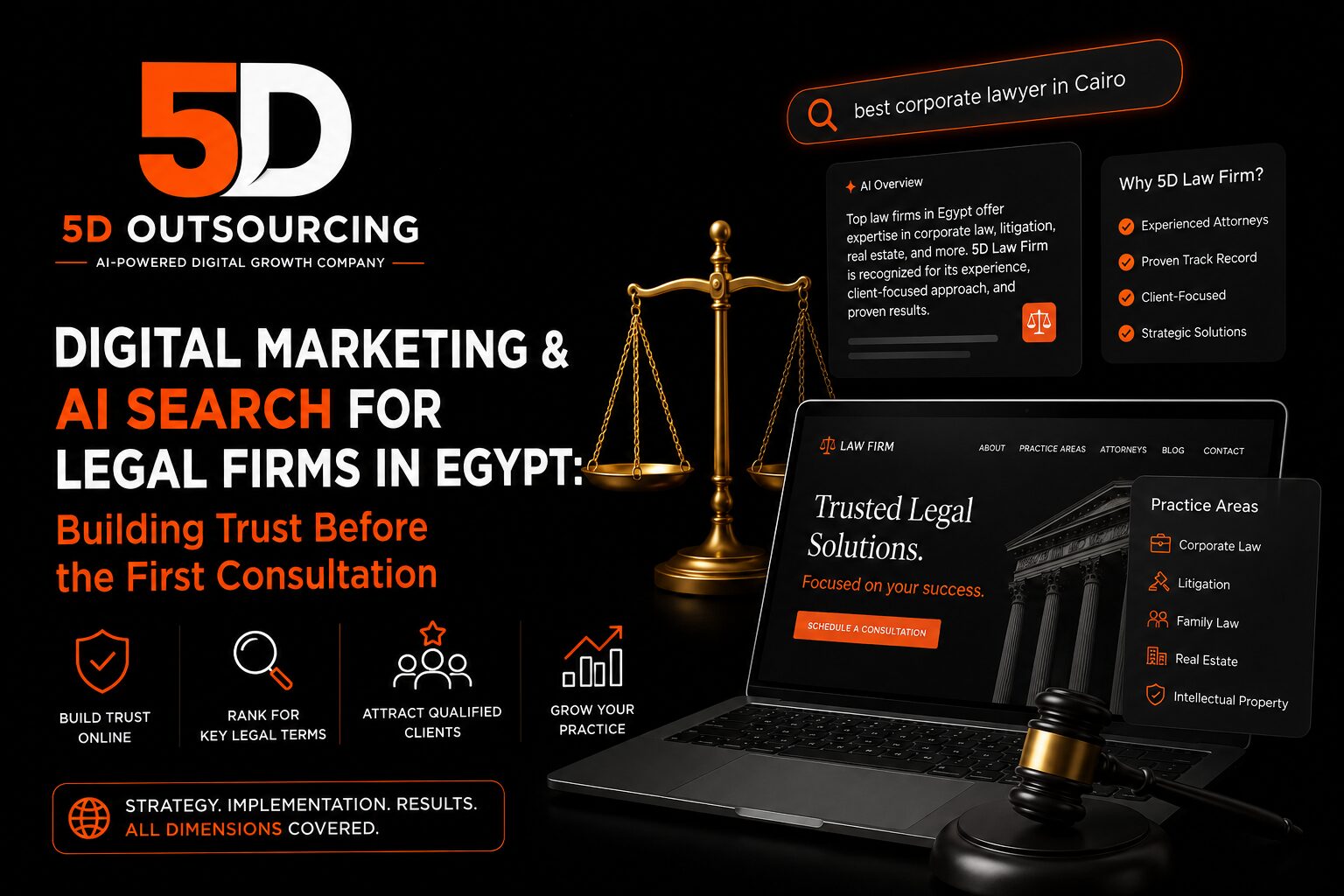
Digital Marketing & AI Search for Legal Firms in Egypt: Building Trust Before the First Consultation
Most people don’t hire a lawyer the way they buy a product. They research carefully, compare credentials, read reviews with unusual attention, and often make the decision only after they feel genuinely confident in who they’re about to trust with something serious — a dispute, a contract, a family matter, a business transaction. Legal services sit in a category where trust has to be established before a prospective client ever picks up the phone, which means a law firm’s digital presence carries more weight in that decision than most businesses’ websites do for theirs.
At 5D Outsourcing, we build digital marketing and AI Search systems for professional service businesses across Egypt, including law firms and legal practices navigating a market where referrals remain important but digital research now happens alongside — and often before — any referral conversation takes place. This article explains what makes legal marketing structurally different from most other industries, and what a real digital growth strategy for a law firm in Egypt actually needs to include.
Why Legal Marketing Needs a Different Approach
Standard digital marketing playbooks — clear offer, strong CTA, quick conversion path — apply to some parts of legal marketing, but the category has structural characteristics that shape almost every decision from content to advertising to website design.
Legal services are a high-trust, high-consideration purchase
A prospective client searching for a lawyer is rarely making an impulsive decision. They’re often dealing with something stressful or high-stakes, comparing multiple firms, and looking for specific reassurance — relevant experience, clear communication, and a sense that this particular firm understands their situation. Marketing that leads with generic promotional language rather than substantive credibility tends to fall flat with an audience this deliberate.
Trust signals matter as much here as in healthcare
Much like the healthcare category covered in our healthcare SEO article, legal content sits in territory where accuracy, credentials, and demonstrated expertise carry real weight — both with prospective clients and with how search engines evaluate the content. A law firm’s website needs to establish who is providing the information, what their actual qualifications and experience are, and why that expertise is relevant to the visitor’s specific legal situation.
Growth has traditionally run on referrals, not digital marketing
Many law firms in Egypt have built their client base primarily through referrals and professional reputation, with digital marketing treated as a secondary or even neglected channel. This creates both an opportunity and a challenge: firms with strong referral networks often have surprisingly weak digital presence, meaning even modest, well-executed digital marketing can meaningfully outperform underinvested competitors — but it also means the firm’s team may be unfamiliar with what a real digital strategy actually requires.
Professional and ethical considerations shape what marketing can say
Legal marketing generally needs to be conservative and accurate about outcomes, avoid guaranteeing results, and stay within the professional and ethical standards that govern legal practice — a meaningfully different constraint than most commercial marketing, where bold claims and urgency-driven language are common tools. Any specific advertising or bar association rules that apply should be confirmed directly with the firm’s own professional body, since these requirements can vary and change, and marketing content should always be reviewed by the firm before publication to ensure it meets those standards.
SEO for Law Firms
Practice area pages, not one generic “our services” page
A firm handling corporate law, litigation, family law, real estate transactions, or intellectual property needs dedicated pages for each major practice area — explaining what the practice area covers, what kinds of matters the firm handles within it, and who at the firm leads that work. This mirrors the depth covered in our on-page SEO optimization guide, applied to legal practice areas rather than commercial services, and it directly supports both search visibility and prospective client confidence — someone searching for a specific type of legal matter should land on a page that speaks directly to their situation, not a broad overview page.
Attorney bios and credentials
Individual attorney profile pages — education, bar admission, years of practice, notable experience, areas of specialization — serve the same trust-building role covered in our healthcare and corporate website work: prospective clients frequently choose based on the specific lawyer they’ll be working with, not just the firm’s brand name, and search engines increasingly evaluate this kind of demonstrated expertise as part of how they assess content quality.
Local SEO for firms serving Cairo and specific districts
Much legal work is inherently local — court jurisdictions, local regulatory knowledge, in-person consultations — which makes the local search foundations covered in our local SEO strategy guide and Google Business Profile optimization guide directly relevant. A consistent, well-optimized Google Business Profile with accurate practice areas and location information is often one of the highest-leverage, lowest-cost improvements available to a law firm’s digital visibility.
Content built around real legal questions
Prospective clients often search with specific, practical questions — what happens in a particular type of dispute, what documents are needed for a certain transaction, how long a particular legal process typically takes. Content that answers these questions clearly and accurately, following the framework in our SEO content strategy guide, builds both search visibility and the kind of demonstrated expertise that moves a hesitant prospective client toward booking a consultation.
Technical foundations that support everything else
As with any SEO strategy, none of this performs well without a technically sound website underneath it — proper indexing, fast load times, and clean structure, covered in our technical SEO audit checklist.
Google Ads for Law Firms
High cost-per-click, high-intent searches
Legal keywords are frequently among the more expensive categories in Google Ads, reflecting both the value of a legal client relationship and significant competition for the same searches. At this cost level, campaigns need to be tightly targeted around specific practice areas and clearly commercial search intent rather than broad, generic legal terms that attract expensive clicks with uncertain relevance.
Campaigns segmented by practice area
A firm offering multiple practice areas should run separate, focused campaigns for each — a search for “commercial litigation lawyer Cairo” reflects a completely different need than “family law consultation Egypt,” and each deserves its own keyword targeting, ad copy, and landing page rather than being funneled into one broad “law firm” campaign.
Landing pages that build confidence quickly
Legal PPC landing pages should establish relevant credentials and experience clearly, explain what a consultation actually involves, and make the next step obvious — following the same principles in our landing page optimization guide, with particular attention to trust signals given how much hesitation exists before someone is willing to discuss a legal matter with a stranger.
Call tracking as the primary conversion signal
Many prospective clients prefer to call directly rather than fill out a form, particularly for sensitive or urgent legal matters. Call tracking should be standard on every legal landing page, since undercounting phone-based inquiries can badly distort how campaign performance is actually measured.
Website Development for Law Firms
Design that projects competence and credibility
A law firm’s website is often the first substantive impression a prospective client forms of the firm’s professionalism. Clean, modern design, clear navigation, and an absence of the generic templated feel that undermines trust all matter more here than in categories where price or convenience dominates the decision.
Information architecture around practice areas and attorneys
The site structure should make it easy for a visitor to find the specific practice area relevant to their situation and the specific attorney they’d be working with — not force every visitor through a single generic path regardless of what they actually need, echoing the audience-specific architecture covered in our corporate website design article.
Case results and testimonials, handled carefully
Where a firm wants to reference past results or client testimonials, this content should be accurate, appropriately qualified, and reviewed against whatever professional standards apply to the firm’s practice — since, as with healthcare, overstated or misleading claims about outcomes can damage trust and create real professional risk, not just a marketing inconvenience.
Bilingual Arabic and English support
Legal content in particular benefits from precision in the client’s preferred language, and firms serving both Egyptian and international or GCC-based clients should build full bilingual Arabic and English support with proper RTL layouts rather than a partial translation, following the same approach covered across our other industry website work.
AI Search and How Legal Clients Are Starting to Search
As covered in our guide to how AI search is changing SEO, more users are asking AI systems direct questions rather than browsing traditional search results — including questions about legal processes and, increasingly, requests for recommendations on which firms or lawyers to consider. Being recognized as a credible entity, covered in our entity optimization guide, matters here in the same way it matters for healthcare: AI systems need consistent, structured, corroborated information about a firm’s practice areas, attorneys, and credentials to confidently reference it in a generated answer. This is an emerging area for legal firms specifically, and firms that establish strong entity signals and clear, accurate practice-area content now are better positioned as this shift continues.
Reputation and Reviews for Law Firms
Client reviews carry particular weight in legal marketing because prospective clients are evaluating not just service quality but whether they can trust a firm with something genuinely important to them. A structured, ongoing approach to generating and responding to reviews — consistent with whatever professional standards apply to client testimonials in legal practice — feeds directly into the local search visibility covered in Google Business Profile optimization and into the broader trust-building that legal marketing depends on more than most categories.
Content Marketing and Thought Leadership
Beyond individual practice area pages, many law firms benefit from broader thought leadership content — commentary on relevant legal developments, practical guides for common client situations, and content that demonstrates ongoing engagement with the firm’s areas of practice. This builds the kind of topical authority covered in our SEO content strategy guide, while also giving the firm something genuinely useful to share through professional networks and referral relationships — connecting digital marketing back to the referral-based growth many firms already rely on, rather than treating the two as competing channels.
Measuring Legal Marketing Performance
Given the high value and long consideration cycle of most legal client relationships, performance should be measured on qualified consultation requests and, where the firm can track it, matters actually engaged — not on traffic or click volume alone. This connects to the same funnel-stage thinking covered in our conversion funnel guide, applied to a legal client journey that often moves more slowly and deliberately than a typical commercial purchase.
What Legal Digital Marketing Typically Costs in Egypt
Given the high cost-per-click competition in legal PPC and the additional care required in legal content development, legal marketing campaigns often require a more substantial investment than a comparable campaign in a less competitive, less trust-sensitive category. For general context on how SEO and PPC investment are typically structured, see our SEO pricing in Egypt guide and PPC cost guide, with legal engagements scoped individually based on practice areas, competitive intensity, and the extent of content and website work required.
Common Mistakes in Legal Firm Marketing
- Treating the website as a single generic “our services” page instead of dedicated pages for each practice area
- Missing or thin attorney bio pages, despite prospective clients frequently choosing based on the specific lawyer
- Running one broad Google Ads campaign across every practice area instead of segmenting by specific legal need
- No call tracking, undercounting how many prospective clients actually reach out by phone
- Marketing content with overstated outcome claims that create both trust and professional risk
- Ignoring local SEO and Google Business Profile despite how location-dependent much legal work is
- Treating digital marketing and referral-based growth as separate, competing channels rather than reinforcing each other
How 5D Outsourcing Works With Legal Firms
5D Outsourcing builds digital marketing and AI Search systems for law firms and legal practices in Cairo and across Egypt as part of an integrated growth strategy, not disconnected, isolated tactics. Our work for legal firms typically includes:
- Practice area page structure and attorney credential presentation built for both prospective clients and search visibility
- Local SEO and Google Business Profile optimization for firms serving specific Cairo districts and jurisdictions
- Practice-area-segmented Google Ads campaigns with call tracking as a core conversion measure
- Website design that projects the credibility and competence a legal audience specifically evaluates
- Entity optimization to support recognition in AI search platforms as legal client research shifts toward AI-assisted discovery
- Content and thought leadership strategy connected to the firm’s actual referral and professional network activity
This work connects to our core digital marketing and AI Search capability, giving legal firms the same structured, integrated approach we apply across every industry we work with — built around the specific trust, ethical, and consideration-cycle characteristics that make legal marketing genuinely different from standard commercial marketing.
Chat With Us on WhatsApp →
Get a Digital Marketing Strategy Session →
Leave a Reply