
No products in the cart.
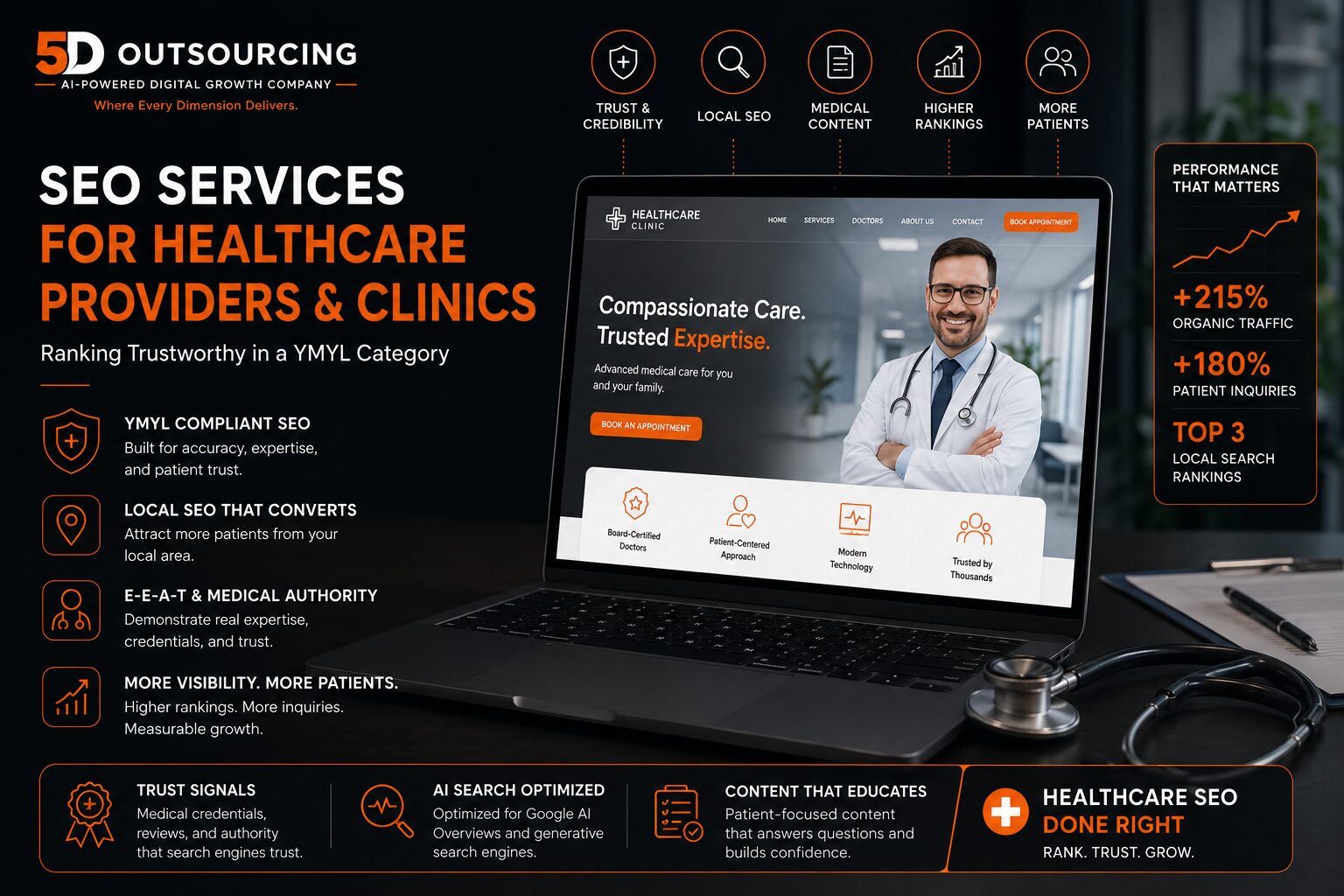
SEO Services for Healthcare Providers & Clinics: Ranking Trustworthy in a YMYL Category
Healthcare SEO carries a weight that most industries don’t have to deal with. Google classifies medical and health content as “Your Money or Your Life” (YMYL) — a category where inaccurate or untrustworthy information can directly affect someone’s health, finances, or safety. That classification means clinics, hospitals, and healthcare providers face a higher bar for demonstrating expertise, authority, and trust than almost any other business category trying to rank in search.
At 5D Outsourcing, we build digital marketing and AI Search systems for healthcare providers and clinics across Cairo and Egypt. This article explains what makes healthcare SEO structurally different from standard SEO, why trust signals matter more here than in almost any other vertical, and what a real SEO strategy for a clinic or healthcare practice actually needs to include.
Why Healthcare SEO Is a Fundamentally Different Discipline
Standard SEO advice — target the right keywords, publish content, build links — applies to healthcare too, but it isn’t enough on its own. Google’s systems, and increasingly AI-powered search platforms, evaluate health-related content against a stricter set of trust signals because the cost of showing unreliable medical information is higher than showing an unreliable product review.
YMYL scrutiny changes what “good content” means
For a YMYL topic, content quality isn’t judged only on how well it’s written or how well it matches a search query. It’s judged on whether the source demonstrates real expertise — is the content written or reviewed by someone with relevant medical credentials, does the practice have a verifiable physical presence and licensed staff, is the information accurate and free of misleading claims. A blog post about a treatment written with no medical oversight carries meaningfully less weight than the same topic written or reviewed by a practicing physician.
E-E-A-T matters more here than almost anywhere else
Experience, Expertise, Authoritativeness, and Trust — Google’s framework for evaluating content quality — applies to every industry, but healthcare is where it’s enforced most strictly. A clinic’s website needs to clearly establish who is providing the information, what their qualifications are, and why the practice should be trusted, not just what services are offered.
Local intent dominates most healthcare searches
Most people searching for a clinic, dentist, dermatologist, or specialist aren’t researching medicine in the abstract — they’re looking for a provider near them, right now. This makes local SEO signals — Google Business Profile accuracy, location pages, consistent contact information — disproportionately important for healthcare compared to many other service categories.
Compliance and patient trust shape what content can say
Healthcare marketing content has to be accurate and careful about the claims it makes — no guaranteed outcomes, no exaggerated results, no content that could be read as medical advice without appropriate context. This isn’t just an ethical consideration; overstated or misleading medical claims are exactly the kind of signal that damages trust with both patients and search engines.
The Core Components of a Healthcare SEO Strategy
Physician and practitioner credentials, clearly displayed
Doctor and specialist bios should include real qualifications — medical degrees, board certifications, years of practice, areas of specialization — presented clearly on both individual practitioner pages and relevant service pages. This is one of the most direct ways a healthcare website can demonstrate the expertise signals that both patients and search engines are looking for.
Service pages structured around specific conditions and treatments
A clinic offering multiple specialties needs dedicated pages for each major service or condition treated, rather than one general “our services” page that briefly mentions everything. Each page should explain the condition or treatment clearly, who it’s for, what the process involves, and who at the practice provides it — mirroring the depth our on-page SEO optimization guide recommends for any commercial page, but with the added requirement of medical accuracy.
Local SEO built around every location the practice serves
For clinics operating from a single location or across multiple branches, local SEO signals need to be precise and consistent. This means an optimized Google Business Profile, accurate NAP (name, address, phone) information across the site, and — for multi-branch practices — dedicated location pages rather than one page trying to represent every branch at once. Our local SEO strategy guide and Google Business Profile optimization guide cover the foundations this builds on.
Reviews and patient trust signals
Patient reviews carry particular weight in healthcare because prospective patients are evaluating not just service quality but whether they can trust a provider with their health. A structured, ongoing review generation and response process is a core part of healthcare SEO, not an optional extra — and it feeds directly into the local search visibility covered in Google Business Profile optimization.
Entity and knowledge graph signals
Search engines and AI systems increasingly evaluate healthcare providers as recognizable entities — a specific clinic, with specific doctors, specific specialties, and a specific location — rather than just a collection of pages containing medical keywords. Consistent business information, structured data, and clear entity signals across the site support this recognition. See our guide on entity optimization for how this works in more depth.
Content accuracy and medical review processes
Any educational or symptom-related content published by a healthcare practice should be accurate, current, and ideally reviewed by a qualified practitioner before publication. Content that overstates outcomes, understates risks, or presents unverified claims damages both patient trust and search visibility — the two outcomes healthcare SEO is actually trying to protect.
Technical SEO Considerations Specific to Healthcare Sites
Structured data for medical entities
Schema markup for physicians, medical specialties, clinic locations, and services helps search engines and AI systems interpret healthcare content accurately rather than guessing at meaning from unstructured text — directly relevant to how content performs in Google AI Overviews and similar AI-generated results.
A technically sound foundation before content work begins
As with any SEO campaign, healthcare sites need a clean technical foundation — proper indexing, fast page speed, mobile responsiveness, and a logical site structure — before content and authority-building work can perform at its best. Our technical SEO audit checklist outlines the baseline every SEO campaign should start from, healthcare included.
Internal linking that reflects medical relationships between topics
A well-structured healthcare site links related conditions, treatments, and practitioner pages together in a way that reflects how patients actually research — someone reading about a condition should be able to find the specialist who treats it and the treatment options available, without a disconnected site structure getting in the way. Our internal linking strategy guide explains the underlying principles this applies to.
Building Healthcare Content That Serves Patients and Search Engines
Healthcare content strategy has to balance two audiences at once: patients looking for clear, trustworthy answers, and search systems evaluating whether that content meets a higher trust bar than most other categories. This generally means:
- Writing for patient understanding first — clear language over medical jargon where possible, without sacrificing accuracy
- Attributing content to qualified practitioners wherever medical claims are made
- Avoiding guaranteed-outcome language or exaggerated claims about treatment results
- Structuring content around real patient questions rather than keyword lists alone
- Keeping medical information current and revisiting content as guidance or treatments evolve
Our SEO content strategy guide covers the broader framework for building content around topical authority and search intent — principles that apply to healthcare with the added layer of medical accuracy and credentialed review.
What Healthcare SEO Typically Costs in Egypt
Healthcare SEO campaigns generally require more depth than a standard local SEO engagement, given the additional work involved in credential documentation, medical content review, and stricter compliance around claims. For a general framework on how SEO investment is structured and what affects cost, see our SEO pricing in Egypt guide — healthcare campaigns should be scoped against that baseline with the added trust and compliance work factored in.
Choosing an SEO Partner for a Healthcare Practice
Not every SEO provider understands the trust and compliance considerations that come with healthcare content. Before choosing a partner, it’s worth confirming they understand E-E-A-T requirements for medical content, have experience with practitioner credential presentation, and won’t push generic content tactics that could create compliance or trust problems. Our guide on how to choose an SEO agency covers the broader evaluation criteria this builds on.
Common Mistakes in Healthcare SEO
- Publishing medical content with no practitioner review or credentialing shown
- Generic “our services” pages instead of dedicated pages for each condition or treatment
- Inconsistent business information across the site, Google Business Profile, and directories
- No structured review generation process, leaving patient trust signals underdeveloped
- Overstated or guaranteed-outcome language that damages both trust and compliance standing
- Ignoring multi-location structure for practices with more than one branch
- Weak technical foundations that limit how well content can rank regardless of quality
How 5D Outsourcing Approaches Healthcare SEO
5D Outsourcing builds SEO strategies for clinics, hospitals, and healthcare providers in Cairo and across Egypt as part of an integrated growth system, not an isolated ranking exercise. Our healthcare SEO work typically includes:
- Practitioner credential presentation built to support E-E-A-T requirements
- Condition and treatment-specific service pages structured for both patients and search engines
- Local SEO and Google Business Profile optimization for single-location and multi-branch practices
- Structured data implementation for medical entities, specialties, and locations
- Content planning that prioritizes accuracy and appropriate medical framing over volume
- Technical SEO foundations to support long-term ranking performance
This work sits within our broader digital marketing and AI Search system for healthcare providers and connects to our core digital marketing and AI Search capability, giving healthcare practices the same structured, integrated approach we apply across every industry we work with.
Leave a Reply