
No products in the cart.
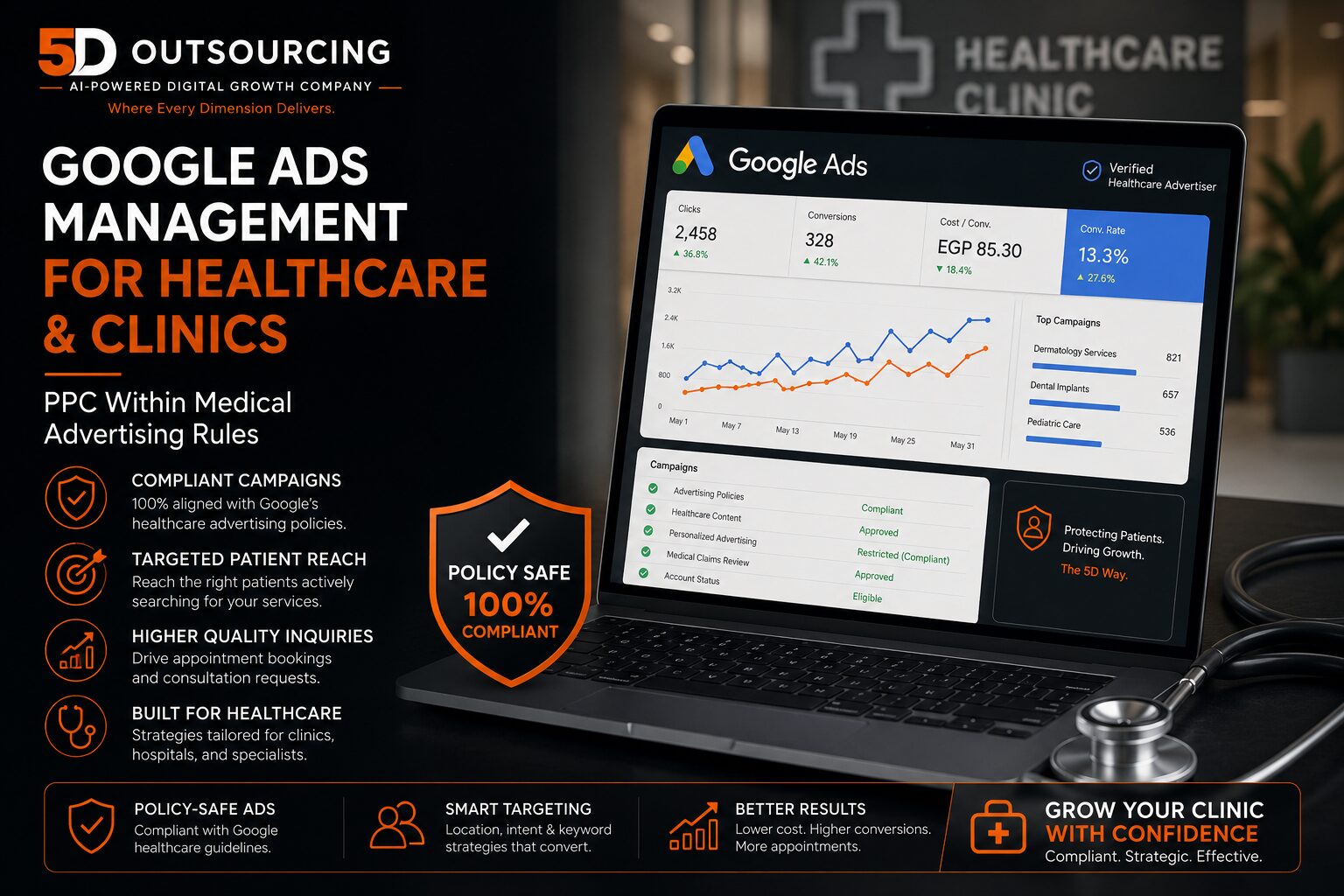
Google Ads Management for Healthcare & Clinics: PPC Within Medical Advertising Rules
Google Ads has stricter rules for healthcare advertising than for almost any other category. Ad copy that would be unremarkable in most industries — bold outcome claims, personalized remarketing based on a visitor’s browsing behavior, urgency-driven language — can violate Google’s healthcare and medicines policies outright, get ads disapproved, or worse, get an account flagged for review. Running healthcare PPC the same way you’d run a standard lead-generation campaign isn’t just less effective — it risks the account itself.
This is the second piece of the healthcare growth system we build at 5D Outsourcing, alongside our SEO services for healthcare providers and clinics, both anchored to our digital marketing and AI Search work for healthcare providers in Egypt. This article explains what makes healthcare Google Ads structurally different, what Google’s advertising policies actually restrict, and how a compliant campaign still generates qualified patient inquiries.
Why Healthcare Google Ads Isn’t Standard PPC
Most industries run into Google’s general advertising policies — no misleading claims, no prohibited content, standard trademark and copyright rules. Healthcare advertisers run into an additional, more specific layer of restrictions built around protecting patients from misleading medical claims and protecting user privacy around sensitive health information. A campaign built without accounting for these rules from the start tends to run into disapprovals, wasted setup time, or underperformance that has nothing to do with targeting or bidding.
Personalized health condition targeting is restricted
Google’s policies limit how advertisers can use personal health information to target or personalize ads — for example, restricting remarketing to users based on health conditions they’ve previously researched, since that kind of targeting raises real privacy concerns. This affects how remarketing campaigns for clinics and healthcare providers can be structured compared to a standard e-commerce or service business, where remarketing to anyone who visited a specific page is unremarkable.
Claims and outcome language face closer scrutiny
Ad copy that guarantees results, overstates success rates, or implies outcomes without appropriate qualification is far more likely to be flagged in healthcare than in most other categories. This isn’t only a policy compliance issue — it’s the same trust consideration covered in our healthcare SEO article: overstated claims damage patient trust as much as they risk ad disapproval.
Certain healthcare content requires certification
Depending on the specific service — particularly anything touching pharmaceuticals, certain medical devices, or specific treatment categories — Google may require advertiser certification before ads are eligible to run at all. This needs to be identified and resolved before campaign launch, not discovered after ads are already rejected.
Patient acquisition funnels look different from standard lead-gen
A patient searching for a specialist or procedure is often moving toward booking an appointment, not just requesting general information. Campaigns should be structured around that specific action — appointment booking, consultation request — rather than a generic “contact us” conversion goal that doesn’t match how patients actually engage.
Google Ads Campaign Types for Healthcare Providers
Search campaigns built around specific conditions and specialties
Search remains the primary driver for healthcare PPC, since patients typically search with clear intent — “dermatologist New Cairo,” “dental implants Cairo,” “pediatrician near me.” Campaigns should be segmented by specialty and condition rather than run as one broad “clinic” campaign, so each ad group can speak directly to a specific patient need with appropriately reviewed, compliant messaging.
Local Services and location-based campaigns
Since most healthcare searches carry strong local intent, location targeting and location extensions matter more here than in many other verticals. Campaigns should be built around the specific areas a clinic or provider actually serves, connecting directly to the local SEO foundation covered in our local SEO strategy guide.
Remarketing, structured within policy limits
Remarketing is still usable in healthcare, but it has to be built carefully — general site visitor remarketing (not tied to specific health conditions viewed) is generally lower-risk than more granular condition-based segmentation. Where in doubt, campaigns should default to broader, less personalized remarketing audiences rather than risk a policy violation for the sake of tighter segmentation.
Display for practice awareness, not diagnosis-adjacent targeting
Display campaigns can build general awareness of a clinic or new service line, but should avoid targeting structured around specific health conditions or symptoms in ways that could be read as inferring a user’s health status — a distinction that matters more in healthcare than almost any other industry.
Building a Compliant Healthcare PPC Campaign That Still Converts
Ad copy that’s accurate, specific, and appropriately qualified
Effective healthcare ad copy leads with concrete, verifiable information — specialties offered, credentials, location, appointment availability — rather than promotional language about outcomes. This isn’t a creative limitation; it also tends to perform better with patients, who are generally more responsive to clear, credible information than to vague marketing claims.
Keyword strategy segmented by specialty and intent
Healthcare keyword research should separate informational searches (“what causes [condition]”) from clearly transactional ones (“book appointment [specialty] Cairo”), since sending informational-intent traffic to an appointment-booking landing page — or vice versa — wastes the click regardless of how well-targeted the keyword itself was.
Negative keywords for non-patient traffic
Healthcare accounts should exclude job-seeker searches (“clinic jobs,” “nurse hiring”), free/low-cost searches that don’t match the practice’s positioning, and condition-adjacent informational searches with no clear intent to book — all of which are common sources of wasted spend in medical PPC accounts that haven’t built out a negative keyword list carefully.
Landing pages built for appointment booking, not just inquiry
Healthcare landing pages should make the path to booking as short and clear as possible — practitioner credentials, service description, and a direct booking or consultation-request action, without unnecessary friction. This connects to the same principles in our landing page optimization guide, applied to a patient audience that’s often looking to act quickly once they’ve decided to search.
Lead capture that respects how patients actually reach out
As with real estate, a meaningful share of healthcare inquiries in Egypt happen by phone or WhatsApp rather than web forms — patients often prefer to speak directly with a clinic before booking, particularly for sensitive or unfamiliar procedures. Call tracking and WhatsApp integration should be standard on every healthcare landing page, not treated as optional.
Conversion Tracking and Measurement for Healthcare PPC
Healthcare campaigns should track appointment bookings and qualified consultation requests as the primary conversion goal, not just form submissions or click volume. Where possible, tracking should distinguish between a general inquiry and a confirmed booking, since the two represent very different levels of patient intent and very different value to the practice.
Cost-per-click and click volume alone say little about whether a campaign is working. Cost per booked appointment, filtered against patient show-rate feedback from the practice, is a far more meaningful measure — and one that requires close coordination between the campaign data and the clinic’s actual scheduling process.
Budget Considerations for Healthcare Google Ads in Egypt
Healthcare keyword costs vary significantly by specialty — cosmetic and elective procedures often carry different competitive dynamics than general practice or pediatric care, for example. Budgets should be planned with this variation in mind rather than assumed to be uniform across every service line a clinic offers. For a general framework on how PPC budgets are structured and evaluated, see our PPC cost guide.
Common Mistakes in Healthcare Google Ads Campaigns
- Ad copy with outcome guarantees or unqualified claims that risk disapproval and damage trust
- Remarketing built around specific health conditions, raising both policy and privacy concerns
- One broad campaign covering every specialty instead of segmentation by condition and intent
- Missing negative keywords, allowing job-seeker and informational traffic to consume budget
- Landing pages that ask for too much information before a patient will commit to an inquiry
- No call or WhatsApp tracking, undercounting how patients actually reach out
- Measuring performance on clicks instead of qualified, booked appointments
If existing healthcare campaigns are producing clicks without real bookings, our guide on why ads get clicks but don’t convert covers the most common underlying causes in more depth.
How 5D Outsourcing Manages Google Ads for Healthcare Providers
5D Outsourcing builds Google Ads accounts for clinics, hospitals, and healthcare providers in Cairo and across Egypt within the same integrated growth system as our healthcare SEO work. Our healthcare PPC management typically includes:
- Campaign structure segmented by specialty, condition, and patient intent
- Ad copy and targeting built to stay within Google’s healthcare and medicines advertising policies
- Landing pages designed around appointment booking, with call and WhatsApp tracking
- Remarketing structured to respect health-condition personalization restrictions
- Conversion tracking built around qualified bookings, not click volume alone
- Ongoing optimization refined through structured A/B testing and coordination with practice scheduling feedback
This work sits alongside our broader Google Ads & PPC management services and our digital marketing and AI Search system for healthcare providers, all coordinated through the same digital marketing and AI Search capability that anchors every industry vertical we work with.
Leave a Reply