
No products in the cart.
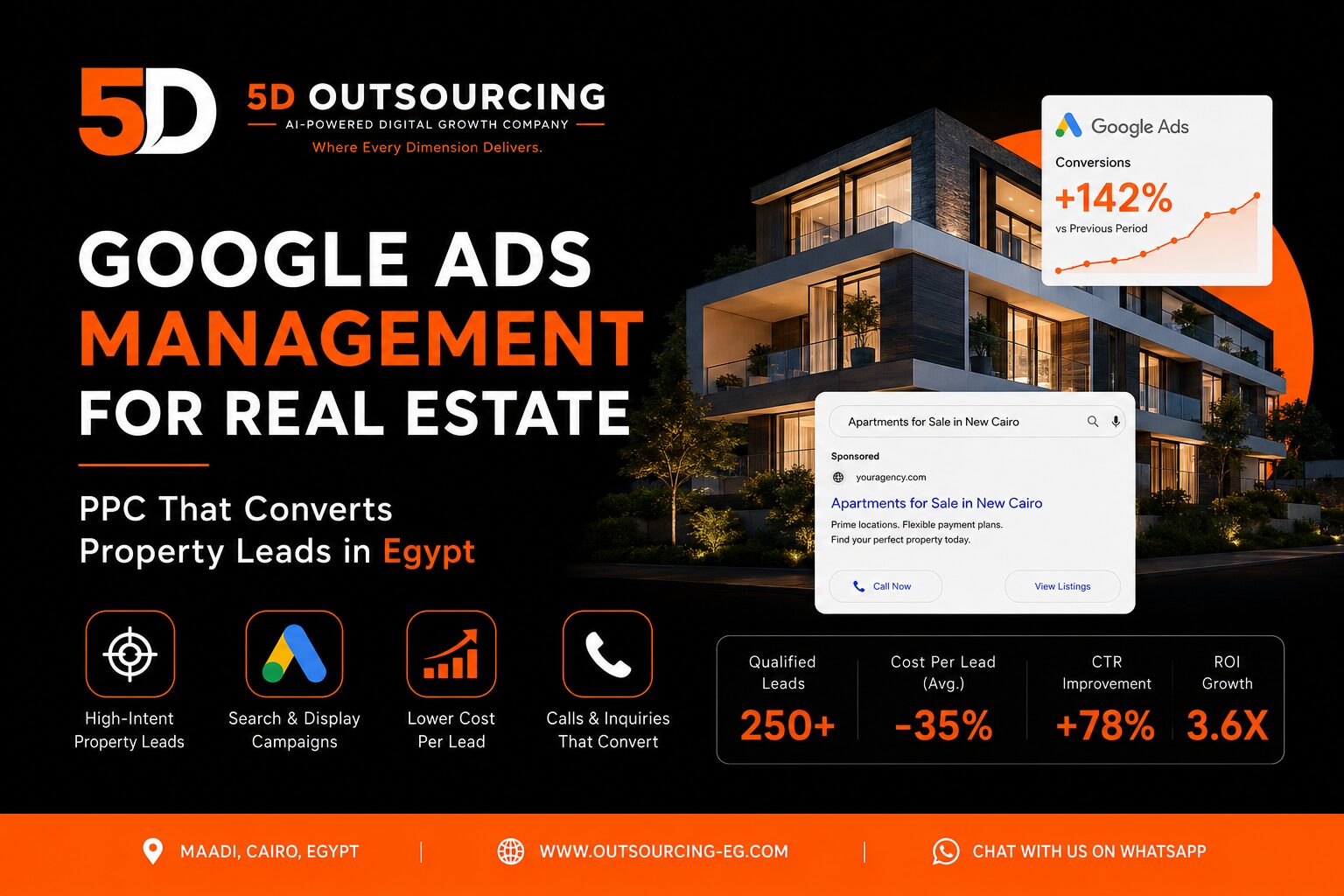
Google Ads Management for Real Estate: PPC That Converts Property Leads in Egypt
Real estate is one of the most expensive, most competitive categories in Google Ads. Cost-per-click for property keywords in Cairo and New Cairo routinely runs higher than most other industries, and a single wasted click from an unqualified searcher — a job seeker, a renter when you sell, a browser six months from any decision — can cost as much as a click that turns into a serious buyer inquiry. Running real estate PPC the same way you’d run a generic lead-gen campaign is one of the fastest ways to burn budget without producing sales.
At 5D, we build Google Ads and AI Search systems specifically for real estate companies operating in Egypt — developers, brokerages, and individual agencies selling or leasing residential, commercial, and compound properties. This article explains what makes real estate PPC structurally different from standard Google Ads management, and how a properly built campaign turns high-cost clicks into qualified property leads instead of wasted spend.
Why Real Estate Google Ads Campaigns Need a Different Structure
Generic PPC advice — write a clear headline, target broad match, send traffic to your homepage — does not survive contact with real estate advertising. Property searches carry distinct intent signals, distinct funnel stages, and distinct cost dynamics that a standard campaign structure isn’t built to handle.
High cost-per-click, low tolerance for waste
Real estate keywords are consistently among the more expensive categories in Google Ads, both because commissions and unit values are high and because developers, brokers, and portals all compete for the same searches. At this cost level, a campaign built on broad keyword targeting and a generic landing page isn’t a minor inefficiency — it’s a direct hit to profitability. Every unqualified click needs to be actively filtered out, not tolerated as an acceptable cost of visibility.
Buyer, renter, and investor intent look almost identical in a keyword
Someone searching “apartments New Cairo” could be a first-time buyer, a tenant looking to rent, or an investor comparing yield across compounds. Someone searching “apartment for sale New Cairo” has narrowed that down — but not fully, since “for sale” searches still mix serious buyers with early-stage browsers. Real estate PPC has to be structured around these distinctions from the keyword level up, because sending a renter’s click to a sales-focused landing page (or vice versa) wastes the click entirely.
Long, multi-touch decision cycles
Property purchases in Egypt, particularly for compounds and off-plan developments, often involve weeks or months of research, comparison, and family discussion before a lead is ready to speak with a sales team. A single Search ad click rarely closes a deal. Campaigns need to account for this with remarketing structures that keep the property in front of a prospect through that entire consideration window, not just a one-shot Search ad.
Location and project specificity matter more than almost any other industry
A buyer interested in a specific compound in New Cairo is not a lead for a project in Sheikh Zayed, even if both are technically “apartments for sale in Cairo.” Real estate campaigns need geographic and project-level targeting precision that most other service businesses never have to think about.
Google Ads Campaign Types for Real Estate Companies
A properly structured real estate PPC account rarely relies on a single campaign type. Different stages of buyer intent call for different formats.
Search campaigns for high-intent property searches
Search remains the backbone of real estate PPC because it captures people actively looking — “apartment for sale in [compound name],” “villa for sale New Cairo,” “commercial office space Maadi.” These campaigns should be tightly segmented by property type, location, and buyer intent (sale vs. rent vs. investment), each with its own ad groups and landing pages rather than one broad campaign covering an entire portfolio.
Performance Max for portfolio-wide visibility
For developers or brokerages managing multiple projects at once, Performance Max campaigns can extend visibility across Search, Display, YouTube, and Discover using a single asset feed — useful for surfacing a broad property portfolio to relevant audiences without building a separate manual campaign for every unit type. It works best layered on top of, not instead of, tightly targeted Search campaigns for your highest-priority projects.
Remarketing for long consideration windows
Given how long real estate decisions take, remarketing is not optional — it’s often where a meaningful share of qualified leads actually convert. Someone who viewed a specific unit page or downloaded a brochure should see that project again across Display and YouTube in the weeks that follow, rather than disappearing from your funnel after one visit.
Display for early-stage awareness
Display campaigns targeting relevant audiences and placements can build awareness of a new launch or an under-marketed project before search demand exists for it — useful for pre-launch and early-phase compound sales where buyers haven’t started actively searching yet.
Building a Real Estate PPC Campaign Structure That Converts
Keyword strategy: property type, location, and intent
Real estate keyword research should be organized around three layers rather than a flat keyword list: property type (apartment, villa, townhouse, office, retail unit), location (compound name, district, city), and transaction intent (for sale, for rent, resale, off-plan). A well-structured account groups keywords along these lines so each ad group can speak directly to a specific search — “3 bedroom apartment for sale [compound]” gets a different ad and landing page than “office space for rent Maadi.”
Negative keywords to filter unqualified traffic
Real estate accounts need an unusually disciplined negative keyword list. Terms like “jobs,” “careers,” “real estate agent salary,” “for rent” (on a sales-only campaign), and generic informational searches like “how to buy property in Egypt” should be excluded early, since they consistently attract clicks with no purchase or lease intent — an expensive category of waste at real estate CPCs.
Ad copy built around what actually moves real estate buyers
Effective real estate ad copy tends to lead with concrete signals: unit sizes, starting prices, payment plan structure, delivery date, and project name — not generic phrases like “luxury living” or “your dream home.” Buyers comparing multiple projects respond to specifics they can compare directly against competitors.
Landing pages built per project, not one generic page
Sending real estate PPC traffic to a general “our properties” page is one of the most common ways campaigns underperform. Each significant project or unit category should have its own landing page with unit types, pricing ranges, floor plans, location context, and a clear lead form — matching what the ad promised rather than asking the visitor to search for it themselves. Read more in our guide to landing page optimization.
Lead capture built for how Egyptian buyers actually contact businesses
In the Egyptian market, a large share of real estate inquiries happen over phone calls and WhatsApp rather than web forms. Campaigns should include call tracking on every landing page and a visible WhatsApp contact option, in addition to standard lead forms, so no genuine inquiry is lost simply because a prospect preferred to message instead of filling out a form.
Budget Considerations for Real Estate Google Ads in Egypt
Real estate budgets need to account for the category’s high cost-per-click and the reality that a meaningful share of early clicks go toward data collection and audience-building rather than immediate conversions — particularly during a campaign’s first few weeks. Budget should be allocated deliberately across campaign types rather than concentrated entirely in Search, since remarketing and awareness campaigns typically cost less per click but play a real role in moving long-cycle buyers toward a decision.
For a general framework on how Google Ads budgets should be structured and evaluated, see our PPC cost guide, and for the underlying logic of how PPC fits into a broader growth strategy, read the power of PPC in digital marketing.
Measuring What Actually Matters in Real Estate PPC
Click volume and cost-per-click are the least useful metrics for judging a real estate campaign’s success. What matters is qualified lead volume, cost per qualified lead, and — where sales data can be connected back to campaign source — cost per closed deal or reservation. This requires conversion tracking set up correctly on forms, calls, and WhatsApp clicks from day one, not added as an afterthought once a campaign is already running.
Businesses running real estate campaigns should also track lead quality directly with their sales team, since a low cost-per-lead figure that produces mostly unqualified inquiries is a worse outcome than a higher cost-per-lead figure that produces buyers who actually show up to viewings.
Common Mistakes in Real Estate Google Ads Campaigns
The same structural mistakes appear repeatedly across underperforming real estate accounts:
- Using one broad campaign for an entire property portfolio instead of segmenting by project, property type, and intent
- Sending all traffic to a homepage instead of project-specific landing pages
- Missing negative keywords, allowing job-seeker and informational traffic to consume budget
- No remarketing strategy for a buyer journey that naturally takes weeks or months
- No call tracking or WhatsApp tracking, undercounting real leads that come in outside web forms
- Judging performance on clicks and impressions instead of qualified leads and sales-team feedback
If your current campaigns are generating clicks without producing real inquiries, our guide on why ads get clicks but don’t convert walks through the most common causes in more depth, and our conversion funnel guide explains how to think about the full path from click to closed deal.
How 5D Manages Google Ads for Real Estate Companies
5D builds Google Ads accounts for real estate developers, brokerages, and agencies in Cairo, New Cairo, Maadi, and across Egypt as part of an integrated growth system — not as a standalone campaign disconnected from the rest of your digital presence. Our real estate PPC work typically includes:
- Campaign structure segmented by project, property type, and buyer intent
- Negative keyword strategy built to filter out job seekers and low-intent searches
- Project-specific landing pages with call tracking and WhatsApp integration
- Remarketing sequences built around the real estate buyer’s typical decision timeline
- Conversion tracking connected to forms, calls, and WhatsApp — not clicks alone
- Ongoing optimization based on lead quality feedback from your sales team, refined through structured A/B testing
This sits alongside our SEO services for real estate agencies, our broader Google Ads & PPC management services, and cornerstone work like local SEO strategy and Google Business Profile optimization, all coordinated through the same digital marketing and AI Search system rather than run as separate, disconnected campaigns.
Management levels and pricing are published on our Google Ads management packages page, and project landing pages can be built through our website design and development service.
Leave a Reply