
No products in the cart.
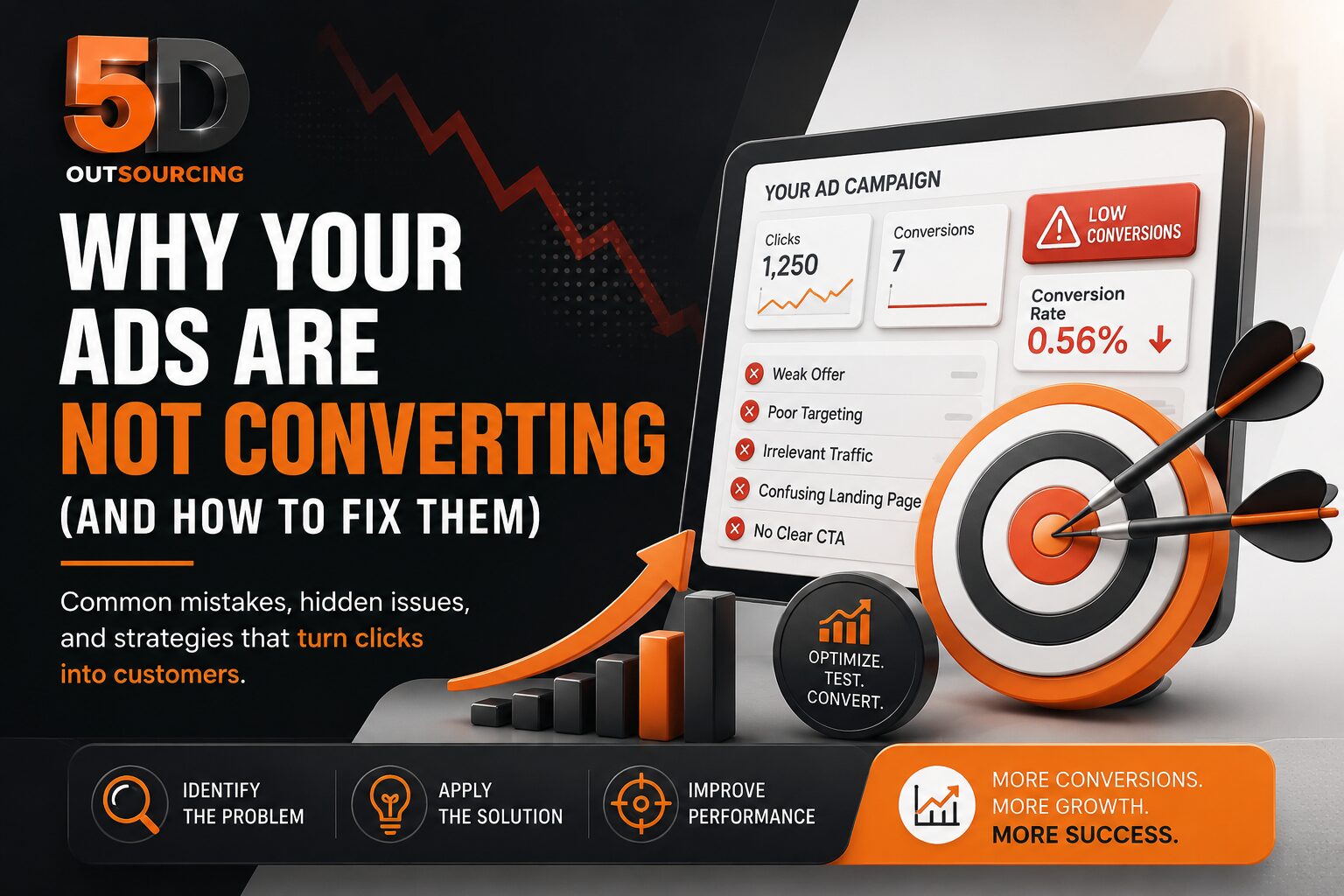
Why Your Ads Are Not Converting (And How to Fix Them)
Why Ads Get Clicks But Do Not Convert
Many businesses invest in Google Ads, social media ads, or paid campaigns expecting immediate leads. The ads may get impressions, clicks, and website visits, but the final result is disappointing: few inquiries, weak lead quality, low form submissions, or no sales conversations.
This is one of the most common paid advertising problems. The campaign may appear active, the budget may be spending, and the traffic may be coming in — but the ads are not converting into real business opportunities.
When ads are not converting, the problem is not always the ad platform. It may be caused by poor targeting, weak ad copy, low-intent keywords, unclear offers, landing page problems, slow website performance, poor user experience, or a broken conversion funnel.
At 5D Outsourcing, paid advertising is treated as part of a complete performance system. A successful PPC campaign should not only generate clicks. It should attract the right audience, send users to the right page, communicate a clear offer, and turn traffic into qualified leads.
What Does “Ads Not Converting” Really Mean?
Ads not converting means your paid campaigns are failing to produce the desired business action. That action may be a phone call, contact form submission, quote request, appointment booking, product inquiry, checkout, or direct message.
Some campaigns fail before the click because the targeting or message is wrong. Other campaigns fail after the click because the landing page does not convince users to take action. In many cases, the real issue is not one single mistake. It is a disconnect between the ad, the audience, the landing page, and the conversion process.
For example, a business may run Google Ads for a high-intent service keyword. The ad may get clicks, but if the landing page is slow, unclear, generic, or difficult to use on mobile, visitors may leave without contacting the business.
This is why paid advertising performance should be measured by conversions and lead quality, not only clicks or impressions.
Clicks Are Not the Same as Conversions
One of the biggest mistakes in PPC advertising is treating clicks as success. Clicks show that users were interested enough to visit the website, but they do not prove that the campaign is profitable.
A campaign can generate many clicks and still fail if those clicks do not become leads. This usually happens when the campaign attracts the wrong users, sends traffic to the wrong page, or does not give visitors a strong reason to take action.
Important PPC performance questions include:
- Are the clicks coming from people with real buying intent?
- Are users landing on a page that matches the ad promise?
- Is the offer clear within the first few seconds?
- Is the call-to-action visible and easy to understand?
- Is the form simple enough to complete?
- Are leads qualified or only low-value inquiries?
- Is the campaign generating business opportunities, not only traffic?
If your website receives traffic but does not generate inquiries, the issue may be connected to conversion optimization. The article Why Your Website Gets Traffic But No Leads explains how traffic can fail when the website does not guide visitors toward action.
Reason 1: Your Targeting Is Too Broad
Broad targeting is one of the most common reasons ads fail to convert. If your campaign reaches people who are not ready to buy, not in your service area, or not looking for your exact solution, the campaign may waste budget on low-quality clicks.
This can happen in Google Ads when keyword match types are too broad, negative keywords are missing, or the campaign targets informational searches instead of commercial searches. It can also happen in social media advertising when the audience is based on general interests instead of clear buyer signals.
Examples of poor targeting include:
- Targeting users outside your service location
- Using broad keywords with weak commercial intent
- Showing ads to people researching only, not ready to buy
- Targeting too many industries with one generic campaign
- Failing to exclude irrelevant search terms
- Using one audience for all services and offers
To fix this, campaigns should be structured around search intent, location, service relevance, and lead quality. For Google Ads, this means reviewing search terms, adding negative keywords, separating campaigns by service, and focusing budget on high-intent queries.
Reason 2: Your Keywords Have Low Buying Intent
Not all keywords are equal. Some keywords show strong buying intent, while others show research intent. If your PPC campaign targets the wrong type of keywords, users may click the ad but never become leads.
For example, a keyword such as “what is PPC advertising” is informational. A keyword such as “Google Ads agency in Cairo” has stronger commercial intent. Both may bring traffic, but they do not have the same conversion potential.
Low-intent keywords can drain budget because they attract users who are still learning, comparing, or browsing. High-intent keywords are usually more valuable because they indicate that the user is closer to making a decision.
Strong PPC keyword strategy should separate:
- Informational keywords: Users want to learn.
- Comparison keywords: Users are evaluating options.
- Commercial keywords: Users are looking for a provider or solution.
- Transactional keywords: Users are ready to request, book, buy, or contact.
If your campaign budget is limited, it should usually prioritize commercial and transactional keywords first. This helps improve lead generation and reduce wasted ad spend.
Reason 3: Your Ad Copy Does Not Match the Customer Pain
Weak ad copy can reduce conversion performance before users even reach your website. If the ad only describes the service without addressing the customer’s problem, it may fail to attract the right clicks.
Good ad copy should connect the service to a specific pain, need, or outcome. It should explain why the user should choose your business instead of another provider.
Weak ad copy often sounds generic:
- “Professional digital marketing services”
- “Best PPC agency”
- “Affordable marketing solutions”
- “Grow your business online”
Stronger ad copy is more specific:
- “Getting clicks but no leads? Fix your PPC funnel.”
- “Reduce wasted ad spend with structured Google Ads management.”
- “Turn paid traffic into qualified leads with conversion-focused campaigns.”
- “Improve Google Ads performance with better targeting, landing pages, and tracking.”
The goal is not only to get attention. The goal is to attract the right user with the right message and prepare them for the landing page experience.
Reason 4: Your Offer Is Not Clear Enough
Even if targeting and ad copy are strong, users may not convert if the offer is unclear. A paid ad should lead users toward a specific action. If the user does not understand what they will get, why it matters, or what happens next, they may leave without taking action.
A weak offer may be too vague, too generic, or too difficult to evaluate. For example, “Contact us” is usually weaker than “Request a PPC Campaign Review” because it does not explain the value of the action.
A strong PPC offer should answer these questions:
- What problem does this solve?
- Who is this offer for?
- What will the user receive?
- Why should they act now?
- What is the next step after submitting the form?
For service businesses, strong offers may include a consultation, audit, quote, campaign review, strategy session, or performance assessment. The offer should match the user’s stage in the buying journey.
Reason 5: Your Landing Page Does Not Match the Ad
Message mismatch is a major reason ads do not convert. If the ad promises one thing but the landing page talks about something broader or different, users may lose trust and leave.
For example, if an ad promotes “Google Ads management for lead generation,” the landing page should immediately explain Google Ads management, lead generation, campaign structure, reporting, and how the service helps the user generate better inquiries.
Sending users to a generic homepage often reduces conversion performance because the visitor must search for the relevant information. A dedicated landing page usually performs better because it focuses on one campaign goal.
A strong landing page should include:
- A headline that matches the ad message
- A clear explanation of the service or offer
- Visible call-to-action buttons
- Trust signals such as reviews, experience, or process clarity
- Short and focused content
- Simple contact form or direct action path
- Mobile-friendly design
If your ads are getting traffic but not leads, review the guide on landing page optimization. Landing pages are often the difference between wasted clicks and qualified inquiries.
Reason 6: Your Website Has Conversion Problems
Sometimes the ads are not the main problem. The website may be the reason users do not convert. A paid campaign can bring the right visitor, but the website must still persuade that visitor to take action.
Website conversion problems may include poor layout, confusing messaging, weak service descriptions, slow loading speed, unclear navigation, low trust signals, or difficult forms. These issues can damage performance across Google Ads, social media ads, SEO traffic, and direct traffic.
Common website conversion issues include:
- No clear value proposition above the fold
- Weak call-to-action buttons
- Too many distractions on the page
- Forms that ask for too much information
- No visible phone number or contact path
- Missing testimonials or trust indicators
- Poor mobile experience
- Slow page loading speed
Before increasing ad budget, businesses should confirm that the website is ready to convert paid traffic. If the website experience is weak, more traffic may only increase wasted spend.
Reason 7: Your Conversion Funnel Is Broken
Paid advertising should be connected to a clear conversion funnel. The user journey should move from ad impression to click, landing page visit, offer understanding, CTA interaction, form submission, and lead follow-up.
If any part of that journey is weak, conversions may drop. For example, the ad may attract the right user, but the landing page may not explain the offer. Or the user may submit a form, but the sales follow-up may be too slow or unclear.
A paid advertising funnel should be reviewed in stages:
- Ad impression: Is the message relevant to the audience?
- Click: Is the ad attracting users with real intent?
- Landing page: Does the page match the ad promise?
- CTA: Is the next step clear?
- Form or contact action: Is it easy to complete?
- Lead handling: Is the business responding quickly?
- Sales qualification: Are leads being measured by quality?
To understand this process in more detail, read Conversion Funnel Explained: From Traffic to Paying Customers. Ads perform better when every funnel stage is designed intentionally.
Reason 8: Your Tracking Is Not Set Up Correctly
If conversion tracking is missing or inaccurate, you may not know which ads are actually working. This can lead to poor budget decisions, weak optimization, and misleading campaign reports.
Many businesses track clicks but do not properly track form submissions, phone calls, quote requests, button clicks, or lead quality. Without accurate conversion tracking, the campaign may appear active but remain difficult to improve.
Important tracking elements include:
- Form submission tracking
- Phone call tracking
- CTA button click tracking
- Landing page conversion tracking
- Google Ads conversion actions
- Google Analytics event tracking
- Lead source tracking
- CRM or sales follow-up tracking
Tracking should not only show how many leads were generated. It should help identify which campaigns, keywords, ads, and landing pages produced the best business opportunities.
Reason 9: Your Budget Is Spread Too Thin
A common PPC mistake is trying to advertise too many services, locations, or audiences with a limited budget. When budget is spread too thin, campaigns may not collect enough data, and the strongest opportunities may not receive enough spend.
For example, a business may try to promote SEO, PPC, website development, social media, and hosting at the same time using one small monthly budget. This can make performance difficult to evaluate because each campaign receives limited traffic.
A better approach is to prioritize the highest-value service or strongest conversion opportunity first. Once the campaign proves performance, the business can expand into additional services, locations, or audiences.
If you are unsure how much to allocate, review the PPC Cost Guide: How Much Should You Spend on Google Ads?. Budget planning should be connected to keyword cost, lead value, competition level, and conversion expectations.
Reason 10: You Are Optimizing for the Wrong Metric
Many campaigns are optimized for surface-level metrics such as impressions, clicks, click-through rate, or cost per click. These metrics are useful, but they do not always show business performance.
A low cost per click may look good, but if the clicks are low quality, the campaign will still fail. A high click-through rate may look strong, but if users do not submit forms or contact the business, the campaign is not converting.
Better PPC metrics include:
- Conversion rate
- Cost per qualified lead
- Lead quality
- Search term relevance
- Landing page conversion rate
- Call quality
- Sales follow-up rate
- Return on ad spend or revenue opportunity
The right metric depends on the business model. For most service businesses, qualified leads are more important than cheap clicks.
Reason 11: Your Mobile Experience Is Weak
Many paid ad clicks come from mobile users. If the landing page is difficult to read, slow to load, or hard to navigate on mobile, conversion rates can drop quickly.
Mobile users need a fast and simple path to action. They should be able to understand the offer, click the CTA, call the business, or submit a form without friction.
Mobile PPC landing pages should include:
- Fast loading speed
- Clear headline above the fold
- Large and visible CTA buttons
- Simple forms
- Readable text size
- Strong spacing between elements
- Clickable phone or contact options
- No unnecessary popups blocking the user
For a deeper understanding of how user experience affects conversions, read UX Optimization: How User Experience Impacts Conversion Rates. PPC campaigns depend heavily on the quality of the post-click experience.
Reason 12: You Are Not Testing Campaign Improvements
Paid advertising should not be launched once and left unchanged. Campaigns need ongoing testing and optimization. Without testing, businesses may continue spending money on weak ads, poor landing pages, and underperforming offers.
Testing can improve campaign performance by identifying which message, audience, keyword, CTA, or landing page produces better results.
Useful PPC tests include:
- Testing different ad headlines
- Testing different call-to-action phrases
- Testing dedicated landing pages against service pages
- Testing shorter forms against longer forms
- Testing different offers such as audit, quote, or consultation
- Testing keyword match types
- Testing audience segments
- Testing trust signal placement
A structured testing process helps reduce guesswork. For more context, read the A/B Testing Guide, which explains how to compare different versions of pages, messages, and conversion elements using real user behavior.
How to Diagnose Why Your Ads Are Not Converting
Before changing everything, businesses should diagnose the campaign step by step. Random changes can make performance worse because they do not identify the real cause of the problem.
A practical diagnosis should review the full paid advertising system:
- Review campaign objective: Confirm whether the campaign is designed for leads, traffic, calls, sales, or awareness.
- Check audience targeting: Make sure the campaign reaches the right location, service audience, and buyer stage.
- Analyze search terms: Identify irrelevant keywords and add negative keywords where needed.
- Review ad copy: Confirm that the message addresses a real customer pain and matches the offer.
- Check landing page relevance: Make sure the page matches the ad promise and user intent.
- Audit CTA visibility: Confirm that users can easily see and understand the next step.
- Test forms and contact paths: Make sure forms, phone links, and buttons work properly.
- Review mobile experience: Test the page on mobile devices, not only desktop.
- Check conversion tracking: Confirm that leads, calls, and important actions are being recorded correctly.
- Evaluate lead quality: Review whether the campaign is attracting the right type of customer.
This process helps separate traffic problems from conversion problems. It also prevents businesses from increasing ad budget before fixing the campaign foundation.
How to Fix Ads That Are Not Converting
Fixing non-converting ads requires improving the full system, not only changing one headline or increasing the budget. The goal is to align targeting, message, landing page, offer, tracking, and follow-up.
To improve ad conversions, businesses should:
- Focus on high-intent keywords and audiences
- Remove irrelevant search terms and low-quality traffic
- Write ad copy around customer pain and business outcomes
- Create dedicated landing pages for important campaigns
- Match the landing page headline with the ad message
- Use clear and specific call-to-action buttons
- Reduce form friction and simplify the contact process
- Add trust signals such as reviews, process clarity, and service proof
- Improve mobile loading speed and layout
- Set up accurate conversion tracking
- Measure qualified leads, not only clicks
- Run continuous A/B tests to improve performance over time
When these elements work together, paid campaigns become more efficient. The business can generate better leads from the same budget instead of depending only on higher ad spend.
When Should You Increase Your Ad Budget?
Increasing ad budget only makes sense after the campaign foundation is working. If the campaign is not converting, more budget may only increase wasted spend.
Before increasing budget, confirm that:
- The campaign is targeting the right audience
- The keywords have strong commercial intent
- The landing page is relevant and conversion-focused
- Conversion tracking is accurate
- The campaign is generating qualified leads
- The cost per lead is acceptable for the business model
- The sales team can respond quickly to inquiries
Once these conditions are met, increasing budget can help scale results. Without them, budget increases may only expose the same conversion problems at a larger cost.
Google Ads vs. Social Media Ads: Different Conversion Problems
Google Ads and social media ads often fail for different reasons. Google Ads usually captures existing demand because users are actively searching. Social media ads often create or interrupt demand because users are browsing content.
Because of this, the conversion strategy should be different.
Google Ads conversion problems often include:
- Wrong keyword match types
- Weak negative keyword strategy
- Low-intent search terms
- Poor landing page relevance
- High cost per click without lead quality
Social media ad conversion problems often include:
- Weak audience segmentation
- Creative fatigue
- Generic offer positioning
- Low trust before the CTA
- Sending cold traffic directly to a hard sales action
Both channels can work, but they need different messaging, funnel structure, and conversion expectations. A business should not judge every channel using the same logic.
How 5D Outsourcing Improves PPC Conversion Performance
5D Outsourcing approaches PPC advertising as a structured growth system. The goal is not only to launch ads. The goal is to build campaigns that connect traffic, landing pages, conversion tracking, and lead quality.
Our PPC improvement process may include:
- Campaign structure review
- Keyword and search term analysis
- Audience and location targeting review
- Ad copy improvement
- Landing page optimization
- Conversion funnel review
- Tracking setup and reporting
- Budget allocation recommendations
- A/B testing for ads and landing pages
- Lead quality analysis
Businesses that need a structured paid advertising foundation can review the Google PPC Starter Package. This package is designed to help businesses in Cairo and Egypt launch focused Google Ads campaigns with better targeting, structure, and performance tracking.
For businesses that need a complete growth system, PPC can also be combined with digital marketing services, SEO, landing page optimization, and website development to improve both traffic generation and conversion performance.
Final Thoughts
If your ads are not converting, the answer is not always to spend more money. The real solution is to identify where the paid advertising system is breaking.
The issue may be targeting, keywords, ad copy, offer clarity, landing page quality, tracking, mobile experience, or the conversion funnel. In many cases, several of these problems happen at the same time.
Strong PPC performance comes from alignment. The right audience must see the right message, click to the right landing page, understand the offer quickly, and have a simple path to contact your business.
When paid campaigns are structured correctly, ads stop being random traffic generators and become measurable lead generation systems.
Are Your Ads Getting Clicks But No Leads?
5D Outsourcing can review your PPC campaign, landing page, targeting, and conversion path to identify why your ads are not producing qualified leads.
Leave a Reply