
No products in the cart.
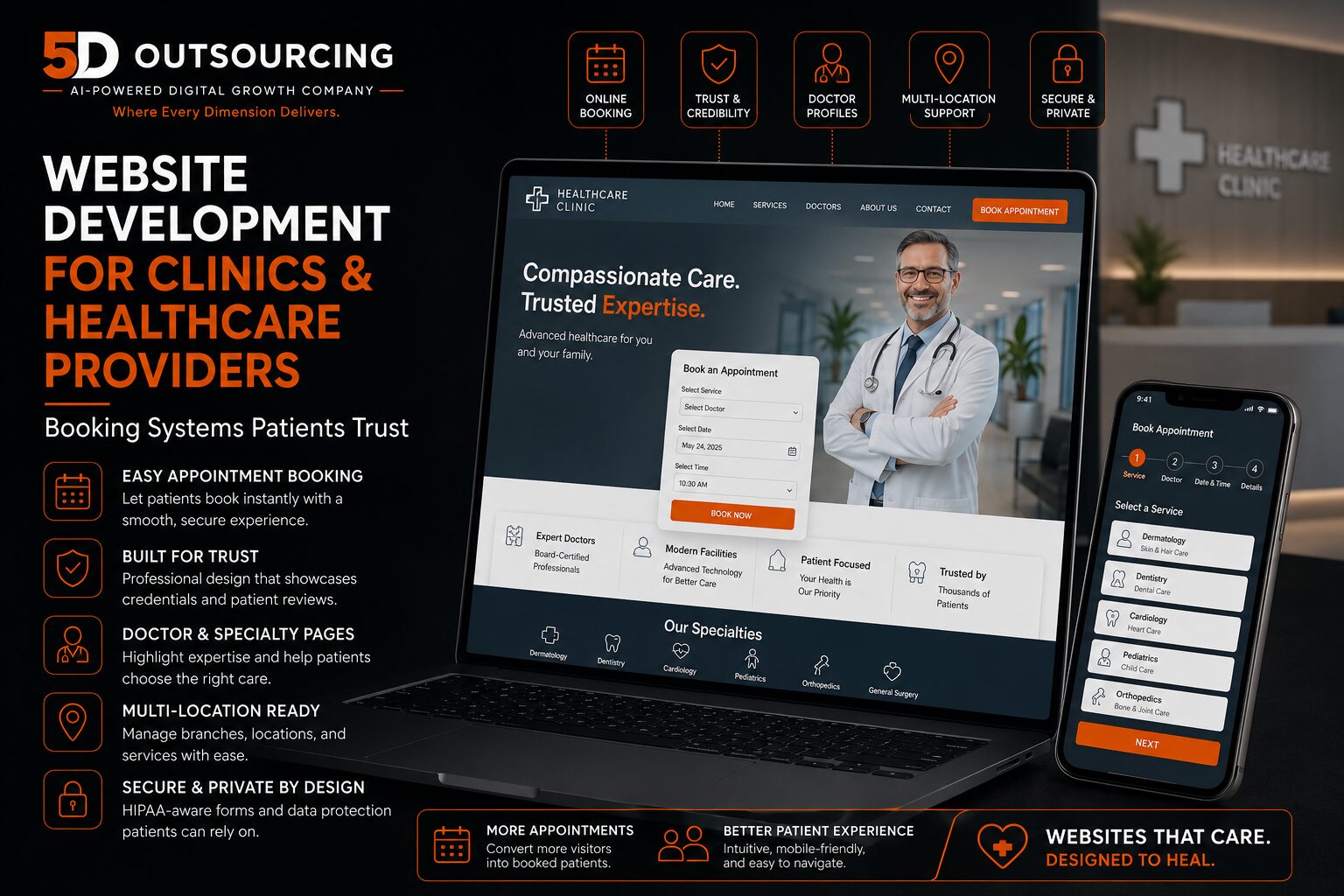
Website Development for Clinics & Healthcare Providers: Booking Systems Patients Trust
A clinic website has to do something a standard business site never has to manage: earn a stranger’s trust with their health information, guide them toward booking an appointment, and make that process feel safe rather than transactional. Patients researching a provider are often anxious, comparing multiple options, and looking for reasons to trust — or reasons to leave. A generic small-business template with a contact form bolted on at the bottom rarely does that job well.
This completes the three-part healthcare growth system we build at 5D Outsourcing, alongside our SEO services for healthcare providers and clinics and Google Ads management for healthcare and clinics, all anchored to our digital marketing and AI Search work for healthcare providers in Egypt. This article explains what makes a healthcare website build a genuinely distinct brief, and what a clinic or medical practice site needs to actually convert visitors into booked patients.
Why Healthcare Websites Are a Different Build Brief
Booking systems, patient-trust design, and information sensitivity separate healthcare websites from most other service-business builds in ways that affect nearly every decision, from information architecture to form design.
Appointment booking is the core function, not an add-on
A patient visiting a clinic website is usually deciding whether to book, not just browsing for general information. That means booking functionality — real-time or request-based scheduling, clear availability by specialty or practitioner, straightforward confirmation — needs to be central to the site’s design, not a form buried at the bottom of a contact page.
Trust design matters more here than in almost any other category
As covered in our healthcare SEO article, medical content and providers face a higher trust bar than most industries. That principle extends directly into website design: clear practitioner credentials, visible qualifications, professional photography, and a site that feels credible and current — not a template that looks identical to a generic small-business site — all affect whether a visitor feels comfortable booking.
Forms collect sensitive information and need to be handled carefully
Appointment and intake forms on a healthcare site often ask for information patients consider sensitive — symptoms, medical history, insurance details. These forms need to be built with appropriate privacy handling and clear communication about how information will be used, since a form that feels careless with sensitive data will lose a patient’s trust before they’ve even submitted it.
Multi-branch and multi-practitioner structure is common
Many healthcare practices in Egypt operate across multiple locations or with multiple specialists under one brand. A healthcare website needs to represent that structure clearly — distinct location pages, individual practitioner profiles, and a way to book with a specific doctor or a specific branch, rather than funneling everyone into one undifferentiated contact form.
Core Features a Healthcare Website Actually Needs
Appointment booking integrated into the site
Whether built as a real-time booking calendar or a structured appointment-request form, booking functionality should be reachable from every relevant page — the homepage, individual specialty pages, and individual practitioner pages — not restricted to a single general contact page.
Practitioner profile pages with real credentials
Each doctor or specialist should have a dedicated profile with qualifications, areas of specialization, years of practice, and a direct booking path. This is one of the clearest ways a healthcare site demonstrates the expertise and trust signals covered in the E-E-A-T section of our healthcare SEO guide, and it directly supports conversion — patients often choose based on the specific doctor, not just the clinic brand.
Specialty and condition pages structured for patient understanding
Each major specialty or condition treated should have its own page explaining what it involves, who provides that care, and what the process looks like — written clearly for patients rather than in dense clinical language, without sacrificing medical accuracy.
Multi-location structure for practices with more than one branch
Practices operating across multiple branches need dedicated location pages with branch-specific address, contact information, hours, and available practitioners — supporting both patient decision-making and the local SEO work covered in our local SEO strategy guide and Google Business Profile optimization guide.
Privacy-conscious intake and contact forms
Forms collecting health-related information should be built with clear communication about data handling, minimal unnecessary fields, and secure form submission — treating patient information with the same care a patient would expect in a physical clinic, not as a routine web form.
WhatsApp and phone as first-class contact options
As with real estate, many patients in Egypt prefer to speak directly with a clinic — confirming availability, asking a quick question, or booking by phone or WhatsApp rather than filling out a form. These channels should be prominent throughout the site, not secondary to a web form.
Accessibility and clarity for a general audience
Healthcare websites are used by a wide range of visitors, including older patients and those less comfortable navigating complex interfaces. Clear navigation, readable text sizes, and straightforward booking flows matter more here than on a site aimed at a narrower, more tech-comfortable audience.
Bilingual Arabic and English support
Patients in Egypt research and communicate in both Arabic and English, and clear, accurate medical information matters more in a patient’s native language than almost any other content category. A healthcare site should support full RTL Arabic layouts alongside English rather than a partial or inconsistent translation.
Technical Foundations That Support Trust and Search Visibility
SEO-native architecture from the build stage
Clean URL structures for specialties, conditions, and practitioner pages, along with proper heading hierarchy, need to be built in from the start — supporting the on-page and technical SEO work covered in our technical SEO audit checklist rather than requiring a retrofit later.
Structured data for medical entities
Schema markup for physicians, medical specialties, and clinic locations helps search engines and AI systems interpret healthcare content accurately — directly supporting the entity signals covered in our entity optimization guide and improving visibility in Google AI Overviews and similar AI-generated results.
Page speed and mobile performance
Slow-loading pages hurt both trust and conversion — a patient researching a specialist on their phone won’t wait through a slow booking page. Fast, mobile-first performance is essential given how much healthcare research happens on mobile devices, a relationship covered more broadly in our UX optimization and conversion rates guide.
Secure hosting and data handling
Given the sensitivity of information collected through healthcare websites, secure hosting infrastructure with SSL, proper form security, and careful data handling practices are non-negotiable — not an optional upgrade layered on afterward.
Conversion Design: Turning Visitors Into Booked Patients
A few structural decisions have an outsized effect on whether a healthcare site actually converts visitors into patients:
- Booking access on every relevant page, not buried behind a single general contact page
- Practitioner credentials shown clearly, since patients frequently choose based on the specific doctor
- Short, clear intake forms that ask only what’s needed to schedule, with sensitive fields handled carefully
- WhatsApp and phone prominently available, reflecting how patients in Egypt prefer to reach out
- Fast mobile performance, since a meaningful share of healthcare research happens on mobile devices
- Honest, appropriately qualified content, avoiding outcome guarantees that damage trust and risk compliance issues
These principles connect directly to the funnel logic covered in our conversion funnel guide and landing page optimization guide, applied to a patient audience with distinct trust and privacy considerations.
What a Healthcare Website Build Typically Costs
Healthcare websites generally require additional development work beyond a standard business site — booking system integration, multi-practitioner and multi-branch architecture, and more careful form security. For a general framework on how website development costs are structured in Egypt, see our website development cost guide — healthcare builds should be scoped against that baseline with the added booking and trust-design complexity factored in.
Common Mistakes in Healthcare Website Builds
- A single general contact form instead of booking access built into every relevant page
- Practitioner information missing or buried, despite patients often choosing based on the specific doctor
- Intake forms that ask for more sensitive information than necessary, with no clear privacy communication
- Desktop-first design that performs poorly on the mobile devices most patients actually research from
- No WhatsApp or phone prominence, missing how patients in Egypt prefer to reach out
- Generic templated design that undermines the trust signals healthcare visitors are specifically looking for
- Content with overstated or unqualified outcome claims that damage both trust and compliance standing
How 5D Outsourcing Builds Healthcare Websites
5D Outsourcing develops websites for clinics, hospitals, and healthcare providers in Cairo and across Egypt within the same integrated growth system behind our healthcare SEO and Google Ads work. Our healthcare website builds typically include:
- Appointment booking integrated across the homepage, specialty pages, and practitioner pages
- Practitioner profile pages built to show credentials and support patient trust
- Multi-location and multi-practitioner architecture for larger practices
- Privacy-conscious intake forms with secure handling of sensitive information
- SEO-native structure and medical entity schema built in from the start
- Full bilingual Arabic/English support with proper RTL layouts
- Secure hosting through our web hosting and domain services
This work connects directly to our broader website design and development services and completes the three-part healthcare service set alongside healthcare SEO and healthcare Google Ads management, all coordinated through the same digital marketing and AI Search system.
Leave a Reply