
No products in the cart.
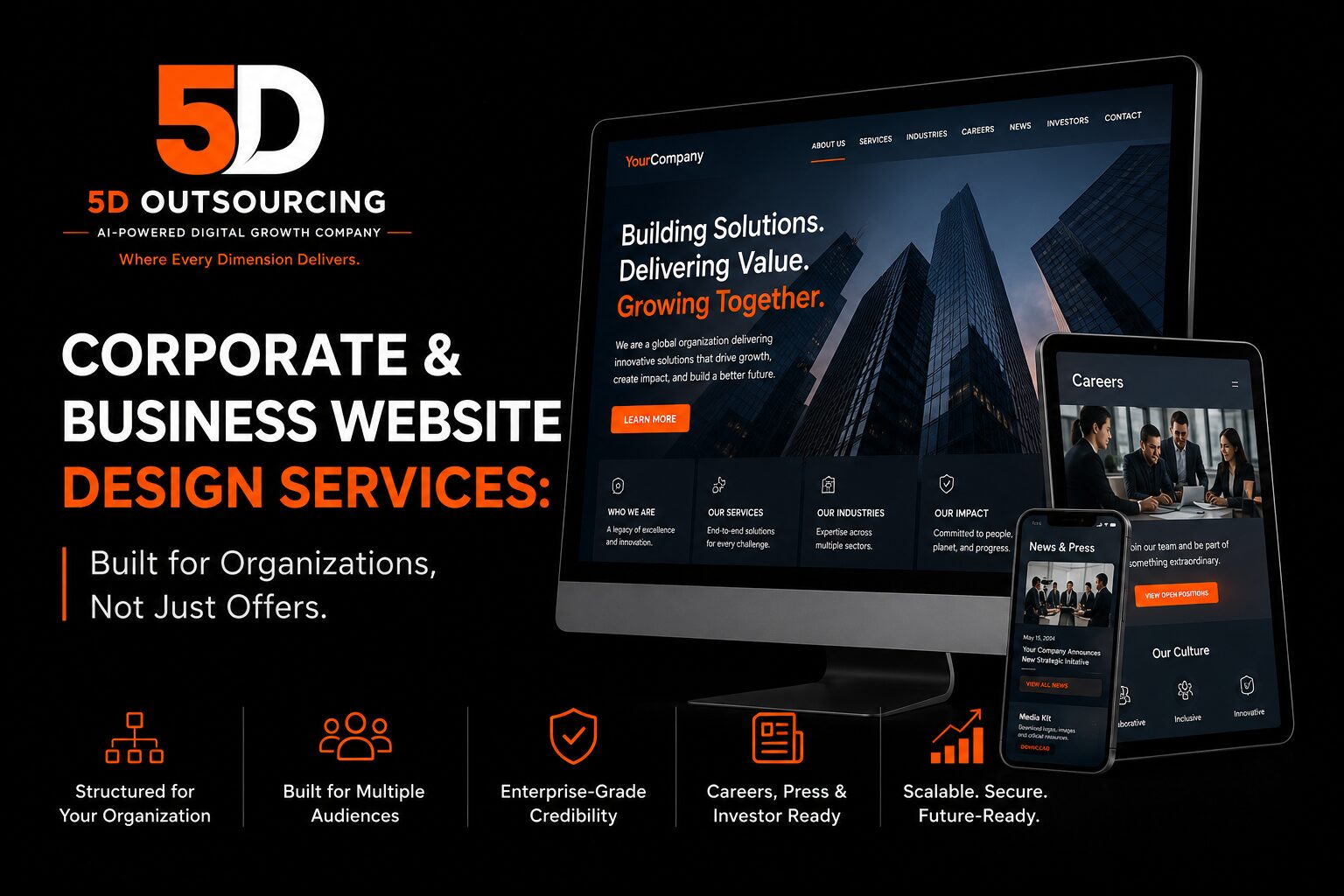
Corporate & Business Website Design Services: Built for Organizations, Not Just Offers
A corporate website solves a different problem than a small business website. An SMB site usually needs to explain one core offer clearly and convert a visitor into an inquiry. A corporate website has to represent an entire organization — multiple departments, multiple stakeholders, multiple audiences ranging from prospective clients to job applicants to press and investors — and do it in a way that satisfies internal brand governance as much as external visitors. Treating a corporate website build like a slightly larger version of a standard business site tends to produce a site that looks the part but structurally can’t do the job an organization actually needs it to do.
At 5D Outsourcing, corporate and business website design sits alongside our standard business website design and development services and our WordPress website development services, but it’s built for a distinctly different buyer — one managing a larger organization, more stakeholders, and requirements that go well beyond a single-offer service site. This article explains what actually separates corporate website design from SMB website design, and what a corporate build needs to get right.
Why Corporate Websites Are a Different Brief Than SMB Sites
The distinction isn’t primarily about size or page count. It’s about who the site has to serve, how many people have to sign off on it, and how much of the organization it has to represent accurately.
Multiple stakeholders, multiple approval layers
An SMB website project usually has one or two decision-makers. A corporate website project typically involves marketing, executive leadership, HR, legal or compliance, and sometimes investor relations — each with legitimate requirements the site has to satisfy simultaneously. A build process that doesn’t account for this structure from the start tends to run into repeated rounds of conflicting feedback late in the project, when changes are far more expensive to make.
The site has to represent an organization, not a single offer
An SMB site is usually built around a handful of services and a clear conversion path. A corporate site has to represent an entire organization’s structure — divisions, subsidiaries, service lines, leadership, history — while still giving each individual visitor a clear path to what they actually came for, whether that’s a specific business unit’s offering, a job listing, or a press contact.
Audiences beyond the customer
Corporate websites serve visitors who aren’t customers at all — job applicants researching the company before applying, journalists looking for press contacts and media assets, and in some cases investors or partners looking for corporate governance information. Each of these audiences needs its own section, built with their specific needs in mind, not folded awkwardly into a customer-facing homepage.
Brand governance at organizational scale
Larger organizations typically operate under formal brand guidelines — approved color palettes, typography, logo usage rules, tone of voice — that a website build has to follow precisely, not interpret loosely. This is a meaningfully different design constraint than an SMB project, where brand identity is often being defined for the first time rather than applied from an existing governance document.
What a Corporate Website Actually Needs
Information architecture built around departments and audiences
Rather than a flat structure built around a single conversion path, corporate sites need navigation that serves distinct audiences cleanly — a business/services section for prospective clients, a careers section for job applicants, a company/about section covering leadership and history, and where relevant, a press or media section and an investor relations area. Getting this architecture right early prevents the common failure mode of a corporate site trying to force every visitor through the same navigation path regardless of what they actually need.
Leadership and executive presence
Executive bios, leadership team pages, and organizational structure content build the credibility and transparency that corporate audiences — particularly B2B prospects and press — specifically look for. This plays a similar trust-building role to the practitioner credential pages covered in our healthcare website work, adapted to a corporate leadership context rather than a medical one.
Careers and talent acquisition pages
A dedicated careers section — company culture content, open positions, and a clear application process — serves an audience that has nothing to do with the site’s commercial conversion goals but matters directly to the organization’s ability to hire. This is frequently underbuilt on corporate sites that focus entirely on customer-facing content and treat careers as an afterthought.
Press, media, and investor relations sections
For organizations that interact with press or investors, dedicated sections with press releases, media assets, and relevant corporate governance information give journalists and stakeholders a direct, self-service path to what they need — reducing the volume of ad hoc requests that otherwise land directly on a marketing or communications team.
Multi-language and multi-region support
Organizations operating across Egypt and into the GCC often need full bilingual Arabic and English support, and in some cases region-specific content variations, built with proper RTL layouts rather than a partial or bolted-on translation. This follows the same bilingual approach we build into other industry site work, applied at organizational scale.
Integration with internal systems
Corporate sites frequently need to connect with CRM platforms for lead routing, HR systems for job application processing, or other internal tools — integration requirements that rarely come up on a standard SMB site build and need to be scoped and planned deliberately rather than discovered mid-project.
Design That Reflects Corporate Brand Standards
Corporate design work generally starts from an existing set of brand guidelines rather than defining brand identity from scratch — meaning the design process is less about creative exploration and more about disciplined, precise application of an already-approved visual system across a much larger number of page templates and content types. This requires a different design workflow than an SMB project, with more structured review cycles built around the organization’s actual approval chain.
Security, Compliance, and Governance Considerations
Larger organizations often have specific security and compliance requirements — data handling standards, accessibility considerations, and in some cases industry-specific regulatory requirements — that need to be addressed at the architecture and hosting level, not treated as an afterthought once the site is otherwise complete. Secure hosting infrastructure, proper SSL implementation, and careful handling of any forms collecting business or personal data should be built in from the start.
SEO Foundations for Corporate Websites
Corporate SEO needs the same technical foundation covered in our technical SEO audit checklist and on-page SEO optimization guide, but applied across a structurally more complex site — multiple service lines, multiple location or regional pages where relevant, and a larger overall page count that needs a logical hierarchy rather than a flat structure. Where an organization serves specific cities or regions, this should connect to the same local SEO principles covered in our local SEO strategy guide.
The Corporate Website Build Process
Corporate website projects generally move through discovery and stakeholder alignment, information architecture planning across departments and audiences, design built against existing brand guidelines, development with any required system integrations, and a structured multi-stakeholder review process before launch — a longer and more formally structured process than a standard SMB site build, reflecting the larger number of legitimate stakeholders who need to sign off along the way.
Corporate vs. SMB Website Development: Choosing the Right Path
Not every business needs a corporate-scale website build. Our standard business website design and development services and WordPress website development services are built for businesses with a clearer, smaller-scale need — a focused service offering, a single decision-maker, and a straightforward conversion path. Corporate website design is the right path specifically for organizations managing multiple stakeholders, multiple audiences beyond customers, and formal brand governance requirements that a standard SMB build isn’t scoped to handle.
What Corporate Website Design Typically Costs in Egypt
Corporate website projects generally require more scope than a standard business site, given the additional information architecture planning, multi-stakeholder review process, and any system integrations involved. For a general framework on how website development costs are structured in Egypt, see our website development cost guide — corporate projects should be scoped against that baseline with the added organizational complexity factored in.
Common Mistakes in Corporate Website Projects
- Building a flat, SMB-style information architecture that fails to serve distinct audiences like job applicants and press separately
- No formal stakeholder alignment process, leading to conflicting feedback rounds late in the project
- Treating careers pages as an afterthought despite their real importance to talent acquisition
- Inconsistent application of existing brand guidelines across page templates
- No plan for CRM, HR system, or other internal tool integration until late in the build
- Ignoring multi-language requirements for organizations operating across Egypt and the GCC
- Weak technical SEO foundations that limit visibility despite a much larger page count
Frequently Asked Questions
How is a corporate website different from a standard business website?
A corporate website is built to represent an entire organization across multiple audiences — customers, job applicants, press, and sometimes investors — with a more complex information architecture and a formal multi-stakeholder approval process, compared to a standard business site built around a single offer and a straightforward conversion path.
Do corporate websites need a careers section?
Most organizations of meaningful size benefit from a dedicated careers section, since job applicants often research a company’s website before applying, and a well-built careers page directly supports talent acquisition even though it serves an audience unrelated to the site’s commercial goals.
Can a corporate website be built on WordPress?
Yes. WordPress can support corporate-scale sites when the information architecture, custom templates, and any required integrations are planned properly — see our WordPress website development services for the underlying platform capabilities this builds on.
Does a corporate website need multi-language support?
Organizations operating across Egypt and the GCC typically need full bilingual Arabic and English support with proper RTL layouts, particularly where the organization serves both Arabic-speaking and international audiences.
How long does a corporate website project typically take?
Corporate projects generally take longer than standard business sites, given the additional stakeholder alignment, information architecture planning, and structured review cycles involved — timelines should be scoped individually based on organizational complexity and any system integrations required.
How 5D Outsourcing Builds Corporate Websites
5D Outsourcing builds corporate and business websites for larger organizations in Cairo and across Egypt, distinct from our SMB-focused website design and development services. Our corporate website work typically includes:
- Information architecture planning built around departments, audiences, and stakeholder requirements
- Design work applied precisely against existing corporate brand guidelines
- Dedicated careers, press/media, and investor relations sections where relevant
- Multi-language architecture with full bilingual Arabic/English support
- Integration with CRM, HR, and other internal systems where required
- SEO-native technical foundations built to support a larger, more complex site structure
- Secure hosting through our web hosting and domain services
This work sits within our broader website development services and connects to our core digital marketing and AI Search capability, giving organizations the same structured, integrated approach we apply across every industry we work with.
Leave a Reply