
No products in the cart.
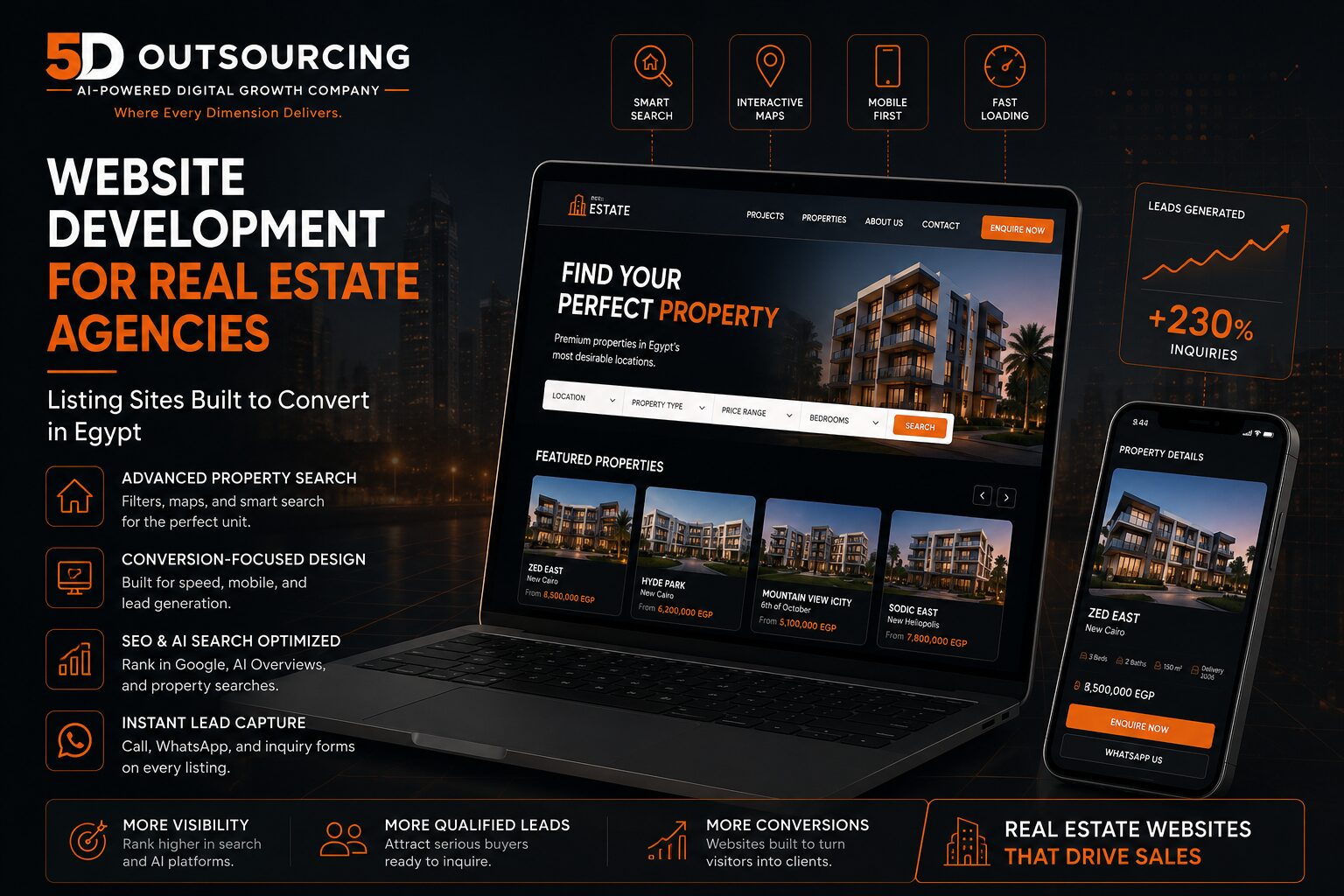
Website Development for Real Estate Agencies: Listing Sites Built to Convert in Egypt
A real estate website is not a smaller version of a corporate brochure site. It has to do something most business websites never attempt: let a visitor search, filter, and compare dozens or hundreds of individual units across multiple projects, then move from browsing to a phone call or WhatsApp message without losing patience along the way. A generic small-business website template — a homepage, an about page, a contact form — simply isn’t built for that job.
This is the third piece of the real estate growth system we build at 5D Outsourcing, alongside our SEO services for real estate agencies and Google Ads management for real estate, all anchored to our digital marketing and AI Search work for real estate companies in Egypt. This article explains what makes a real estate website build fundamentally different from a standard business website, and what a property-focused site needs to actually convert visitors into qualified leads.
Why Real Estate Websites Are a Different Build Brief
Most business websites need to explain a service and generate an inquiry. A real estate website needs to do that while also functioning as a searchable property catalog — closer to a lightweight e-commerce platform than a standard service-business site. That distinction shapes almost every technical and design decision that follows.
Listing and search functionality, not just static pages
Buyers expect to filter properties by location, price range, unit type, number of bedrooms, delivery date, and payment plan — and to do it quickly, without waiting on slow page loads between every filter change. A site built on static pages for each property, with no real search or filtering layer, forces visitors to browse manually through everything you have listed, which is exactly the kind of friction that sends them to a competitor’s site or a property portal instead.
Image and media weight that has to be managed carefully
Property listings live or die on photography, floor plans, and increasingly video or 360° virtual tours. That media is essential to the buying decision, but it’s also the single biggest threat to page speed on a real estate site if it isn’t optimized properly. A slow-loading gallery on a unit page is one of the most common reasons real estate sites lose visitors before they ever see a floor plan.
Mobile is not a secondary consideration
A large share of property research in Egypt happens on mobile devices — browsing listings on a commute, comparing units in a family group chat, filling out an inquiry form from a phone. A real estate site that treats mobile as an afterthought to a desktop-first design is working against how most of its actual traffic behaves.
Lead capture needs to work at every stage, not just at the end
A generic business website often has a single contact page. A real estate site needs inquiry paths built into individual listing pages, project pages, and search results — because a buyer interested in one specific unit shouldn’t have to leave that page and hunt down a general contact form to ask about it.
Core Features a Real Estate Website Actually Needs
Property listing pages built around buyer decisions
Each unit or project should have a dedicated page with unit specifications, pricing or price ranges, floor plans, payment plan terms, delivery date, location context, and photography — organized so a visitor can find the specific information that drives a real estate decision without scrolling through irrelevant marketing copy first.
Search and filtering that actually narrows results
Functional search filters — location, property type, price range, bedrooms, delivery date — are what separate a real listing platform from a digital brochure. This is one of the clearest differences between a real estate website and a standard business site, and it’s usually where template-based, non-custom builds fall short.
Interactive maps and location context
Buyers weigh location as heavily as the unit itself — proximity to schools, main roads, other compounds, commercial areas. Map integration on listing and project pages gives that context directly, rather than forcing a visitor to cross-reference an external map on their own.
Fast-loading galleries and virtual tour support
Photography and video should be compressed and served responsively so a 20-image gallery doesn’t collapse page speed on mobile. Where virtual tours or 360° walkthroughs are used, they should load on demand rather than forcing every visitor to download that weight just to view a listing.
Lead capture on every meaningful page
Inquiry forms, click-to-call, and WhatsApp buttons should appear on individual listing pages and project pages, not only on a general contact page. This mirrors the lead-capture approach we build into real estate Google Ads campaigns — every entry point into the site should give a visitor an immediate way to act.
Agent and developer profiles for trust
For brokerages and agencies working with multiple agents, dedicated agent profile pages with contact details and active listings help buyers feel they’re reaching a specific person rather than a faceless inquiry form — a meaningful trust signal in a transaction as significant as a property purchase.
Bilingual Arabic and English support
Real estate buyers in Egypt search and browse in both Arabic and English, and GCC-facing developments often need to serve both audiences from the same platform. A real estate site should support full RTL Arabic layouts alongside English, not a partial translation bolted onto an English-first template.
Technical Foundations That Support Search Visibility
A real estate website’s structure directly affects whether it can compete in organic search and AI-generated answers, which is why website development and SEO can’t be planned separately for this category.
SEO-native architecture from the build stage
Clean URL structures per project and unit type, proper heading hierarchy, and crawlable listing pages need to be built in from day one — retrofitting SEO structure onto an already-built listing site is far more work than designing it correctly the first time. This is covered in more depth in our technical SEO audit checklist.
Structured data for property listings
Schema markup on listing pages helps search engines and AI systems understand unit specifications, pricing, and location as structured data rather than unstructured text — supporting both traditional search visibility and inclusion in AI-generated property comparisons.
Page speed as a ranking and conversion factor
Slow-loading listing pages hurt both search rankings and conversion rates simultaneously. Image compression, lazy loading for galleries, and efficient hosting infrastructure aren’t cosmetic choices on a real estate site — they directly affect how many visitors stay long enough to submit an inquiry. Our guide on UX optimization and conversion rates covers this relationship in more detail.
Local SEO integration
A real estate website should be built to support the local search work covered in our local SEO strategy guide and Google Business Profile optimization — location pages, consistent business information, and content structured around the neighborhoods and compounds a developer or agency actually serves.
Conversion Design: Turning Browsers Into Qualified Inquiries
Traffic to a real estate site is worthless if it doesn’t produce inquiries the sales team can follow up on. A few structural decisions have an outsized effect on conversion:
- Inquiry forms on listing pages, not just a general contact page — capture interest at the moment it’s highest
- WhatsApp as a first-class contact option, not an afterthought — reflecting how Egyptian buyers actually prefer to reach out
- Clear pricing or price-range signals on listing pages, since hiding pricing behind an inquiry form often filters out serious buyers along with unserious ones
- Fast page loads on mobile, where a meaningful share of real estate browsing happens
- Simple, short inquiry forms that ask only what’s needed for a sales team to follow up effectively
These principles are covered more broadly in our landing page optimization guide and conversion funnel guide, both of which apply directly to how individual property pages should be structured.
What a Real Estate Website Build Typically Costs
Real estate websites generally sit above standard business website pricing because of the additional development work required for listing search, filtering logic, map integration, and multi-agent or multi-project architecture. For a general framework on how website development costs are structured in Egypt, see our website development cost guide — real estate builds should be scoped against that baseline with the added complexity of listing functionality factored in, rather than priced as a standard brochure site.
Common Mistakes in Real Estate Website Builds
- Using a generic business website template with no real search or filtering functionality
- Uncompressed, unoptimized property photography that collapses page speed
- Contact forms only on a general contact page, missing inquiries at the listing level
- No WhatsApp integration, despite it being a primary contact channel for Egyptian buyers
- Desktop-first design that performs poorly on the mobile traffic that makes up most real estate browsing
- No structured data on listing pages, limiting visibility in both search engines and AI-generated answers
- English-only builds that ignore Arabic-speaking buyers and GCC-facing audiences
How 5D Outsourcing Builds Real Estate Websites
5D Outsourcing develops real estate websites for developers, brokerages, and agencies in Cairo, New Cairo, Maadi, and across Egypt as part of the same integrated growth system behind our real estate SEO and Google Ads work. Our real estate website builds typically include:
- Property listing and search functionality with filtering by location, price, type, and delivery date
- SEO-native architecture and structured data built in from the start, not retrofitted later
- Optimized, fast-loading galleries and virtual tour support
- Lead capture — forms, click-to-call, and WhatsApp — built into listing and project pages
- Interactive map integration for location context
- Full bilingual Arabic/English support with proper RTL layouts
- Hosting and technical infrastructure through our web hosting and domain services
This work connects directly to our broader website design and development services and completes the three-part real estate service set alongside real estate SEO and real estate Google Ads management, all coordinated through the same digital marketing and AI Search system.
Leave a Reply