
No products in the cart.
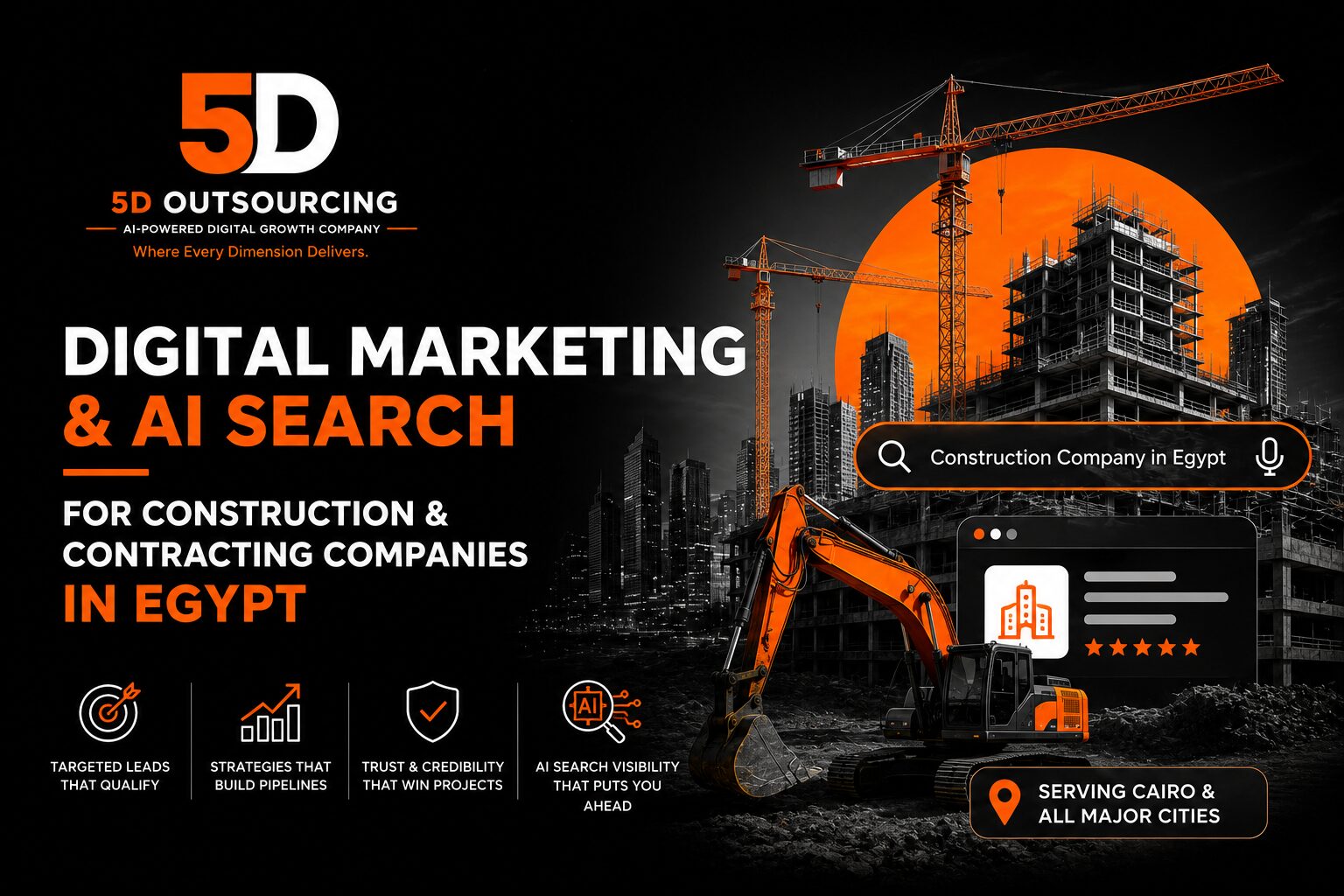
Digital Marketing & AI Search for Construction & Contracting Companies in Egypt
A construction or contracting company rarely wins a client through a single ad click. Most projects — residential developments, commercial fit-outs, infrastructure work — involve a long evaluation process with multiple decision-makers weighing in: a property developer’s project team, an architect recommending contractors, a business owner comparing bids for a commercial build-out. Digital marketing for construction companies has to support that entire evaluation process, not just generate a lead and hope the sales team can close it from there.
At 5D Outsourcing, we build digital marketing and AI Search systems for B2B and project-based businesses across Egypt, including construction and contracting companies competing for residential, commercial, and infrastructure work. This article explains what makes construction marketing structurally different from consumer-facing industries, and what a real digital growth strategy for a contracting company in Egypt actually needs to include.
Why Construction Marketing Needs a Different Approach
Construction sits at an unusual intersection: it’s B2B in the sense that many clients are developers, architects, or businesses rather than individual consumers, but it also often involves large residential and commercial projects with individual property owners directly. Either way, the sales cycle and evaluation process look nothing like a standard consumer purchase.
Long sales cycles with multiple stakeholders
A construction contract rarely closes on a single interaction. It typically moves through initial research, a request for proposal or quote, site visits, reference checks, and negotiation — often involving a project owner, an architect or engineer, and sometimes a project management firm, each evaluating the contractor from a slightly different angle. Marketing built around a quick, single-touch conversion path doesn’t reflect how this decision actually gets made.
Portfolio and past project evidence matter more than almost any other trust signal
Prospective clients evaluating a contractor want to see real, verifiable evidence of past work — completed projects similar in scale and type to what they’re planning, with photography, project details, and where possible, client references. This is arguably the single most important trust-building asset a construction company’s digital presence can have, more than testimonials or general marketing copy.
Service area and project type both define relevant search intent
A contractor’s relevant market is usually bounded geographically — the areas they can realistically service — and by project type — residential, commercial, industrial, infrastructure, renovation versus new build. Marketing needs to be structured around both dimensions simultaneously, since a search for “commercial fit-out contractor New Cairo” and “residential villa contractor Maadi” represent genuinely different audiences even though both fall under construction broadly.
Credentials, certifications, and safety records carry real weight
For commercial and infrastructure work in particular, relevant certifications, safety records, and demonstrated compliance capability are often part of what a prospective client or their project team is evaluating — closer to the credential-based trust signals covered in our healthcare and legal marketing work than to typical consumer marketing.
SEO for Construction Companies
Service and project-type pages, not one generic services list
A contracting company offering residential builds, commercial fit-outs, renovations, and infrastructure work needs dedicated pages for each major service and project type — explaining scope, typical project scale, process, and relevant experience — following the same on-page depth covered in our on-page SEO optimization guide, applied to construction service categories rather than a flat list of capabilities.
A real, structured project portfolio
Individual project case studies — photography, project scope, timeline, and where the client is willing, a reference or testimonial — should be built as their own structured content rather than a scattered image gallery with no context. This portfolio content also feeds directly into SEO, since project-specific pages can rank for the kind of specific, comparison-driven searches prospective clients actually run when evaluating contractors.
Local SEO for service areas across Cairo and Egypt
Construction work is inherently local, making the foundations covered in our local SEO strategy guide and Google Business Profile optimization guide particularly relevant. A well-optimized Google Business Profile, consistent business information, and content that clearly signals which areas and districts a company actually services all support visibility for the location-based searches that dominate this category.
Content that demonstrates real technical knowledge
Content explaining construction processes, material choices, timelines, and common project considerations — written with genuine technical depth, not generic marketing language — builds the topical authority covered in our SEO content strategy guide, while also giving architects, project managers, and property owners a reason to trust the company’s expertise before ever picking up the phone.
A technically sound website as the foundation
As with any SEO strategy, this content and portfolio work performs best on a technically healthy site — proper indexing, fast load times, and clean structure, covered in our technical SEO audit checklist.
Google Ads for Construction and Contracting Companies
High-value keywords with long consideration windows
Construction keywords often carry meaningful cost-per-click given the high value of individual contracts, but the searches themselves span a wide range of intent — from early research (“how to choose a contractor”) to clearly transactional (“commercial contractor quote New Cairo”). Campaigns should separate these intent levels clearly rather than bidding on everything at the same priority.
Campaigns segmented by service and project scale
A company handling both small residential renovations and large commercial builds should run separate campaigns for each, since the keywords, ad messaging, and even the landing page a searcher expects to see differ substantially between a homeowner planning a renovation and a developer sourcing a commercial contractor.
Landing pages built around request-for-quote, not a generic contact form
Given the project-based nature of construction sales, landing pages should be structured around a clear request-for-quote or consultation process — asking for enough project detail (type, scope, rough timeline, location) to let the sales team follow up meaningfully, rather than a generic single-field contact form that produces vague, hard-to-qualify inquiries. This connects to the same principles in our landing page optimization guide, adapted for a longer, more detailed intake process.
Call tracking and lead qualification
Given how much construction inquiry activity happens by phone, particularly for larger or more urgent projects, call tracking should be standard, and campaign performance should be measured against qualified inquiries — real project leads a sales team can pursue — rather than raw click or form-submission volume, which can be misleading in a category with this much variation in inquiry quality.
Website Development for Construction Companies
A portfolio-first architecture
The site’s information architecture should make the project portfolio genuinely easy to browse and filter — by project type, scale, or location — rather than burying past work in a small, static gallery. For a category where portfolio evidence is the single strongest trust signal available, this is one of the highest-leverage design decisions a construction company’s website can make.
Multi-stakeholder navigation, similar to corporate site structure
Given that construction clients can range from individual homeowners to developers and project management firms, site navigation should serve these different audiences clearly — echoing the audience-specific structure covered in our corporate website design article, applied to residential versus commercial versus infrastructure client segments rather than departments.
Detailed request-for-quote functionality
Given the project-based, detail-dependent nature of construction inquiries, the site should support a structured quote-request process that captures the information a sales team actually needs to respond meaningfully — project type, approximate scope, location, and timeline — rather than a bare-bones contact form that produces inquiries requiring several follow-up calls just to understand what’s actually being requested.
Mobile performance for field and site-visit research
Architects, project managers, and property owners frequently research contractors while on-site or between meetings, making fast, functional mobile performance a real practical consideration, not just a general best practice — connecting to the mobile-first principles covered in our UX optimization and conversion rates guide.
AI Search and Construction Company Discovery
As covered in our guide to how AI search is changing SEO, project owners and architects increasingly research vendors through AI-assisted search alongside traditional search engines. Being recognized as a credible entity — covered in our entity optimization guide — matters here too: consistent, structured information about a company’s service areas, certifications, and project history helps AI systems confidently reference a construction company when a user asks for contractor recommendations or comparisons.
GCC Expansion for Egyptian Construction Companies
Construction and contracting companies looking to compete for projects across Saudi Arabia, UAE, and the wider GCC face an additional layer of digital authority requirements — demonstrated project experience, regional entity signals, and often Arabic-language content built for GCC-specific audiences rather than an Egypt-only presence. This connects to our broader business development services for companies pursuing regional market expansion alongside their digital marketing strategy.
Measuring Construction Marketing Performance
Given long sales cycles and high individual contract values, performance should be measured on qualified project inquiries and, where trackable, proposals that lead to won contracts — not on traffic or click volume, which say little in a category where a single closed deal can represent significant revenue relative to overall marketing spend. This connects to the same funnel-stage thinking covered in our conversion funnel guide, applied to a longer, more deliberate B2B and project-based buyer journey.
What Construction Digital Marketing Typically Costs in Egypt
Construction marketing campaigns generally require investment scoped around portfolio content development, local SEO across multiple service areas, and PPC campaigns competing for relatively high-cost keywords. For general context on how SEO and PPC investment are typically structured, see our SEO pricing in Egypt guide and PPC cost guide, with construction engagements scoped individually based on service areas, project types, and the extent of portfolio and website work required.
Common Mistakes in Construction Company Marketing
- A weak or scattered project portfolio instead of structured, detailed case studies for past work
- One generic services page instead of dedicated pages for each service and project type
- Running a single broad Google Ads campaign across residential and commercial work instead of segmenting by client type and project scale
- Generic single-field contact forms that produce vague, hard-to-qualify leads
- No local SEO strategy despite how location-dependent the business fundamentally is
- Weak mobile experience despite how often prospective clients research contractors while on-site or between meetings
- Measuring marketing performance on traffic instead of qualified project inquiries and won contracts
How 5D Outsourcing Works With Construction Companies
5D Outsourcing builds digital marketing and AI Search systems for construction and contracting companies in Cairo and across Egypt as part of an integrated growth strategy. Our work for construction companies typically includes:
- Structured project portfolio development connected directly to SEO strategy
- Service and project-type page architecture built for both search visibility and client evaluation
- Local SEO and Google Business Profile optimization across the specific areas a company services
- Google Ads campaigns segmented by client type and project scale, with call tracking and detailed lead capture
- Website design built around portfolio evidence and multi-stakeholder navigation
- Entity optimization and GCC expansion support for companies pursuing regional project work
This work connects to our core digital marketing and AI Search capability, giving construction and contracting companies the same structured, integrated approach we apply across every industry we work with — built around the long sales cycles, portfolio-driven trust signals, and multi-stakeholder decision process that make construction marketing genuinely different from consumer-facing categories.
Chat With Us on WhatsApp →
Get a Digital Marketing Strategy Session →
Leave a Reply