
No products in the cart.
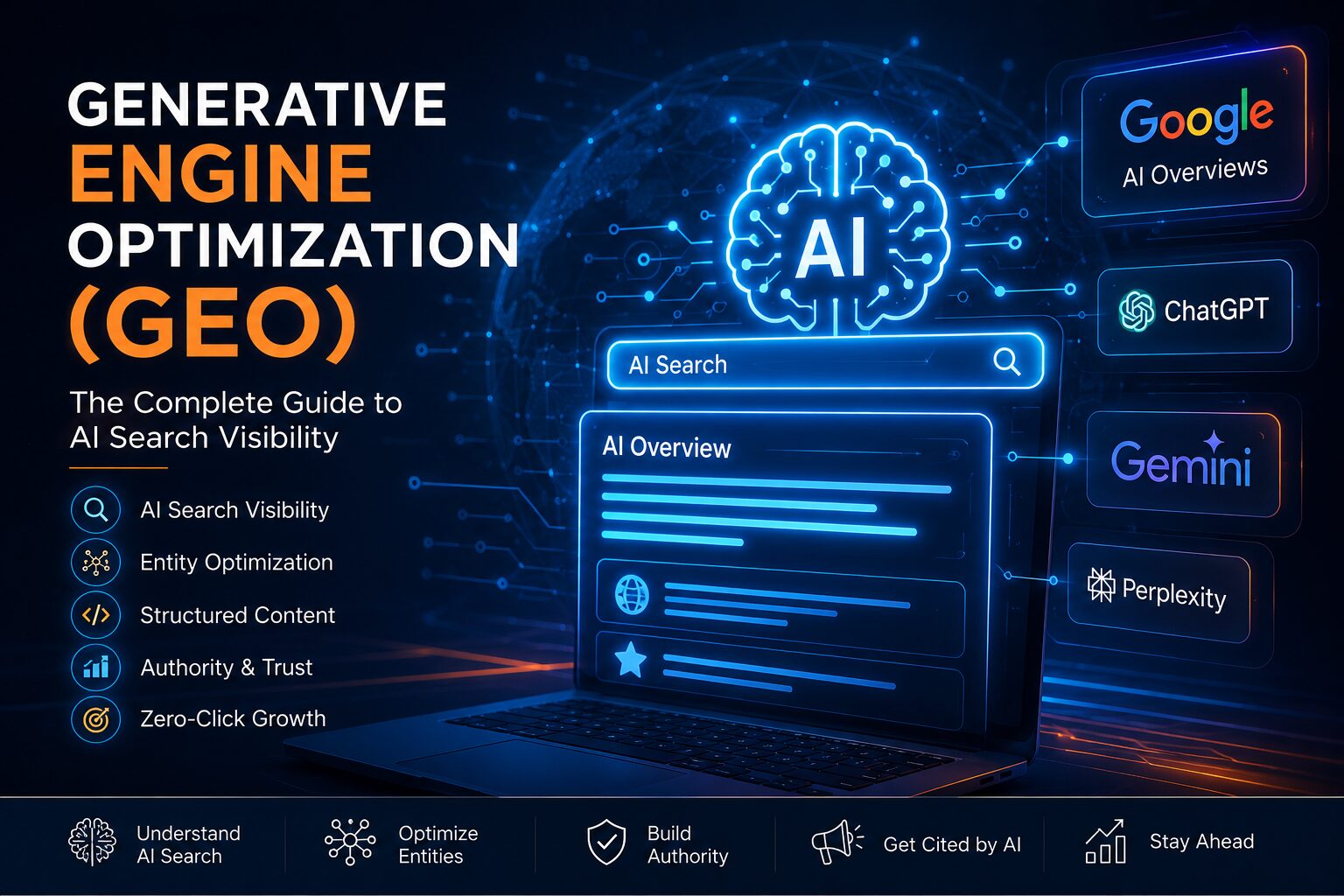
Generative Engine Optimization (GEO): The Complete Guide to AI Search Visibility
Search is changing faster than ever before. For years, businesses focused on ranking web pages in traditional search engine results. Today, artificial intelligence is transforming how information is discovered, interpreted, and presented to users. Instead of simply displaying a list of links, search engines and AI platforms increasingly generate direct answers, summaries, recommendations, and insights.
This shift has created a new challenge for businesses. Ranking on Google is still important, but visibility alone is no longer enough. Brands must now ensure that AI systems can understand their expertise, recognize their authority, and confidently reference their content when generating answers.
This is where Generative Engine Optimization (GEO) becomes essential. GEO is the practice of optimizing your brand, content, website, and digital presence for AI-powered search systems such as Google AI Overviews, ChatGPT, Gemini, Perplexity, and other generative search platforms.
Just as traditional SEO helps websites appear in search engine results, GEO helps businesses become visible within AI-generated responses. Companies that invest in GEO today are positioning themselves for the future of search, where authority, entities, structured information, and trust signals often matter more than keyword rankings alone.
At 5D Outsourcing, we help businesses prepare for this evolution by combining traditional SEO, AI search optimization, conversion-focused content strategies, and technical website improvements into a unified digital growth framework.
If you’re new to AI-powered search, we recommend first exploring our guides on How AI Search Is Changing SEO Forever, AI SEO Strategy, and Google AI Overviews Optimization to understand how search visibility is evolving.
What Is Generative Engine Optimization (GEO)?
Generative Engine Optimization (GEO) is the process of optimizing digital content, brand entities, website architecture, and authority signals so that artificial intelligence systems can understand, trust, and reference your business within AI-generated search results.
Unlike traditional SEO, which focuses primarily on improving rankings for target keywords, GEO focuses on increasing a brand’s visibility within AI-generated answers. The goal is not only to rank pages but also to become a trusted source of information that AI systems choose to cite, summarize, or recommend.
As AI-powered search becomes more common, businesses must think beyond rankings and clicks. Visibility now includes appearing inside AI-generated responses, knowledge panels, AI summaries, entity graphs, and conversational search experiences.
Successful GEO strategies typically focus on:
- Entity optimization and brand recognition
- Structured data and machine-readable content
- Topical authority and subject expertise
- Content quality and factual accuracy
- Internal linking and semantic relationships
- Authority signals across multiple platforms
- AI-friendly content architecture
- Zero-click search visibility
In simple terms, traditional SEO helps search engines understand pages, while GEO helps AI systems understand brands, expertise, and trustworthiness.
Why Generative Engine Optimization Matters for Modern Businesses
Search behavior is changing rapidly. Millions of users now rely on AI-generated answers instead of clicking through multiple websites. Whether someone uses Google AI Overviews, ChatGPT, Gemini, or Perplexity, the goal is often the same: receive an immediate answer without browsing dozens of pages.
This shift creates both challenges and opportunities. Businesses that fail to adapt may experience reduced visibility, lower click-through rates, and declining organic traffic. Meanwhile, organizations that establish strong entity authority and AI search visibility can gain exposure even when users never click a traditional search result.
Generative Engine Optimization helps businesses remain visible in this evolving landscape by improving how AI systems interpret their expertise, services, products, and authority.
- Increase visibility in AI-generated answers
- Strengthen brand authority and trust signals
- Support traditional SEO performance
- Improve zero-click search visibility
- Enhance entity recognition across search platforms
- Create sustainable long-term digital authority
- Improve discoverability across AI ecosystems
Businesses investing in GEO often combine these efforts with SEO Services, Website Design & Development Services, and broader Digital Marketing Services to maximize visibility across both traditional and AI-powered search environments.
How AI Search Works
To understand Generative Engine Optimization, it is important to understand how AI-powered search differs from traditional search engines.
Traditional search engines primarily retrieve and rank web pages based on factors such as relevance, authority, backlinks, content quality, and user experience. Users then choose which result to visit.
AI search systems work differently. Instead of simply displaying links, they analyze information from multiple sources, identify patterns and relationships, and generate direct answers for users.
Modern AI search platforms such as Google AI Overviews, ChatGPT, Gemini, Perplexity, and other large language model systems rely heavily on:
- Entity recognition
- Knowledge graphs
- Structured data
- Topical authority
- Brand credibility
- Semantic relationships
- Content quality and accuracy
- Cross-platform authority signals
This means businesses can no longer rely solely on keyword rankings. They must build clear authority around their brand, services, and areas of expertise so AI systems can confidently understand and reference them.
If you want to understand the factors influencing AI visibility, explore our guide on AI Search Ranking Factors.
Generative Engine Optimization (GEO) vs Traditional SEO
One of the most common misconceptions is that GEO will replace SEO. In reality, the two strategies work together.
Traditional SEO remains essential for attracting traffic from search engines, while GEO expands visibility into AI-generated environments.
- SEO focuses on: rankings, keywords, backlinks, crawlability, and search traffic.
- GEO focuses on: entities, AI visibility, semantic authority, structured information, and brand recognition.
- SEO helps users find pages.
- GEO helps AI systems understand and reference brands.
- SEO measures rankings and traffic.
- GEO measures citations, visibility, and AI mentions.
The strongest digital strategies combine both disciplines. Businesses that invest only in SEO may rank well but remain invisible in AI-generated answers. Businesses focusing only on GEO may struggle to attract traditional organic traffic.
For most organizations, GEO should be viewed as an evolution of SEO rather than a replacement.
Our SEO Services Guide explains how traditional optimization continues to play a critical role in modern search visibility.
GEO vs AEO vs SEO: Understanding the Differences
As AI search evolves, several new optimization terms have emerged. Understanding the difference between GEO, AEO, and SEO helps businesses build a more effective visibility strategy.
SEO (Search Engine Optimization)
SEO focuses on improving rankings in search engine results pages. The primary goal is attracting qualified organic traffic from search engines such as Google and Bing.
AEO (Answer Engine Optimization)
Answer Engine Optimization focuses on helping content appear in featured snippets, direct answers, voice search results, and question-based search experiences.
AEO helps search engines quickly extract concise answers from content.
GEO (Generative Engine Optimization)
Generative Engine Optimization goes further by optimizing brands, entities, authority signals, and content ecosystems for AI-generated search experiences.
Instead of simply answering questions, GEO helps AI systems understand who you are, what you do, and why your business deserves to be referenced.
The future of search visibility will likely require a combination of SEO, AEO, and GEO working together.
Businesses building future-ready search strategies should also explore our AI Search Optimization Checklist and AI Search Visibility Measurement Guide.
Why GEO Is Becoming Essential for Digital Visibility
Google AI Overviews, ChatGPT, Gemini, Perplexity, and other AI systems are changing how users discover information. Many users now receive answers directly without clicking multiple search results.
This shift has accelerated the growth of what many marketers call zero-click search. Users still receive information, recommendations, and guidance, but they often remain within the AI interface rather than visiting multiple websites.
Businesses that establish strong entity authority, structured content ecosystems, and recognizable expertise are more likely to appear within these AI-generated experiences.
If you’re preparing for this shift, our guides on Zero-Click Optimization and Entity Optimization provide deeper insights into building AI search authority.
The Core Components of Generative Engine Optimization
Successful Generative Engine Optimization is not based on a single ranking factor. AI systems evaluate multiple signals to determine whether a business, website, or piece of content is trustworthy enough to be referenced within generated responses.
Organizations that achieve strong AI search visibility typically focus on several interconnected areas that help AI systems understand their expertise, authority, and relevance.
1. Entity Optimization
Entity Optimization is one of the most important foundations of GEO. An entity is a clearly identifiable person, company, brand, service, product, location, or concept that search engines and AI systems can recognize and understand.
Instead of relying solely on keywords, AI search systems increasingly use entities and relationships between entities to determine credibility and relevance.
For example, AI systems should clearly understand that:
- 5D Outsourcing is a digital marketing agency.
- 5D Outsourcing provides SEO services.
- 5D Outsourcing offers website development solutions.
- 5D Outsourcing specializes in AI search optimization.
- 5D Outsourcing operates in Maadi, Cairo, Egypt.
The stronger these entity relationships become across your website and external platforms, the more likely AI systems are to recognize and reference your brand.
Learn more in our complete guide to Entity Optimization.
2. Structured Data and Schema Markup
Structured data helps search engines and AI systems understand website content in a machine-readable format.
Schema markup provides explicit information about:
- Organizations
- Services
- Products
- Articles
- FAQs
- Authors
- Locations
- Reviews
When properly implemented, structured data reduces ambiguity and helps AI systems interpret relationships between content, brands, and topics.
This is one reason why modern GEO strategies often include organization schema, service schema, FAQ schema, article schema, and entity-focused structured data.
3. Topical Authority and Subject Expertise
AI search systems prefer sources that demonstrate consistent expertise across an entire subject area rather than isolated pieces of content.
This is why businesses should build content clusters around their primary services and areas of specialization.
For example, 5D Outsourcing is developing authority around:
- Search Engine Optimization (SEO)
- AI Search Optimization
- Generative Engine Optimization (GEO)
- Google AI Overviews
- Conversion Rate Optimization (CRO)
- Google Ads and PPC Management
- Website Development
- Digital Marketing Strategy
When AI systems repeatedly encounter high-quality content covering related topics, they become more confident in the expertise of that brand.
Businesses seeking long-term authority should also explore our AI SEO Strategy Guide and AI Search Optimization Checklist.
4. AI-Friendly Content Architecture
Content structure plays a major role in AI search visibility. Well-organized content is easier for search engines and AI systems to analyze, interpret, and reference.
AI-friendly content typically includes:
- Clear headings and subheadings
- Logical content hierarchy
- Frequently asked questions
- Structured explanations
- Supporting examples
- Relevant internal links
- Semantic topic relationships
This approach improves both traditional SEO performance and AI readability.
5. Brand Authority Signals
AI systems evaluate authority using signals gathered from across the web rather than relying exclusively on a single website.
Authority signals may include:
- Brand mentions across trusted websites
- Business directory listings
- Industry publications
- Social media profiles
- Expert contributions
- Backlinks from authoritative sources
- Consistent business information
The stronger your brand presence becomes across multiple platforms, the more likely AI systems are to view your business as a credible source.
This is closely connected to our guide on Measuring AI Search Visibility, where businesses can track their growing authority across AI ecosystems.
6. Internal Linking and Topic Clusters
Internal linking remains one of the most powerful but often overlooked components of GEO.
Strong internal linking helps AI systems understand relationships between topics, services, products, and expertise areas.
For example, this GEO guide connects naturally with:
- How AI Search Is Changing SEO Forever
- Google AI Overviews Optimization
- Entity Optimization
- AI Search Ranking Factors
- Zero-Click Search Optimization
- AI SEO Strategy
Together, these interconnected resources help build topical authority and create a stronger AI-readable knowledge ecosystem around your brand.
How Google AI Overviews Use GEO Signals
Google AI Overviews represent one of the most significant shifts in search history. Instead of showing only traditional search results, Google increasingly generates AI-powered summaries that answer user questions directly within the search results page.
To generate these answers, Google evaluates multiple signals, including content quality, entity relationships, topical authority, structured data, user intent, and source credibility.
Businesses that invest in GEO are better positioned to appear within these AI-generated summaries because their content is easier for AI systems to understand, trust, and reference.
Organizations looking to improve visibility in these environments should also review our complete guide to Google AI Overviews Optimization.
How ChatGPT, Gemini, and Perplexity Discover Brands
Many business owners assume AI systems simply read websites and provide answers. In reality, AI-powered search systems evaluate a wide range of signals to determine which brands deserve visibility.
These signals often include:
- Website content quality and expertise
- Entity recognition across the web
- Structured data implementation
- Brand mentions and citations
- Topical authority within a subject area
- Content consistency across platforms
- Technical website quality
- User trust and credibility signals
Businesses that build strong authority ecosystems are more likely to be recognized by AI systems and referenced in generated answers. This is why GEO is becoming a critical component of long-term digital marketing strategy.
To understand how businesses can monitor AI visibility, read our guide on Measuring AI Search Visibility.
How to Build a Successful GEO Strategy
Implementing Generative Engine Optimization requires a structured, long-term approach. Businesses that achieve the strongest AI visibility typically focus on building authority rather than chasing short-term tactics.
- Establish Clear Brand Entities — Ensure your business, services, products, and expertise areas are clearly defined.
- Build Topical Authority — Create comprehensive content clusters around your core services.
- Implement Structured Data — Use schema markup to improve machine readability.
- Strengthen Internal Linking — Connect related content and service pages.
- Improve Technical SEO — Maintain fast, secure, and accessible websites.
- Develop Consistent Brand Messaging — Reinforce expertise across all digital channels.
- Measure AI Visibility — Track citations, mentions, and visibility across AI search systems.
Businesses combining GEO with SEO Services, Google Ads Management, and Website Development Services often achieve stronger long-term visibility and lead generation results.
Common GEO Mistakes Businesses Should Avoid
- Treating GEO as a replacement for SEO.
- Focusing only on keywords instead of entities.
- Ignoring structured data and schema markup.
- Publishing isolated content without topic clusters.
- Neglecting internal linking.
- Building weak brand authority signals.
- Ignoring AI visibility measurement.
- Failing to align content with user intent.
Many of these issues can significantly limit a business’s ability to appear in AI-generated search experiences.
Frequently Asked Questions About GEO
What is Generative Engine Optimization (GEO)?
Generative Engine Optimization (GEO) is the process of optimizing content, entities, authority signals, and digital assets so AI systems can understand, trust, and reference a business within AI-generated search results.
Is GEO different from SEO?
Yes. SEO focuses on ranking pages in traditional search results, while GEO focuses on improving visibility within AI-generated answers and search experiences.
Does GEO replace traditional SEO?
No. GEO complements SEO. The most effective strategies combine traditional search optimization with AI visibility optimization.
Why is GEO important for businesses?
As AI-powered search becomes more common, businesses need to ensure their expertise and authority are visible within AI-generated responses, not just traditional search results.
How can businesses improve AI search visibility?
Businesses can improve AI visibility by strengthening entity optimization, implementing structured data, building topical authority, improving technical SEO, and creating high-quality interconnected content.
The Future of Search Is AI-Driven
Search is evolving beyond traditional rankings. AI systems are becoming the gateway through which users discover information, evaluate businesses, and make decisions.
Organizations that invest in Generative Engine Optimization today are building the foundations for long-term visibility, authority, and digital growth.
By combining SEO, GEO, entity optimization, structured data, technical excellence, and authoritative content, businesses can position themselves for success in the next generation of search.
At 5D Outsourcing, we help businesses build AI-ready digital ecosystems that improve search visibility, strengthen authority, and generate qualified leads through integrated SEO, GEO, website development, and digital marketing strategies.
Start a WhatsApp conversation with our team today and discover how your business can improve visibility in Google AI Overviews, ChatGPT, Gemini, Perplexity, and the next generation of AI-powered search platforms.
Leave a Reply