
No products in the cart.
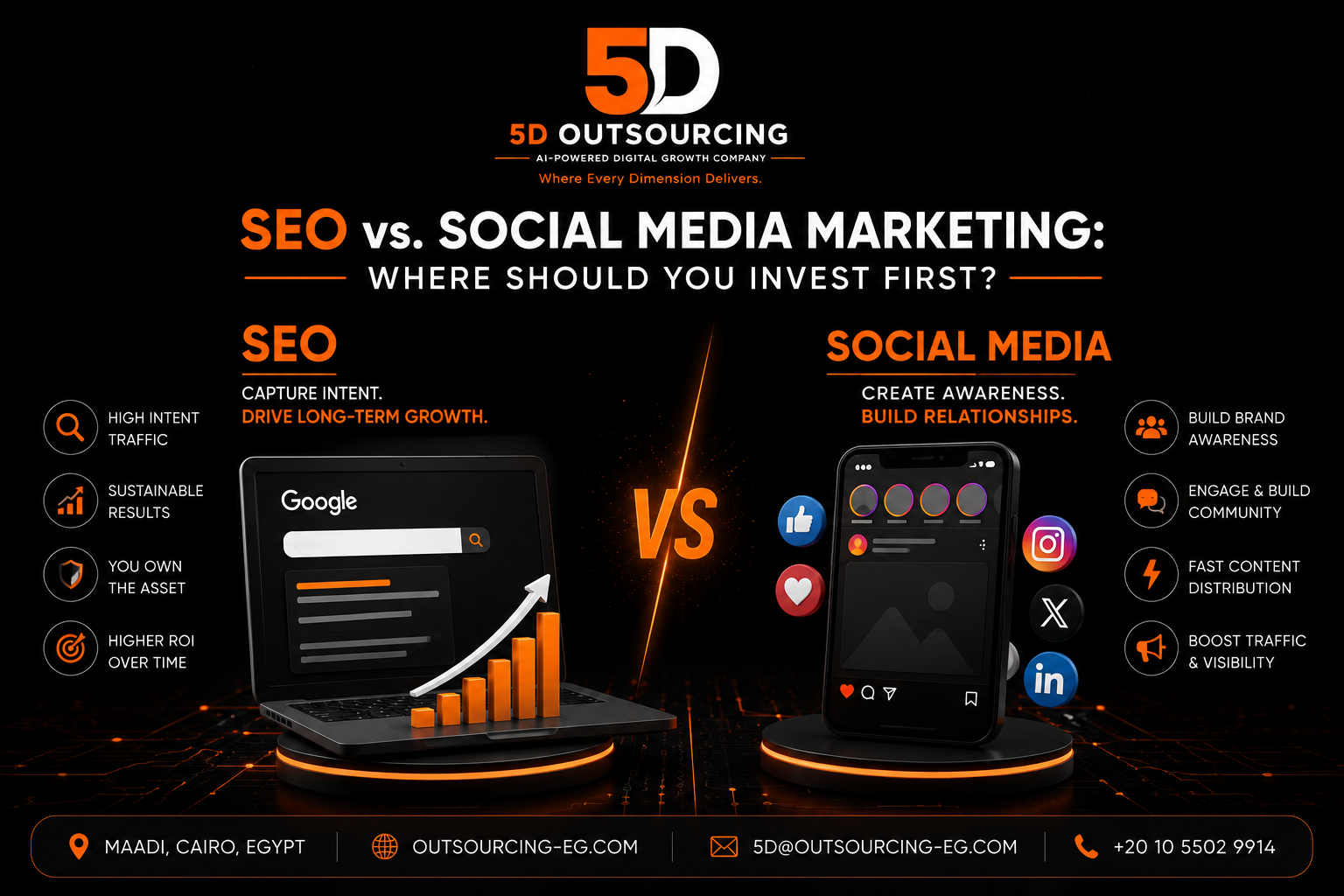
SEO vs. Social Media Marketing: Where Should You Invest First?
This is a genuinely different question from SEO versus Google Ads, even though it gets asked in the same breath. SEO and Google Ads both compete for the same real estate — search engine results pages — with different cost structures. SEO and social media marketing compete for something different entirely: attention in two fundamentally different contexts, one where someone is actively looking for something, and one where they weren’t looking for anything at all until your content interrupted their feed.
The Real Difference: Intent vs. Interruption
SEO captures people who are already searching — they’ve typed a question, a problem, or a product name into Google because they want an answer right now. Social media marketing works the opposite way: it reaches people scrolling through a feed with no active intent related to your business, and earns their attention through content compelling enough to make them stop. Our ultimate guide to SEO and social media marketing guide cover each channel individually in depth; this article focuses on how to decide between them.
How SEO Works: Capturing Existing Intent
You’re meeting a decision someone has already started making
Someone searching “best CRM for small business” or “SEO agency Cairo” has already decided they have a need and started researching it. SEO’s job is to be the answer they find, not to convince them the need exists in the first place.
Content compounds and keeps working
A well-ranked page continues generating traffic for months or years with only maintenance-level ongoing investment, the same compounding value covered in our SEO vs. Google Ads article.
Slower to build, but you own the asset
SEO takes months to show meaningful results, but the content and rankings you build live on your own domain, largely insulated from the kind of sudden algorithm or platform policy change that can upend a social strategy overnight.
How Social Media Marketing Works: Creating Demand and Awareness
You’re reaching people before they know they have a need
Social content works earlier in the customer journey than most SEO content — introducing a brand, a product, or an idea to someone who wasn’t actively searching for it, planting awareness that may turn into an active search later.
Fast content velocity, short individual lifespan
A single social post generally has a lifespan measured in hours or days, not the months or years an SEO article can remain relevant — meaning social requires sustained, ongoing content production to maintain visibility, rather than a body of work that keeps paying off passively.
Built on rented land
Your following, reach, and content all exist within a platform you don’t control — subject to algorithm changes, policy shifts, or even platform decline, in a way your own website and its SEO never are.
Strong for brand-building, community, and direct engagement
Social platforms let you build a direct relationship with an audience, respond in real time, and build the kind of brand familiarity and trust that search rankings alone don’t fully replicate.
SEO vs. Social Media Marketing: Key Differences at a Glance
- User intent: SEO — active, existing intent. Social — passive, interrupted attention.
- Content lifespan: SEO — compounds over months/years. Social — days at most.
- Ownership: SEO — lives on your own domain. Social — lives on a platform you don’t control.
- Funnel stage: SEO — often mid-to-bottom funnel, capturing decision-stage intent. Social — often top-of-funnel, building awareness and consideration.
- Content format: SEO — long-form written content, structured pages. Social — short-form video, image, and native platform content.
- Measurement: SEO — organic traffic, rankings, conversions. Social — reach, engagement, followers, and increasingly, direct conversions through social commerce.
When to Prioritize Social Media Marketing First
- You’re building brand awareness from scratch — a new brand with no existing search demand needs to create awareness before SEO has any search volume to capture.
- Your product or service is visually driven — fashion, food, interior design, and similar categories often perform better on visually native platforms than through written search content alone.
- You’re targeting a younger, platform-native audience that discovers brands primarily through social feeds rather than search engines.
- You need to build community and direct engagement — social platforms remain the most direct channel for real-time interaction with your audience.
When to Prioritize SEO First
- People are already actively searching for what you offer — if there’s meaningful, identifiable search demand for your product or service category, SEO captures intent that already exists rather than trying to create it.
- You’re in a B2B or technical category — buyers in categories like the manufacturing and logistics sectors research primarily through search, not social feeds.
- You need durable, compounding results rather than content that needs to be continually replaced to stay relevant.
- You’re in a trust-sensitive category like healthcare or legal services, where organic search credibility tends to carry more weight than social content.
Why Most Businesses Eventually Need Both
Social media and SEO aren’t really competing for the same job — social builds awareness and demand, SEO captures that demand once it becomes an active search. A business that only invests in social risks having no organic presence to catch the interest it’s generating once someone decides to search. A business that only invests in SEO risks having no visibility with people who aren’t yet actively searching but would respond well to being introduced to the brand. The two channels reinforce each other: social content can drive brand searches that improve SEO signals, and strong SEO content can be repurposed and distributed through social channels, connecting to the content systems covered in our AI content workflows guide.
Budget and Resource Considerations
Social media marketing generally requires more sustained, ongoing content production to maintain visibility, given how short individual post lifespan is — meaning it often demands more continuous resourcing than SEO, which can generate lasting value from content already published. If budget only supports one channel initially, the decision should follow the factors above — existing search demand, category trust-sensitivity, and target audience discovery behavior — rather than which channel feels more immediately engaging to run.
Industry-Specific Considerations
E-commerce and consumer-facing brands, covered in our e-commerce SEO article, often benefit from strong social presence to drive discovery and brand awareness alongside SEO’s role in capturing product-specific search intent. Real estate, covered in our real estate SEO article, often sees strong performance from both — visual social content for awareness, SEO for capturing active property search intent. B2B and technical categories like manufacturing and logistics typically lean more heavily on SEO, since their buyers research through search far more than social discovery.
Common Mistakes When Choosing Between SEO and Social Media
- Treating the two channels as interchangeable rather than serving genuinely different roles in the funnel
- Investing heavily in social with no SEO foundation to capture the demand that awareness eventually generates
- Expecting social engagement metrics to directly predict SEO or search performance, which they don’t reliably do
- Abandoning SEO content because it doesn’t show quick results the way a viral social post can
- Underestimating how much ongoing content production social visibility actually requires to sustain
Frequently Asked Questions
Does social media activity directly improve SEO rankings?
Social signals aren’t a confirmed direct ranking factor, but social activity can indirectly support SEO by driving brand searches, referral traffic, and content visibility that leads to natural backlinks over time.
Which is better for a new business with no existing brand awareness?
Social media marketing is often more effective for building initial awareness from zero, since SEO depends on people already searching for something related to your brand or category, which a brand-new business may not yet have.
Is social media marketing faster than SEO?
Individual social content can generate engagement quickly, but building a following and consistent visibility takes sustained effort over time — SEO is slower to build initially but, once established, requires less ongoing content replacement to maintain visibility.
Should B2B companies prioritize SEO over social media?
Generally yes, since B2B buyers — particularly in technical categories — tend to research through search engines more than social feeds, though social platforms like LinkedIn can still play a role in relationship-building and thought leadership.
Can you run both SEO and social media marketing at the same time?
Yes, and for most established businesses this is the strongest long-term approach, since the two channels reinforce each other rather than compete for the same outcome.
How 5D Outsourcing Helps You Decide
5D Outsourcing helps businesses across Egypt determine the right channel priority based on their actual audience behavior, industry, and growth stage — not a one-size-fits-all recommendation. Whether the right starting point is SEO, social media marketing, or both together, this decision fits within our broader digital marketing and AI Search capability, where every channel is planned as part of one integrated growth strategy.
Leave a Reply