
No products in the cart.
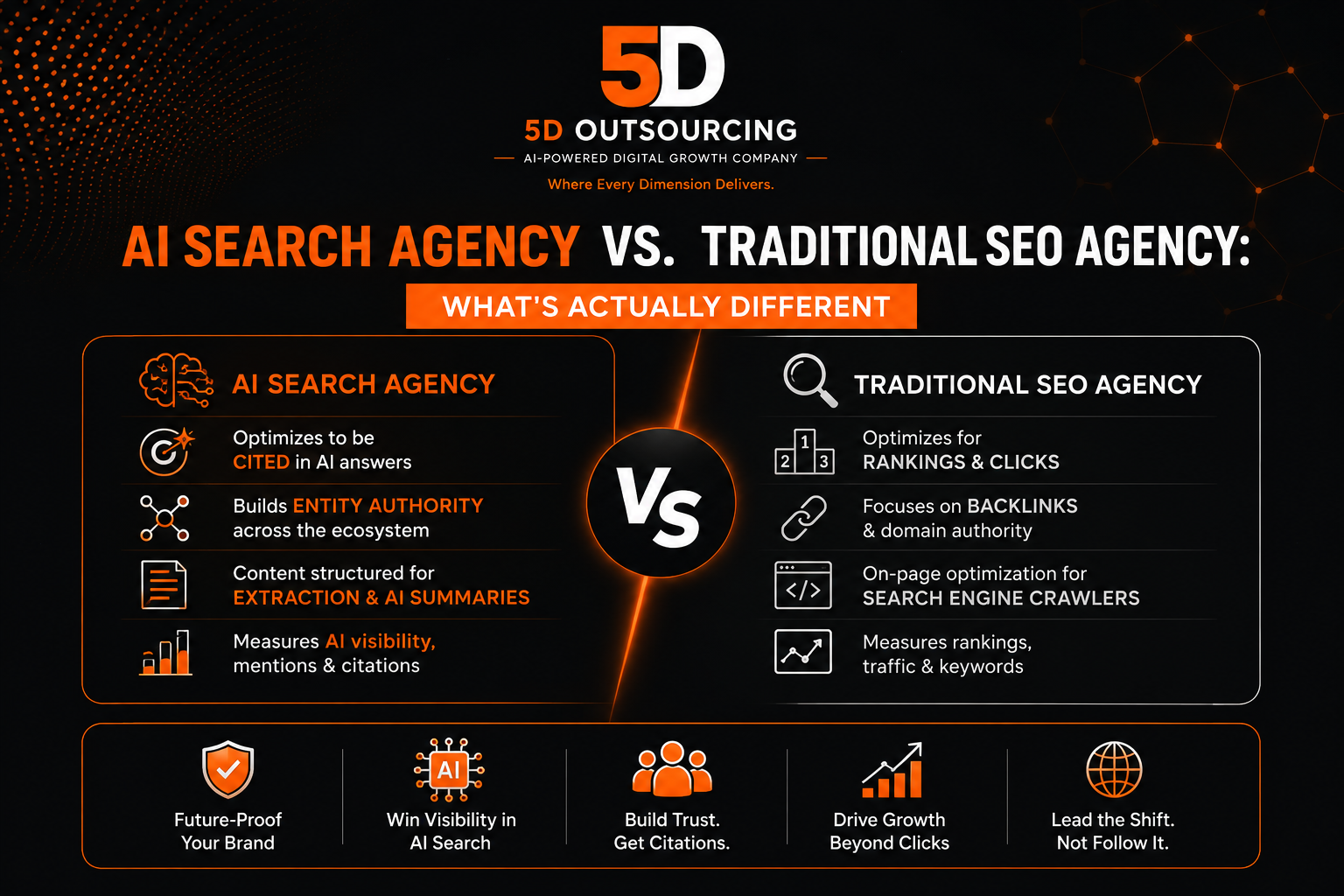
AI Search Agency vs. Traditional SEO Agency: What’s Actually Different
“AI Search agency” has become a popular label almost overnight, and a fair number of agencies using it are simply relabeling the same SEO services they were offering last year. That doesn’t mean the distinction is meaningless — real differences exist between traditional SEO work and genuine AI Search optimization — but it does mean the label alone tells you very little. This article explains what’s actually different, what still overlaps, and how to tell whether an agency’s “AI Search” positioning reflects real capability or just a rebrand.
Why This Comparison Even Exists
As covered in our guide to how AI search is changing SEO, the rise of AI Overviews, ChatGPT, Perplexity, and similar platforms has genuinely changed how a share of search behavior works — more users are getting answers directly from AI-generated summaries rather than clicking through a list of blue links. That shift created real demand for agencies that understand it, and predictably, plenty of agencies responded by adding “AI Search” to their service list without meaningfully changing what they actually do.
What Traditional SEO Agencies Focus On
Keyword targeting and ranking position
Traditional SEO is built around ranking specific pages for specific keywords in traditional search results — the classic blue-link SERP — measured primarily through ranking position and organic click-through traffic.
Backlinks and domain authority
Link building and overall domain authority have long been core traditional SEO levers, based on the logic that other sites linking to yours signals credibility to search engines.
On-page optimization for search engine crawlers
Meta tags, keyword density, heading structure, and page-level optimization aimed at helping search engine crawlers understand and rank a page — the foundational work covered in our on-page SEO optimization guide.
What’s Genuinely Different in AI Search Optimization
Optimizing for citation, not just ranking
AI Search optimization is built around a different goal: being the source an AI system cites or summarizes in a generated answer, which may happen even without the user ever clicking through to your site — the zero-click dynamic covered in our zero-click optimization guide. Ranking position in traditional search results doesn’t directly translate to being cited in an AI-generated summary.
Entity recognition over keyword matching
As explained in our entity optimization guide, AI systems evaluate brands as structured, corroborated entities rather than matching keywords to pages — meaning schema markup, cross-platform consistency, and knowledge graph signals matter in ways traditional keyword-focused SEO never emphasized.
Content structured for extraction, not just readability
AI systems need to be able to pull clear, direct answers from content to summarize accurately. This means structuring content around direct question-answer formats, clear headings, and extractable facts — a different content discipline than writing primarily to satisfy a human reader scanning a results page, covered in our Google AI Overviews optimization guide.
A different, evolving set of ranking signals
Our AI search ranking factors guide covers how relevance, entity trust, topical authority, and technical accessibility combine differently in AI systems than in traditional search algorithms — meaning optimization strategy has to account for signals traditional SEO didn’t need to weight the same way.
Different measurement entirely
Traditional SEO measures rankings and organic click traffic. AI Search performance requires tracking brand mentions and citations within AI-generated answers — a fundamentally different measurement approach covered in our how to measure AI search visibility guide, which most traditional SEO reporting simply isn’t built to capture.
Where They Overlap: AI Search Builds On SEO, It Doesn’t Replace It
This is the part genuine AI Search expertise gets right and lazy rebranding gets wrong: AI systems still rely heavily on the same technical foundation traditional SEO has always required. Crawlability, site speed, clean structure — covered in our technical SEO audit checklist — remain just as necessary for AI Search visibility as they’ve always been for traditional rankings. Content strategy built around genuine topical authority, covered in our SEO content strategy guide, still matters — AI systems favor sources that demonstrate real depth on a topic, not thin content stuffed with keywords. A business doesn’t need to abandon traditional SEO practice to pursue AI Search visibility; it needs to extend that foundation with the entity, structure, and citation-focused work AI systems specifically evaluate.
Red Flags: When “AI Search Agency” Is Just Relabeled SEO
- No mention of entity optimization or structured data — if an agency’s “AI Search” pitch doesn’t include schema markup, entity consistency, or knowledge graph work, it’s likely traditional SEO with a new label.
- No AI visibility measurement or reporting — if reporting only covers traditional rankings and organic traffic, the agency isn’t actually tracking the outcome AI Search work is supposed to produce.
- No distinct content approach — if content strategy hasn’t changed to account for extraction-friendly structure and direct answer formatting, the “AI Search” label isn’t reflected in the actual deliverable.
- Vague claims with no specifics — generic language about “optimizing for AI” without concrete tactics (entity work, structured data, GEO principles) is a sign the positioning is marketing, not methodology.
What to Actually Ask an Agency Claiming AI Search Expertise
- How do you specifically optimize for citation in AI-generated answers, beyond standard SEO practice?
- What entity and structured data work is included, and how is it implemented?
- How do you measure AI Search visibility, and how is that different from your standard SEO reporting?
- Can you show an example of content restructured specifically for AI extraction, versus standard SEO content?
Straight, specific answers to these questions distinguish genuine capability from a relabeled service list — the same due-diligence approach covered more broadly in our guide to choosing an SEO agency.
Do You Need a Separate AI Search Agency, or an SEO Agency That’s Evolved?
Given how much AI Search optimization depends on the same technical and content foundation traditional SEO has always required, the strongest position is generally an agency or team that’s genuinely extended its SEO practice to include entity, structured data, and citation-focused work — not two entirely separate specialists working in isolation. This connects to the same structural reasoning covered in our SEO agency vs. freelancer vs. in-house comparison: a coordinated team covering the full picture generally outperforms disconnected specialists handling separate pieces of the same underlying work.
Common Mistakes in This Decision
- Choosing an agency based on “AI Search” positioning alone without verifying what’s actually different about their methodology
- Assuming AI Search optimization replaces the need for solid technical SEO and content fundamentals
- Working with an agency that can’t explain or demonstrate how they measure AI visibility specifically
- Treating traditional SEO and AI Search as competing services rather than a connected, evolving discipline
- Paying a premium for “AI Search” services that turn out to be standard SEO work with new terminology
Frequently Asked Questions
Is AI Search optimization completely different from SEO?
No. AI Search optimization builds on the same technical and content foundation traditional SEO requires, while adding entity optimization, structured data, and citation-focused strategy that traditional SEO didn’t need to emphasize the same way.
How can I tell if an agency’s AI Search services are genuine?
Ask specifically about their entity optimization methodology, how they measure AI visibility, and whether their content strategy has genuinely changed to account for AI extraction — vague answers or no distinct methodology are signs of a relabeled service rather than real capability.
Do I need to switch agencies if mine hasn’t mentioned AI Search?
Not necessarily, but it’s worth asking your current agency directly what their AI Search approach involves — an agency with strong existing SEO fundamentals is well positioned to extend into genuine AI Search work if they’re willing to do so.
Does AI Search optimization cost more than traditional SEO?
It typically requires additional scope — entity work, structured data implementation, and different measurement — so genuine AI Search work often does cost more than standard SEO, though this should reflect real additional deliverables, not just a price increase attached to a new label.
Will AI Search eventually replace traditional SEO entirely?
Traditional search results and AI-generated answers currently coexist, and the technical and content foundations traditional SEO built remain necessary for AI Search visibility — the discipline is evolving and expanding rather than being replaced outright.
How 5D Outsourcing Approaches This
5D Outsourcing built its AI Search work as a genuine extension of SEO fundamentals, not a rebrand. Our AI Search consulting, audit, and implementation services are built on the same technical SEO discipline covered throughout our work, extended with the entity optimization, structured data, and citation-focused strategy explained in our Generative Engine Optimization guide. We’re happy to walk through exactly what’s included and how it’s measured, rather than asking you to take a label at face value.
Leave a Reply