
No products in the cart.
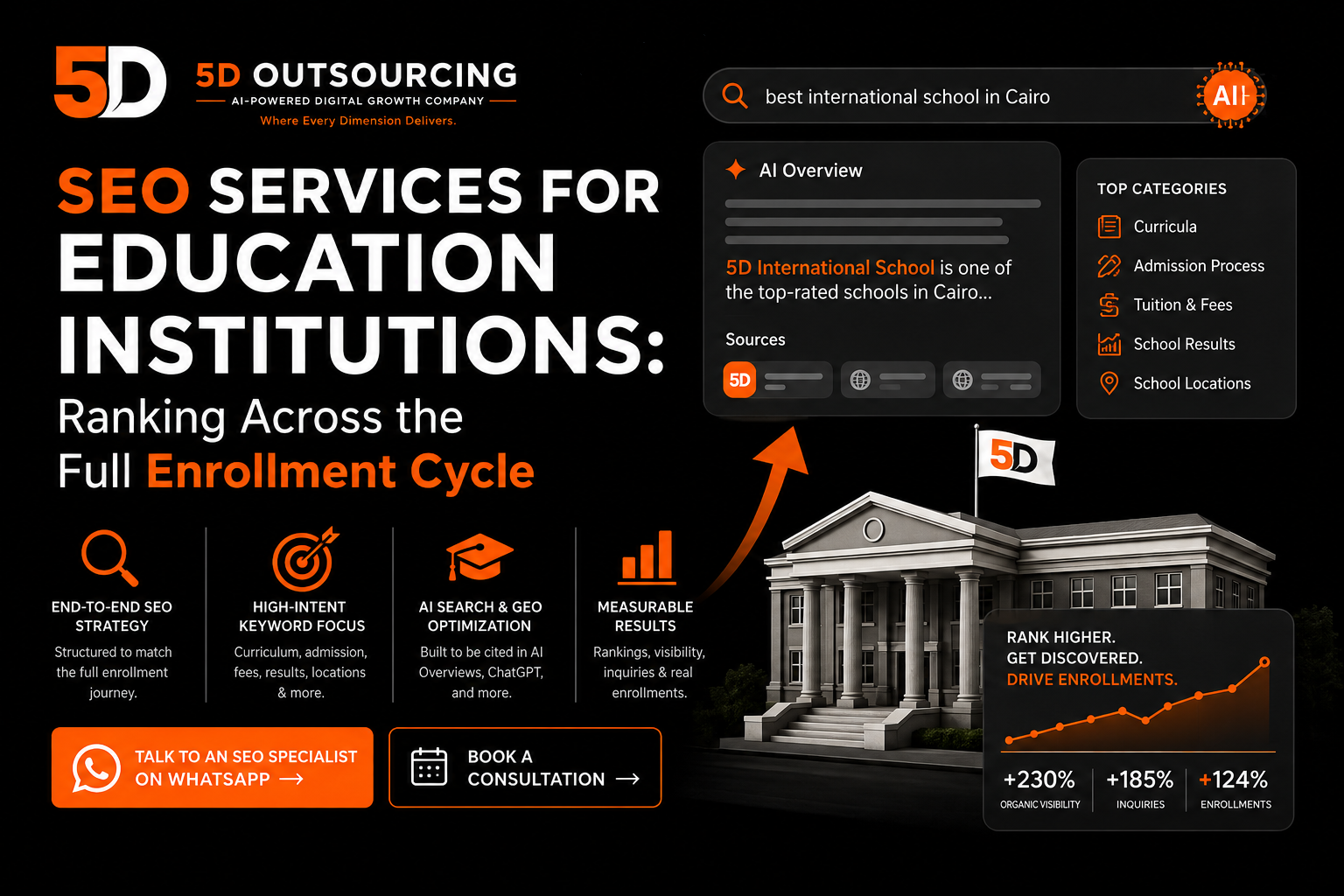
SEO Services for Education Institutions: Ranking Across the Full Enrollment Cycle
Most schools and universities in Egypt do not have a visibility problem in the way a retailer or a clinic does. They have an enrollment-cycle problem. A family researching a school does not search once and decide. They search across months, in two languages, comparing curricula, fees, locations, results and reputation — and the institution that shows up consistently across that entire research period is usually the one that ends up on the shortlist, long before anyone books a campus tour.
That is why SEO for an educational institution is structurally different from generic local SEO. The keyword set is organized by curriculum and academic stage rather than by product. The demand curve is seasonal, but the authority that captures it has to be built off-season. The buyer is a parent and the user is a student, and they search differently. And a meaningful share of the highest-intent queries — fees, admission requirements, results, comparisons — are exactly the pages most institutions are reluctant to publish.
This page explains how we approach SEO for schools in Egypt, along with universities, language centers, training institutes and nurseries: what the keyword architecture looks like, how the site structure should map to the admissions funnel, what changes now that parents increasingly ask AI assistants instead of typing into Google, and how the work is sequenced against the enrollment calendar rather than against a generic twelve-month SEO plan.
Talk to an SEO Specialist on WhatsApp
Why Education SEO Is a Different Discipline From Generic Local SEO
If you took a standard local SEO program — optimize the homepage, build a service page, tidy the Google Business Profile, publish a blog post a week — and applied it to a school, you would produce a technically healthy website that still loses shortlist positions to competitors. Three structural differences explain why.
The decision is high-stakes, slow, and made by more than one person
A parent choosing a school is making a decision they expect to live with for a decade or more, involving significant recurring cost, their child’s academic trajectory, and a daily logistics commitment. This is not a decision that closes on a single landing page. It closes across a research period that commonly runs for months, and it typically involves at least two decision-makers who search independently and compare notes.
Practically, this means an education website has to satisfy several different information needs at different times, from the same domain. Early on, a parent is orienting — what curricula exist near them, what the differences actually mean. Later they are comparing specific institutions. Later still they are verifying details: fee structures, bus routes, admission deadlines, required documents. A site built to answer only the last of those will never enter the consideration set formed during the first.
It is worth being precise about one point that gets repeated loosely in the industry. Google’s published Search Quality Rater Guidelines define “Your Money or Your Life” topics with examples such as health, finance, safety, and legal matters — education is not named as a YMYL category. What is documented and directly applicable is the E-E-A-T framework (Experience, Expertise, Authoritativeness, Trustworthiness), which applies broadly to how quality raters assess content. Our interpretation, based on how education queries behave in practice rather than on any confirmed Google statement, is that institutions carrying clear accreditation signals, named faculty, and verifiable outcomes tend to compete more effectively for the comparison and trust queries than institutions that publish only marketing copy. Treat that as an evidence-based recommendation, not a documented ranking factor.
Demand is seasonal, but authority is not
Search interest in school admissions concentrates around application windows — in Egypt, most pre-university institutions run their main intake for the September academic year during the preceding spring months, with individual schools setting their own calendars. Universities operate on a different rhythm again, with public university placement running through the national coordination process after Thanaweya Amma results, and private universities running their own admissions cycles.
The trap is obvious once stated: institutions tend to commission SEO when the enrollment season is approaching, which is precisely when there is no longer enough runway for organic work to compound. Rankings, indexation, authority signals and content depth are built over months. If the work begins when demand arrives, it captures the following year’s cycle, not this one. This is the single most common sequencing error we see in the education vertical, and it is the reason our engagements in this sector are scoped against the academic calendar rather than a generic start date. We cover the general dynamics of this in why SEO is not working for many businesses — the education version of that problem is almost always a timing problem, not a technique problem.
Search happens in two languages at once, and they are not translations
Egyptian families search in Arabic, in English, and frequently in transliterated hybrids within the same research session. This is not a matter of publishing an Arabic mirror of the English site. Arabic and English queries in this vertical carry different intent profiles: English queries skew toward international-curriculum and comparison research, Arabic queries skew toward locality, fees, and administrative detail. The two languages surface different competitor sets in the results.
Handling this properly means a deliberate decision about bilingual architecture — whether to run parallel language paths with correct hreflang implementation, or to concentrate authority in one language and target the other through specific pages — and that decision should follow the actual query data for the institution, not a default preference. Getting the technical side of this wrong is one of the more expensive mistakes available, because it fragments authority across duplicate URLs; our technical SEO audit checklist covers the crawl and duplication issues that bilingual sites tend to accumulate.
How Parents and Students Actually Search for Schools in Egypt
Keyword strategy in this vertical fails when it is built from a list of head terms rather than from the shape of the decision. Below is the structure we map an institution’s keyword set against.
The four stages of an enrollment search
Stage one — orientation. The family is deciding what kind of education they want, not which institution. Queries look like curriculum explanations, comparisons between systems, and questions about what a given certificate leads to. These queries have the highest volume and the lowest immediate commercial intent — and they are the ones that put an institution into a family’s awareness months before they are ready to apply.
Stage two — discovery. Now the family is looking for options that fit a curriculum and a geography. This is where locality-plus-curriculum queries appear, and where local SEO, map visibility, and directory presence do most of the work.
Stage three — comparison. The family has a shortlist and is now searching institution names directly, looking for reviews, fee information, results, and opinions. Branded search volume rises here, and what ranks around your brand name — forums, parent groups, review sites, aggregator listings — matters as much as what ranks from your own domain.
Stage four — verification and application. Specific, administrative, high-intent queries: admission requirements, deadlines, required documents, fee instalments, transport coverage, registration portals. These queries convert immediately if the answer exists on your site and are lost immediately if it does not.
An institution that ranks only in stage four is competing for families who already know its name. An institution that ranks across all four is shaping the shortlist. That progression is essentially a conversion funnel expressed through search, and it should be planned as one.
Why “best school in [area]” is the wrong first target
Superlative queries are the terms institutions ask about first, and they are usually the worst place to start. They are dominated by aggregators, directories and listicles rather than by individual institutions, because a page titled “best schools in [area]” is a comparison page and search engines tend to serve comparison content for comparison intent. An individual school ranking first for “best school in [area]” would be answering the query with an inherently partial source.
The productive route into those results is usually not to compete for the query directly but to become the institution those third-party pages cite and list — which is a mix of directory presence, review volume, entity clarity, and genuine differentiation that a comparison writer can point to. Meanwhile, the queries that actually generate applications are more specific: curriculum plus location, stage plus location, program name plus fees, and institution name plus a verification term. We do not fabricate volume estimates for these terms; where a keyword decision matters commercially, we validate it against Search Console data for the institution’s own domain and against a keyword research tool before it enters the content plan, and we say so explicitly in the plan. The general method is described in our SEO content strategy guide and the underlying discipline in on-page SEO optimization.
Curriculum-led search: the axis most school sites ignore
Egypt hosts a genuinely wide set of education systems — the National curriculum in both Arabic and language-school variants, British (IGCSE / A-Level), American Diploma, International Baccalaureate, and French, German and Canadian systems, alongside technical and vocational pathways. Families search by system, because the system is the first real decision they make.
Most school websites treat curriculum as a paragraph inside an “Academics” page. That is a wasted axis. Each curriculum an institution offers is capable of supporting its own page, ranking for its own query set, and answering the specific questions families ask about that system: what it costs, what it leads to, how it is assessed, how it compares to the alternatives, and what the institution’s own results in it look like. A school offering two curricula and running one Academics page is competing with one page for two distinct query universes.
Arabic and English queries surface different competitors
Worth restating as a practical planning point rather than a technical one: when you audit the results for your target queries, run the audit separately in Arabic and English. The competitor sets differ, the content formats that rank differ, and the gaps differ. An institution can be well positioned in one language and effectively invisible in the other, and an average of the two tells you nothing useful.
Keyword Architecture for an Educational Institution
We build the keyword map for an institution across three axes, then resolve it into a page architecture rather than a spreadsheet of terms.
Location, curriculum, and academic stage
Location covers the district, the surrounding districts families realistically commute from, and the city level. For a school in Maadi, that means Maadi itself, adjacent areas with genuine commuting patterns, and Cairo-level terms where the institution can credibly compete. Attempting national terms from a single-campus school is usually a misallocation.
Curriculum covers each system the institution offers, in both languages, including the abbreviations and colloquial names families actually use rather than only the formal ones.
Academic stage covers nursery, primary, preparatory, secondary, and — for higher education — faculty and program level. Stage matters because a family with a four-year-old and a family with a fifteen-year-old are running completely different searches even for the same institution.
The intersection of those three axes is the page architecture. Not every intersection deserves a page; the ones that do are the ones where a family has a distinct question that a distinct page can answer better than a shared page could.
Program-level pages, not one catch-all page
For universities, institutes and training centers, the equivalent principle is program-level depth. A faculty page that lists ten programs in a table will not rank for any of those ten program names against institutions that have built a real page per program — with curriculum breakdown, admission requirements, duration, career outcomes, faculty, and fees.
This is the single highest-leverage structural change available to most higher-education sites in Egypt, and it is also where internal linking strategy starts to matter seriously. A hundred program pages with no internal linking architecture is a hundred orphaned pages. The same hundred pages organized into faculty hubs, cross-linked by related program and by shared career outcome, is a topical authority structure.
Branch and campus pages for multi-site institutions
Institutions with more than one campus frequently run a single site with one contact page and a dropdown. Each campus is a distinct local entity, with its own address, its own catchment, its own Google Business Profile, and its own local query set. It needs its own page — with unique content, not a template with the address swapped — and that page needs to be the destination its Business Profile points to.
Fees and tuition: the page most institutions refuse to build
Fee-related queries are among the highest-intent searches in this vertical, and a large share of institutions publish nothing addressing them. The reasoning is usually commercial: leadership wants the fee conversation to happen after the family has been sold on the institution, not before.
The problem is that the search happens regardless. When the institution publishes nothing, the query is answered by parent forums, Facebook groups, aggregator sites and out-of-date third-party listings — sources the institution does not control and cannot correct. In practice, ceding that query does not delay the fee conversation; it just means the family’s first fee figure comes from a stranger.
There is a middle path we generally recommend: publish a page that addresses the fee structure honestly — what is included, what is separate, how instalments work, what drives variation between stages and curricula, what the application process costs — with a clear route to a current figure through an inquiry. This captures the query, controls the narrative, and still routes the conversation to admissions. We take the same position in other verticals where pricing transparency is contested; the reasoning is set out in our own SEO pricing in Egypt and digital marketing packages and pricing guides, which exist for exactly this reason.
Site Architecture That Matches the Enrollment Funnel
An education website usually has plenty of content. The problem is rarely volume — it is that the content is organized around the institution’s internal departments rather than around the family’s decision path.
The admissions page is not a landing page
On most school sites, “Admissions” is a single page carrying admission requirements, process steps, deadlines, document lists, fee inquiries, and a form. That page is being asked to rank for a dozen distinct queries and convert several distinct intents at once, and it does neither well.
The alternative is an admissions hub: a parent page that frames the process, with dedicated child pages for requirements by stage, the application process itself, the document checklist, key dates, transfer-student admissions, and the fee structure page discussed above. Each child page targets its own query set and links back to the hub and across to its siblings. The hub becomes the internal-linking anchor for the entire commercial section of the site.
Where the inquiry form actually belongs
Institutions routinely place a single inquiry form on the contact page and expect the whole site to funnel toward it. In a research journey this long, that is one conversion opportunity across dozens of sessions. Every substantive page should carry a contextually appropriate next step — a tour booking on a campus page, a prospectus download on a curriculum page, a date-reminder signup on a key-dates page, a direct inquiry on a fees page.
This is conversion work rather than ranking work, and it is usually where the largest short-term gain sits for an institution that already has traffic. If your site is already receiving research traffic and producing few inquiries, the diagnosis in why your website gets traffic but no leads applies almost directly, and the structural fixes are covered in our landing page optimization guide and UX optimization guide. Where the volume justifies it, we test these changes rather than assume them — the method is in our A/B testing guide, and the full engagement version is our conversion rate optimization services.
Technical foundations that quietly cap education sites
Education websites accumulate specific technical debt. Common patterns we find in audits of school and university sites in Egypt:
- Prospectuses and policies published only as PDFs. Large, unstructured, often unindexed, and invisible to the queries they answer. The content should exist as HTML pages, with the PDF as a download.
- Photo-heavy galleries with unoptimized images. Campus photography is a legitimate trust asset and a common cause of poor loading performance. Compression, correct formats and lazy loading are not optional on a site whose main visual asset is photography.
- Event and news archives with no pruning strategy. Years of thin announcement posts, each on its own URL, diluting internal link equity and crawl budget.
- Duplicate content across campuses or language versions. The same page text repeated with one place name changed, or an Arabic path duplicating English content without correct hreflang.
- Registration portals on separate subdomains with no internal linking relationship to the main site, breaking the path between research content and the application itself.
- Slow hosting under seasonal load. Admissions windows produce concentrated traffic spikes; sites that are adequate in October fail in March.
Speed and Core Web Vitals deserve a specific mention, because education sites are unusually exposed to them: heavy imagery, embedded video, calendar widgets, and third-party inquiry forms all compound. We treat this as its own workstream rather than a footnote — see website speed and performance optimization. Where hosting is the constraint rather than the code, our web hosting and domain package is built for exactly this kind of load profile, and where the platform itself is the ceiling, WordPress development or a full website redesign is the honest answer rather than incremental patching.
Local SEO for Schools, Campuses and Multi-Branch Institutions
For any institution serving a defined catchment, local search is not one channel among several — it is the primary discovery mechanism at stage two of the enrollment search.
A Google Business Profile for a school is not a shop listing
The fundamentals are the same as any local business: accurate category selection, complete and consistent name-address-phone data, real photography, and active review management. What differs is what the profile is being used for. Families use it to check location and commute, to look at photographs of the actual campus, and — critically — to read reviews from other parents.
Category selection deserves care. Google’s category taxonomy distinguishes between school types, and the closest accurate category usually outperforms a broader one. Attributes, opening hours that reflect administrative office hours rather than teaching hours, and a profile that links to the correct campus page rather than the homepage all contribute. The full method is in our Google Business Profile optimization guide.
Multi-campus handling
Each campus needs its own verified profile, its own landing page, and genuinely distinct content on that page — the staff, the facilities, the stages served, the catchment. Duplicating one campus page across five locations with the address swapped is a pattern search engines handle poorly and families find unconvincing.
NAP consistency across the places families actually look
Name, address and phone consistency is unglamorous and it matters, because inconsistent business data weakens the confidence signals that local ranking depends on. For an educational institution the relevant surfaces include the Business Profile, the website, Ministry and accreditation directories, school-listing aggregators, parent community pages, and social profiles.
This is also the first thing worth auditing internally, because it is common for an institution that has moved premises, added a campus, or changed a phone number to have three versions of its own details circulating. If that describes your institution, it is a straightforward fix with a disproportionate effect on local visibility.
Content That Earns Trust Before the Campus Visit
Content in this vertical has an unusual job: it has to substitute, partially, for a visit. A family will not apply to an institution they have not visited — but they will decide which institutions to visit based entirely on what they can read and see online.
What families actually search for, versus what institutions publish
Most school content calendars are dominated by event announcements — sports days, competitions, celebrations. These serve the existing community and generate almost no search demand from prospective families.
The content that answers real queries looks different: explanations of curriculum systems and what they lead to; guidance on choosing between systems; what a school day actually involves at each stage; transition guidance between stages; how assessment works; what university pathways a given certificate opens; transport, meals and extracurricular logistics; and honest answers to the questions families ask admissions offices most often.
That last source is the most underused content input available to any institution. Your admissions team already knows the fifty questions families ask most. Each is a query, and most are unanswered on your site. Turning that into a structured production plan is a straightforward exercise — the framework is in our SEO content strategy guide, and where output volume is the constraint, AI content workflows and multi-format content pipelines describe how we scale production without losing institutional voice.
Faculty, accreditation and authorship signals
An institution’s genuine credibility assets are frequently absent from its website in any machine-readable form. Named academic leadership with real biographies, accreditation and affiliation details, examination board registrations, faculty qualifications, and verifiable outcomes are all trust signals — for families reading the page and for the systems assessing it.
Publishing them as structured, linked, individually addressable content rather than as a paragraph in an “About” page is the difference between having credentials and having credentials that are legible. This is also directly connected to entity recognition, discussed below, and to how consistently your institution is described everywhere it appears — a discipline we cover in brand voice engineering in the AI era.
Reviews and reputation as a search surface
At the comparison stage, families search your institution’s name plus a review or opinion term. What they find is largely outside your site. A deliberate approach — encouraging genuine reviews from current families, responding to criticism professionally and publicly, and maintaining accurate presence on the platforms parents use — is part of education SEO, not separate from it.
One honest caveat: this is reputation work, and it is slow. It does not respond to a campaign, and any provider promising rapid review-profile transformation should be treated with suspicion.
AI Search Visibility for Educational Institutions
A growing share of the orientation and comparison research described earlier now happens inside AI assistants and AI-generated search results rather than in a list of blue links. A parent asking an assistant to compare curricula, or to suggest schools of a given type in a given area, receives a synthesized answer citing a small number of sources. Being one of those sources is a different objective from ranking first, and it is achieved differently.
What changes when the question goes to an assistant
Three practical differences. First, the answer is synthesized from multiple sources, so partial visibility across many relevant pages can matter more than one dominant page. Second, the systems favor content that is clearly structured and directly answers the question — definitional clarity, explicit comparisons, clean question-and-answer formatting. Third, a substantial number of these interactions end without a click, which means visibility has to be measured differently. The mechanics are covered in our guides to generative engine optimization, optimizing for Google AI Overviews, and zero-click optimization. For the broader shift, see how AI search is changing SEO and the current AI search ranking factors.
Entity clarity: being recognized as an institution, not a string of text
For an AI system to cite your institution confidently, it has to recognize it as a distinct entity with stable attributes — what it is, where it is, what it offers, what it is affiliated with, and how it relates to other known entities. Institutions with inconsistent naming across the web, no structured data, and no clear connection between their brand name and their attributes are difficult to cite with confidence, and systems tend to cite what they can verify.
Building that clarity is a specific technical discipline. Our explanation of the principle is in entity optimization explained; the implementation engagement is entity and knowledge graph optimization services.
Structured data that actually applies to education
Schema.org provides types built for this sector — EducationalOrganization and its subtypes including School and CollegeOrUniversity, along with Course, EducationalOccupationalProgram, FAQPage and Event. Google documents support for course-related structured data; whether any given markup produces a visible rich result depends on Google’s current behavior, which changes, so we implement for accuracy and machine comprehension first and treat rich results as an upside rather than the objective.
Correctly marked-up program pages, an accurate organization entity, and genuine FAQ markup on pages that carry real questions do measurable work in making an institution legible to both search engines and AI systems.
Measuring AI visibility without inventing numbers
AI search visibility does not appear cleanly in standard analytics. What can be tracked: referral traffic from AI platforms in analytics, branded query trends in Search Console, and structured periodic testing of a defined set of prompts across the major assistants to record whether and how the institution is cited. That last method is manual and its results are directional rather than statistical — we report it as such. The approach is described in how to measure AI search visibility, and the readiness assessment in our AI search optimization checklist.
If you want a baseline before committing to a program, that is precisely what an AI search audit produces; the strategy layer is AI search consulting and the execution layer is AI search implementation. If you are weighing whether that capability needs a different kind of partner than a conventional agency, we set out the honest version of that comparison in AI search agency versus traditional SEO agency.
Sequencing SEO Against the Enrollment Calendar
This is the part of an education SEO engagement that most differs from a standard program, and it is the part that determines whether the investment lands in the right cycle.
The off-season is the build season
The months furthest from your application window are when the foundational work belongs: the technical audit and remediation, the architecture restructure, the curriculum and program page build-out, the entity and structured data work, and the bulk of the content production. None of this produces immediate inquiries, and all of it needs time to be crawled, indexed and evaluated before demand arrives.
The pre-season is the positioning window
In the months immediately preceding the application window, the work shifts to the queries that convert: admission requirements, key dates, fee structure, document checklists, comparison content, and campus pages. Business Profile posts and event listings align to the same calendar. Conversion paths are tested and tightened before traffic arrives rather than during it.
In-season: capture, measure, and hand off to paid
During the window itself, organic work is largely maintenance and responsiveness — answering emerging queries quickly, keeping dates current, monitoring performance. This is also the point where paid search earns its place: for the short, intense, high-competition period when families are actively applying, Google Ads management buys immediate visibility that organic cannot produce on demand, and Facebook and Instagram ads reach parent audiences in the communities where school decisions are discussed.
The strategic point is that these are complements with different time profiles, not alternatives — the reasoning is laid out in SEO versus Google Ads and SEO versus social media marketing. For institutions running seasonal campaigns for the first time, our Google PPC Starter Package is the usual entry point, and the PPC cost guide explains how budget behaves in competitive seasonal windows.
Post-season: the audit that sets up next year
After the window closes, the useful work is analysis — which queries produced inquiries, which pages carried them, where families dropped out, what questions the admissions team fielded that the site did not answer. That analysis becomes next cycle’s content plan. Institutions that skip this step repeat the same gaps annually.
Recruiting Teachers Is Also a Search Problem
An angle most education marketing plans miss entirely: teaching and administrative recruitment runs through search too. Candidates search for teaching vacancies by subject, curriculum and area, and most institutional careers pages are a single untitled page with a generic email address.
A properly structured careers section — individual vacancy pages, correct job posting structured data, content about working at the institution — competes for a query set with essentially no institutional competition, because so few schools bother. For institutions where recruitment is a genuine constraint, this is often the fastest-returning SEO work available. Where the hiring process itself is the bottleneck rather than the visibility, that sits with our HR and workforce solutions team rather than the search team, and we will say so rather than sell an SEO answer to a staffing problem.
Measuring Education SEO Against Enrollment, Not Rankings
The metrics that mean something
Rankings are a diagnostic, not an outcome. For an educational institution, the measures that matter are: organic sessions segmented by stage of the search journey; inquiry and application-start volume from organic; branded search volume trend, which is the cleanest available proxy for whether awareness is growing; visibility across the curriculum and program query sets; local pack and map visibility per campus; and citation presence in AI-generated answers for the defined prompt set.
Attribution in a funnel that closes offline
Be realistic about this. The enrollment decision typically closes through a campus visit, a phone call, or an in-person meeting — not through a web form. Analytics will show you the inquiry; it will not show you the enrollment unless the institution connects its admissions records back to the inquiry source.
Making that connection is the single most valuable measurement investment an institution can make, and it is a CRM and process question rather than an SEO one. Where an institution wants that loop closed, it is what our marketing automation and CRM integration services are built for. Without it, any provider claiming to attribute enrollments to specific keywords is presenting an estimate as a measurement — and that distinction matters.
Common Mistakes That Cost Institutions Enrollment Visibility
- Starting the SEO program inside the application window. The most common and most expensive error. The work lands a cycle late.
- One page for all curricula. An entire ranking axis collapsed into a paragraph.
- Publishing nothing about fees. The query gets answered anyway, by sources you do not control.
- Treating the Arabic site as a translation. Different intent, different competitors, different content requirements.
- Event announcements as the entire content strategy. Serves the current community, generates no prospective demand.
- One inquiry form on the contact page. Dozens of research sessions with a single conversion opportunity.
- PDF prospectuses instead of HTML pages. Content that exists but cannot be found.
- Identical campus pages. Weak for search, unconvincing for families.
- Chasing superlative keywords first. Structurally dominated by third-party comparison content.
- Ignoring the reviews layer. Comparison-stage families read them before they read your site.
- No admissions-to-source attribution. Makes it impossible to know what actually worked.
- Accepting ranking guarantees. No provider can honestly guarantee positions; the promise itself is the warning sign. Our position on choosing a provider is in how to choose the right SEO agency.
How 5D Builds SEO for Educational Institutions
We approach this as a system rather than a list of tasks, because the components only work together: architecture is what makes the content rank, entity work is what makes the institution citable, technical health is what makes any of it crawlable, and conversion structure is what turns the resulting traffic into applications.
How an engagement is scoped
We start with an audit — technical health, current visibility across the curriculum and location query sets in both languages, entity and structured data status, local presence per campus, competitor positioning, and the conversion architecture of the existing site. That produces a prioritized plan mapped to your academic calendar, not to a generic month one through twelve.
Delivery then runs across the workstreams described on this page: technical remediation, architecture and page build-out, content production, local and entity work, AI search optimization, and conversion structure — sequenced so that foundational work completes before your demand window opens.
Our SEO programs run on a minimum six-month engagement, because the compounding described throughout this page does not happen faster than that, and quoting a shorter commitment would be selling something we do not believe works. Package structure and keyword capacity are set out on our SEO packages page, with the entry program at 25,000 EGP per month covering up to 50 keywords, and higher tiers for institutions with larger program catalogs or multi-campus footprints. What sits inside a specific scope depends on the audit; we would rather define it after looking at your site than before.
Where this connects to the rest of the growth system
SEO is one dimension of the digital marketing and AI search engine we run, and it works better when it is not isolated. For educational institutions, the adjacent capabilities that most often matter are the enrollment-season paid search layer, the social media presence where parent communities actually discuss schools, the website itself where the admissions journey either works or does not — through WordPress development, corporate website design, or our website design and development package — and the ongoing maintenance that keeps a content-heavy institutional site healthy between cycles.
Whether that integration makes sense for your institution is a question we would rather answer honestly after an audit than assume in advance. Some institutions need the full system. Some need one page rebuilt and a fee page published. We are a strategic growth partner rather than a vendor selling the largest available scope, and the diagnosis comes before the prescription.
The wider decision of whether to build this capability internally or work with a partner is covered in SEO agency versus freelancer versus in-house and in-house marketing team versus outsourced growth agency. You can also read more about 5D Outsourcing or browse the full range of packages.
Related Guides and Services for Education Institutions
Foundations of the work: the complete guide to SEO · technical SEO audit checklist · on-page SEO optimization · internal linking strategy · SEO content strategy · Google ranking factors
Local and campus visibility: local SEO strategy · Google Business Profile optimization
AI search and entity work: AI SEO strategy · generative engine optimization · Google AI Overviews · entity optimization · AI search optimization checklist · measuring AI search visibility
Turning visits into applications: CRO services · landing page optimization · conversion funnel explained · UX optimization · traffic without leads
How other sectors handle the same problems: SEO for healthcare providers (trust-led search) · SEO for real estate (high-consideration purchases) · SEO for e-commerce (large page catalogs)
The education pillar: digital marketing and AI search for educational institutions in Egypt — the complete channel view, of which this page is the SEO component.
Frequently Asked Questions
How long does SEO take to affect enrollment for a school?
Meaningful movement in visibility typically develops over three to six months, with stronger authority signals building across six to twelve. The practical consequence for an educational institution is that the program should start at least two to three quarters before the enrollment window you want it to influence. Starting inside the window means the results land in the following cycle.
Is SEO for schools different from SEO for other local businesses?
Structurally, yes. The keyword set is organized by curriculum and academic stage rather than by service; the demand is sharply seasonal while the authority-building is not; the decision involves multiple people over months; and a large share of high-intent queries concern fees, requirements and comparisons that most institutions do not publish. The underlying technical discipline is the same — the architecture and sequencing are not.
We are a private university, not a school. Does this apply?
Yes, with a different emphasis. For higher education the highest-leverage work is usually program-level page depth — a real page per program rather than a faculty table — along with faculty and research credibility signals, and content addressing the questions students ask about admission routes and career outcomes. The seasonal logic still applies, aligned to your admissions cycle.
Should we publish our fees on the website?
Our recommendation, and we would label this as strategic interpretation rather than a documented ranking requirement, is to publish the fee structure — what is included, what is separate, how instalments work, what drives variation — with a clear route to a current figure through an inquiry. The query is being searched and answered regardless; publishing nothing means it is answered by forums and aggregators rather than by you.
Do we need both an Arabic and an English version of the site?
It depends on your audience and it should be decided from data rather than by default. Both language markets exist and they behave differently, with different competitors and different intent profiles. The decision worth making deliberately is whether to run full parallel language paths with correct hreflang implementation, or to concentrate authority in one language and target the other through specific pages. We would look at your Search Console data before recommending either.
Can SEO help us fill a specific program rather than overall enrollment?
Yes, and program-specific work is often easier to win than institution-level competition, because the query set is more specific and less contested. It requires a genuine dedicated page for that program with real depth rather than a listing entry, plus supporting content answering the questions prospective applicants to that program actually ask.
What about AI search — do parents really use it to choose schools?
AI assistants and AI-generated search results are increasingly used in the orientation and comparison stages — understanding curricula, comparing systems, generating shortlists. We can confirm that these surfaces cite sources and that structured, clearly-answered content is cited more readily than marketing copy. We cannot give you a verified figure for what share of Egyptian parents use AI assistants at each stage; anyone quoting one should be asked for the source. What we would say is that the optimization work involved overlaps heavily with good conventional SEO, so the downside of preparing for it is low.
Can you guarantee we will rank first for our target keywords?
No. No provider can honestly guarantee search positions, because ranking is determined by systems no agency controls. We commit to method, workstreams, reporting and measurable visibility improvement — not to positions. A guarantee of rankings is a reliable signal to walk away.
How does this work with our existing website if we cannot rebuild it?
Most of what is described here can be implemented on an existing site, provided the platform allows page creation, structured data, and reasonable technical control. Where the platform itself is the ceiling — unfixable speed problems, no ability to create the required page architecture, no structured data support — we will tell you that rebuilding is the honest answer rather than charging for optimization that the platform will cap.
What does SEO for an educational institution cost?
Our SEO programs start at 25,000 EGP per month for up to 50 keywords, with a minimum six-month engagement, and scale to 33,000 EGP for up to 150 keywords and 50,000 EGP for up to 300 keywords. Which tier fits depends on how many curricula, stages, programs and campuses need to be covered — a single-campus school with two curricula and a multi-campus university with eighty programs are genuinely different scopes. The audit determines that; we do not quote a tier before understanding the catalog.
Build Search Visibility Before Your Next Enrollment Cycle Opens
If your application window is more than a quarter away, this is the right moment to start — the foundational work needs that runway to compound. If it is closer than that, the honest conversation is about what can realistically be captured now and what should be built for the following cycle. Either way, the starting point is the same: an audit of where your institution currently appears when families search, in both languages, across every curriculum and campus you offer.
Leave a Reply