
No products in the cart.
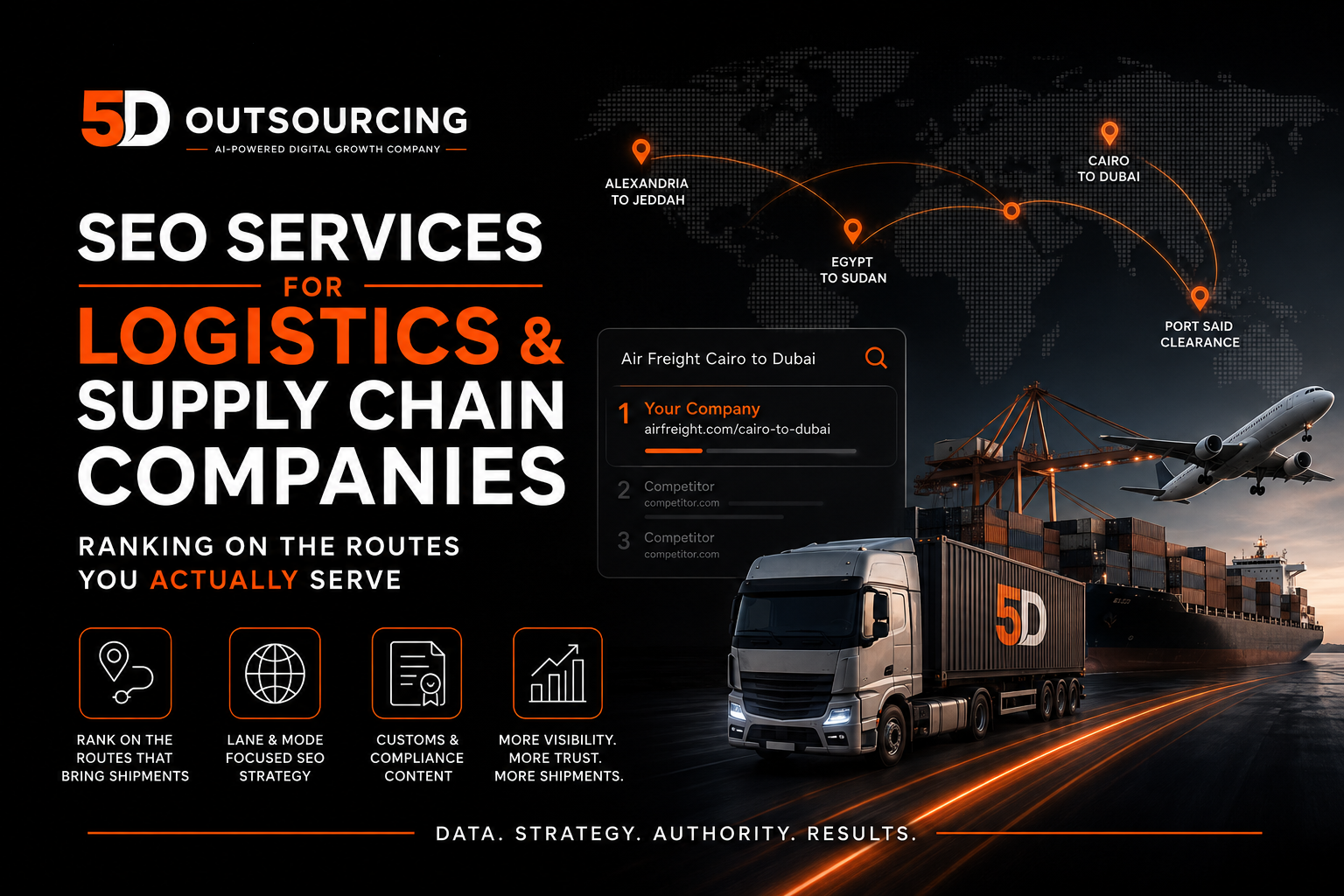
SEO Services for Logistics & Supply Chain Companies: Ranking on the Routes You Actually Serve
A logistics company’s most valuable search queries almost never contain the word “logistics.” They contain two place names and a mode of transport. Shipping from Alexandria to Jeddah. Air freight Cairo to Dubai. Customs clearance at Port Said. Land transport Egypt to Sudan.
That is the structural fact most freight forwarders, shipping lines, customs brokers and 3PL providers in Egypt miss when they commission SEO. They optimize a services page for “logistics company Egypt” — a broad, low-intent term dominated by directories — while the searches that actually carry shipments go to whoever built a page for that specific lane.
This page explains how we approach SEO for logistics companies in Egypt — freight forwarders, customs brokers, shipping and NVOCC operators, land transport companies, warehousing and 3PL providers, and cold chain specialists: why the origin-destination pair is the unit of keyword architecture, what content genuinely earns authority in this sector, why your tracking page is probably your most-visited and least-optimized asset, and how to measure work whose payoff arrives as a tender invitation rather than a form fill.
Talk to an SEO Specialist on WhatsApp
Why Logistics SEO Is Built on Routes, Not Services
The origin-destination pair is the keyword
Freight demand is expressed as a movement. A buyer does not need “sea freight” in the abstract — they need a container moved from a specific origin to a specific destination, and that is how they search. The lane is the unit of intent.
Practically, that means the keyword architecture for a logistics company is a matrix: every origin you serve, crossed with every destination, crossed with every mode. Not all of those intersections deserve a page — but the ones where you have real capability and there is real demand almost always do, and almost nobody builds them.
Service mode multiplies the matrix
Sea freight, air freight, land and cross-border trucking, rail where applicable, customs clearance, warehousing and distribution, project and heavy-lift cargo, cold chain, express and last mile. Each is a different service with a different buyer, a different urgency profile and a different competitive set.
Combine mode with lane and you have the real keyword universe. A page for “air freight from Cairo to Riyadh” is competing for a specific, high-intent query. A page called “Our Services” listing all nine modes is competing for nothing in particular.
Why one services page cannot compete
Search engines reward the page that most specifically answers the query. A single page trying to cover every mode across every lane will always lose to a page dedicated to the exact movement the searcher described — and in this sector, that dedicated page frequently belongs to a directory, a marketplace or an international forwarder with a large content operation, rather than to the local company that could actually handle the shipment better.
The remedy is architectural rather than promotional: build the lane and mode pages, give each one genuinely specific content about that movement, and connect them properly. The internal structure that makes this compound rather than fragment is covered in our guide to internal linking strategy.
Who Is Searching, and What They Are Actually Trying to Do
The three buyer types
The SME importer or exporter. Often shipping for the first time, or the first time on a new lane. Searches in plain language, asks cost and process questions, and needs education as much as a quotation. This is the largest search volume group and the one most under-served by logistics websites.
The experienced logistics or procurement manager. Knows the terminology, searches specifically, and is usually looking for a new supplier on a lane where the incumbent has failed, or a spot rate for something outside the normal contract. Lower volume, higher value, and unforgiving of a site that cannot demonstrate capability quickly.
The multinational or large shipper running a tender. Rarely converts from search directly. They will, however, search your company name during evaluation — and what they find determines whether you survive the shortlist. Your website is the verification point, not the discovery point.
The spot shipment versus the tender
These are two entirely different sales motions sharing one website. A spot shipment is urgent, transactional and often decided in a day. A tender runs for months, involves procurement, and is won on capability, compliance and references.
The site has to serve both without confusing either: fast, obvious quotation paths for the urgent buyer, and depth — certifications, network coverage, capability documentation, case references — for the evaluating one. Trying to serve both with one generic contact form serves neither well.
What urgency looks like here
A shipper with cargo sitting at a port accruing demurrage is not browsing. They need a phone number, a WhatsApp route and a response now. Response speed is a genuine competitive variable in this sector, and a slow or hard-to-find contact path costs business that had already decided to call someone.
The Content That Genuinely Earns Logistics Search Visibility
Trade lane pages
The core asset. A proper lane page covers the transit time, the ports or airports involved, typical documentation, customs considerations at both ends, the service modes available on that lane, and what commonly goes wrong on it. That last element is where most companies stop short and where genuine expertise shows.
Build lane pages for the routes you actually serve well. A thin page for a lane you cannot competently handle wins a click and loses a client, which is worse than not ranking.
Customs and documentation content
Customs queries carry some of the highest commercial intent in this vertical, because a shipper searching a clearance question usually has cargo in motion. Documentation requirements, clearance procedures, duties and inspection processes, and the systems importers have to work through are all searched heavily.
Egypt’s advance cargo information requirements are a good example of the category — the kind of procedural topic where importers search for guidance and very few Egyptian logistics companies publish anything useful. We would add one caution: customs procedures and systems change, sometimes with little notice. Content in this area needs a review cycle and a visible last-updated date, and it should point readers to the official authority for current requirements rather than presenting your page as the regulatory source. Publishing confidently wrong procedural guidance in this sector damages credibility faster than publishing nothing.
Incoterms, HS codes and the explainer layer
Incoterms explanations, HS code guidance, bill of lading and certificate of origin content, container type and capacity references, and cargo insurance basics all attract substantial search volume from exactly the buyers you want. They are also stable — unlike rates and procedures, an Incoterms explainer written well does not need constant revision.
This is the authority layer. It brings SME shippers into your orbit during the research phase, months before they have a shipment, and it demonstrates the competence that a procurement evaluator is looking for. The framework for building it as a program rather than sporadically is in our SEO content strategy guide.
Cost and rate queries — and the volatility problem
Shipping cost queries are heavily searched and genuinely difficult to serve, because freight rates move constantly with capacity, fuel, season and route conditions. Publishing a rate table guarantees it will be wrong within weeks and quoted back at you.
The workable pattern is to explain the cost structure rather than the number: what components make up a freight quote, what drives variation on that lane, what surcharges typically apply, what the difference between LCL and FCL means for the total, and what conditions push rates up or down. Then route to a live quotation. That captures the query, demonstrates expertise, pre-qualifies expectations, and commits you to nothing. We take the same position on pricing transparency in our own market — see SEO pricing in Egypt.
The Tracking Page Nobody Optimizes
On most logistics websites, track-and-trace is the highest-traffic page by a wide margin — and it is usually treated as a utility rather than an asset.
Two things follow. First, it drives significant branded search volume: people search your company name plus “tracking” constantly, which is free, high-intent traffic arriving at your domain. That query deserves a fast, findable, mobile-friendly destination rather than a link buried in a menu.
Second, it is the one page your existing customers visit repeatedly, which makes it the best-positioned surface on the site for anything you want them to see — service expansion, a new lane, a quotation path for their next shipment. Most tracking pages are a dead end with a text box. That is a wasted asset, and improving it is one of the cheapest wins available. The conversion logic is in conversion funnel explained, with the interface principles in our UX optimization guide.
Local SEO for Ports, Depots and Branches
Logistics is physically distributed. A company with offices at Alexandria, Port Said, Ain Sokhna, Damietta and Cairo airport has five distinct local entities, each with its own catchment of searches — port-specific clearance queries, depot searches, and “near me” logistics queries from shippers in that governorate.
Each needs its own page and its own verified profile with accurate hours and contact routes, not a single contact page with a dropdown. Port and terminal proximity is a genuine differentiator in this sector and it should be visible in both the content and the local signals. See Google Business Profile optimization and local SEO strategy.
Credibility Signals in a Trust-Dependent Sector
Shippers are handing over goods with real value and accepting liability exposure. They check before they commit — and the things they check are frequently absent from logistics websites.
What does the work: licensing and registration details, membership of recognized trade bodies, agent and network affiliations, insurance and liability terms, the physical asset base where relevant — fleet, warehousing capacity, temperature-controlled facilities — and named operational leadership rather than an anonymous “our team.” Certifications listed as logos in a footer convince nobody who is actually verifying.
This matters for search as well as for persuasion. Our interpretation, and we would label it an evidence-based recommendation rather than a documented ranking factor, is that logistics companies with clear, structured, verifiable organizational information compete better for the comparison and evaluation queries than those publishing only service descriptions — and they are considerably easier for AI systems to cite, for reasons covered below.
Technical SEO for a Logistics Site
Lane page scale without thin content
The lane matrix creates a scale problem. Fifty origins by forty destinations by six modes is a very large number of theoretically possible pages, and generating them from a template produces exactly the thin, duplicated content that fails.
The discipline is to build pages only where you have genuine capability and there is genuine demand, and to give each one specific, non-templated substance — real transit times, real port detail, real documentation notes for that movement. Fewer, better lane pages outperform a generated matrix every time. The page-level standard is in our on-page SEO guide, with the crawl and duplication issues in our technical SEO audit checklist.
Bilingual, and the counterpart market
Egyptian logistics companies serve Arabic-speaking domestic shippers and English-speaking international counterparts, and the two search differently. There is a third consideration most firms miss: on an import lane, the party searching may be in the origin country entirely — a Chinese exporter looking for an Egyptian clearance agent, or a Gulf shipper looking for an Egyptian partner.
Whether to serve that with additional language content or with English is a market decision that should follow your actual lane data. What is not optional is deciding it deliberately, because right-to-left layout has to be designed in from the start rather than retrofitted. Regional context for the main counterpart markets is in our guides to Saudi Arabia, the UAE, Qatar and Kuwait, with the market-entry view in SEO and AI search services in Saudi Arabia.
Speed, and the tracking widget
Logistics sites are frequently slowed by third-party tracking widgets, map embeds and rate-calculator scripts. Buyers often access them on mobile, sometimes from a port or a warehouse on a poor connection, and frequently in a hurry. Performance is commercial here — see website speed and performance optimization.
AI Search and the “How Do I Ship X From Y” Query
A growing share of the education-stage research described earlier now happens inside AI assistants. A first-time importer asking how to ship a container from China to Egypt, what documents they need, or what clearance involves receives a synthesized answer citing a small number of sources.
Being one of those sources depends on two things: publishing genuinely useful procedural and explanatory content in structured, machine-readable form, and being a clearly recognized entity with consistent, verifiable information — company name, registrations, locations, services, affiliations — expressed as structured data rather than only as prose.
The mechanics are in generative engine optimization, optimizing for Google AI Overviews, AI search ranking factors and entity optimization explained, with readiness assessed by our AI search optimization checklist and measurement covered in how to measure AI search visibility. For a baseline, an AI search audit; for strategy, AI search consulting; for execution, AI search implementation and entity and knowledge graph optimization.
One caution specific to this sector: AI systems synthesizing procedural guidance can and do get customs and documentation details wrong. That is an argument for publishing accurate, dated, authoritative content — both because it is more likely to be the cited source, and because the alternative is your prospective clients acting on someone else’s error.
Seasonality and the Trade Calendar
Freight demand runs on its own calendar, and content and campaign timing should follow it. Ramadan and the Eid periods change domestic transport patterns and working rhythms. Chinese New Year produces a well-known pre-holiday rush and post-holiday slowdown on Asia lanes. Q3 and Q4 carry peak-season pressure on many trade routes. Harvest and agricultural export windows drive specific cold chain and bulk demand.
Publishing lane and procedural content ahead of the period when it is searched, rather than during it, is the same sequencing discipline that applies to any seasonal vertical — and the same trap: organic work commissioned when demand arrives lands after it has passed. The general dynamic is covered in why SEO is not working for many businesses.
Measuring Logistics SEO
The metrics that matter: quotation requests by lane and by mode, which tells you where the content is actually working; branded search volume trend, the cleanest available proxy for growing recognition; visibility across your priority lane and customs query sets; tracking page traffic, both as a retention signal and as a conversion surface; local visibility by port and branch; and citation presence in AI answers for a defined set of shipper questions.
Be realistic about attribution. A large share of logistics business closes through a phone call, a WhatsApp conversation, an existing relationship or a tender process that started months earlier. Connecting a shipment back to a search session requires your own systems to record it. Without that, anyone attributing bookings to specific keywords is presenting an estimate as a measurement. Where a firm wants that loop closed properly, it is what marketing automation and CRM integration is built for, and the conversion work sits with CRO services, landing page optimization and A/B testing.
Common Mistakes in Logistics SEO
- Optimizing for “logistics company Egypt” and little else. Broad, low-intent, dominated by directories, and not how shipments are searched.
- No lane pages. The single largest missed opportunity in the sector.
- Generating a lane matrix from a template. Thin, duplicated pages that rank for nothing and disappoint anyone who lands on them.
- Nothing published about customs or documentation. Ceding the highest-intent queries in the vertical.
- Publishing rate tables. Wrong within weeks and quoted back at you.
- Treating the tracking page as a utility. Your highest-traffic page, doing no commercial work.
- One contact page for a multi-port network. Five physical locations, one local signal.
- Anonymous credibility. No named leadership, no licensing detail, no verifiable affiliations.
- Slow contact paths for urgent cargo. A shipper accruing demurrage will call whoever answers first.
- Procedural content with no review cycle. Customs guidance goes stale and stale guidance costs credibility.
- English only, or Arabic only. Half the counterpart market cannot read your capability.
- Starting content ahead of a season that has already begun. The work lands after the demand.
How 5D Approaches SEO for Logistics Companies
How an engagement is scoped
We start with the lane map rather than a keyword list: which origins and destinations you genuinely serve well, which modes on each, where you have real competitive capability, and which lanes you would rather not attract. Then the current position — what the site ranks for now, what share of existing traffic is branded and tracking-driven, what the customs and documentation content situation is, whether local signals exist per location, and how quickly inquiries are answered.
That produces a prioritized plan: which lane pages to build first, which procedural content earns authority fastest, what the technical remediation is, and how the whole thing paces against your trade calendar rather than a generic twelve-month schedule.
A reference point from our own work
For Alwefaq National Transport, a logistics and transport company in Saudi Arabia, 5D delivered technical SEO implementation, keyword research, content and website optimization, indexing improvements, internal link architecture and Arabic SEO for the Saudi market. The recorded outcome included a first-position Google ranking for the primary target keyword, average position improving from 26.9 to 18.6, click-through rate moving from 1.6% to 1.8%, and 645 total clicks with over 6,400 website users across the measured period.
To be precise about what that is: a point-in-time record of one client’s results in one market, not a projection of what any other logistics company should expect. Lanes, competition and starting positions differ enormously. It does demonstrate that the approach described on this page is one we have run in this sector rather than described theoretically.
Where this connects to the rest of the growth system
Our SEO programs run on a minimum six-month engagement, because the authority described here does not compound faster than that. Package structure and keyword capacity are on our SEO packages page, with the entry program at 25,000 EGP per month covering up to 50 keywords, and higher tiers for companies with large lane matrices or multi-country operations. Which tier fits depends on how many lanes, modes and locations need covering — that comes out of the audit rather than before it.
SEO is one dimension of the digital marketing and AI search engine we run. For logistics companies the adjacent capabilities that most often matter are Google Ads for urgent spot-shipment queries where organic cannot respond on demand — the trade-off is set out in SEO versus Google Ads — LinkedIn Ads for reaching supply chain and procurement decision-makers by role, and the website itself where capability either reads as credible or does not, through corporate website design or WordPress development. The complete channel view for this sector is our pillar page on digital marketing and AI search for logistics and supply chain companies in Egypt.
Whether a company needs all of that is a question we would rather answer after an audit than assume. We are a strategic growth partner rather than a vendor selling the largest available scope. Read more about 5D Outsourcing, browse the full range of packages, see our frequently asked questions, or view the complete service overview. If you are weighing how to resource this, SEO agency versus freelancer versus in-house and how to choose the right SEO agency set out the honest version of that decision.
Related Guides and Services
SEO foundations: the complete guide to SEO · technical SEO audit checklist · on-page SEO · internal linking strategy · SEO content strategy · Google ranking factors
Local and network visibility: local SEO strategy · Google Business Profile optimization
AI search: AI SEO strategy · how AI search is changing SEO · generative engine optimization · zero-click optimization · AI search agency versus traditional SEO agency
Turning visits into inquiries: CRO services · landing page optimization · traffic without leads · speed and Core Web Vitals · maintenance and support · website development cost
Sectors you move goods for: manufacturing websites · e-commerce brands · e-commerce SEO
How other sectors approach SEO: education institutions (seasonal enrollment cycles) · healthcare providers (trust-led search) · real estate agencies (high-consideration purchases) · in-house versus outsourced
Frequently Asked Questions
What keywords should a logistics company actually target?
Route-based ones. The queries that carry shipments combine an origin, a destination and a mode — “sea freight Alexandria to Jeddah,” “air cargo Cairo to Dubai,” “customs clearance Port Said.” Broad terms like “logistics company Egypt” have volume but low intent and are dominated by directories. Build the lane pages for routes you genuinely serve, and the broad terms tend to follow from the authority those pages create.
Should we publish our freight rates?
We would not publish rate tables — they go stale within weeks in a market this volatile and get quoted back at you. What works is explaining the cost structure: what components make up a quote, what drives variation on that lane, which surcharges typically apply, and what conditions move rates. That captures the query and pre-qualifies the buyer without committing you to a number.
How many lane pages do we need?
Fewer than the matrix suggests. Build pages only where you have genuine capability and there is genuine demand, and give each one real substance — transit times, ports, documentation, what commonly goes wrong on that route. A generated grid of templated lane pages produces thin content that ranks for nothing. Twenty strong lane pages outperform two hundred weak ones.
Is customs content worth publishing given how often procedures change?
Yes, with discipline. Customs queries are among the highest-intent searches in this vertical. What they require is a review cycle, a visible last-updated date, and a clear pointer to the official authority for current requirements rather than presenting your page as the regulatory source. Publishing confidently wrong procedural guidance damages credibility faster than publishing nothing.
How long does logistics SEO take to work?
Meaningful visibility movement typically develops over three to six months, with stronger authority building across six to twelve. Lane pages for less contested routes can move faster. The practical planning point is to build content ahead of the season it serves — content published during a peak arrives too late for it.
Our tracking page gets most of our traffic. Is that useful?
Very. It is repeat traffic from existing customers and it drives substantial branded search. Most companies treat it as a dead-end utility. Making it fast, easy to find and useful — with a clear path to a quotation for the next shipment and visibility of services the customer is not yet using — is one of the cheapest improvements available on a logistics site.
Do we need Arabic and English?
For most Egyptian logistics companies, yes. Domestic shippers search in Arabic, international counterparts in English, and on import lanes the searching party may be in the origin country entirely. The decision worth making deliberately is which language leads and whether additional languages serve specific lanes — and right-to-left support has to be designed in rather than retrofitted.
Will SEO help us win tenders?
Not directly. Tenders are won through procurement processes, capability, compliance and references. What SEO does is ensure that when the evaluation team searches your company name — and they will — they find a site that confirms rather than undermines the capability claims in your submission. That is a real contribution to a process search does not otherwise touch.
What does SEO for a logistics company cost?
Our SEO programs start at 25,000 EGP per month for up to 50 keywords with a minimum six-month engagement, scaling to 33,000 EGP for up to 150 keywords and 50,000 EGP for up to 300. Which tier fits depends on how many lanes, service modes and physical locations need covering — a single-mode domestic transport company and a multimodal forwarder with five port offices are genuinely different scopes. The audit determines it.
Can you guarantee first-position rankings?
No. No provider can honestly guarantee search positions. We commit to method, workstreams, reporting and measurable visibility improvement. We can point to work in this sector — including a first-position ranking achieved for a transport client’s primary keyword in Saudi Arabia — but a past result in one market is evidence of capability, not a promise about yours.
Start With Your Lane Map, Not a Keyword List
The most useful first step for a logistics company is not an SEO proposal. It is an honest lane map: which origins and destinations you serve well, which modes on each, where your real competitive advantage sits, and which movements you would rather not attract. That map determines the entire content architecture — and it is the difference between ranking for the shipments you want and ranking for a category term that brings inquiries you cannot profitably serve.
Leave a Reply