
No products in the cart.
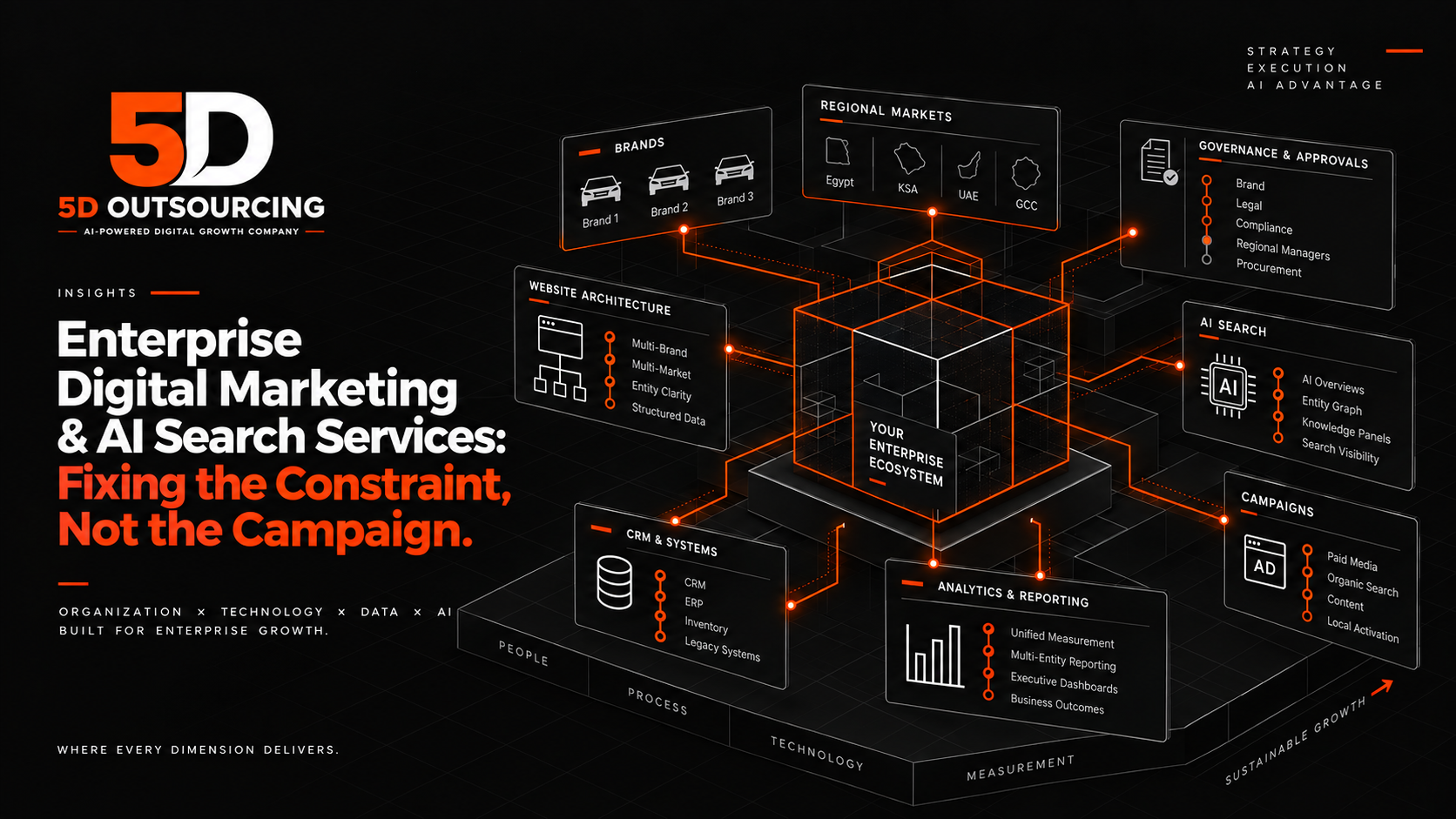
Enterprise Digital Marketing & AI Search Services: Fixing the Constraint, Not the Campaign
At enterprise scale, the thing limiting marketing performance is almost never the marketing. It is the number of people who have to say yes.
A campaign that a 20-person company launches in four days takes eleven weeks inside a large organization — not because anyone is incompetent, but because it passes through brand, legal, three regional managers, procurement and a compliance review, and each pass adds a round of revisions. By the time it ships, the market moment it was built for has moved.
Most agencies selling to enterprises pretend this problem does not exist. They present the same tactical playbook they sell to smaller companies, priced higher, and then discover six months in that the work is stuck in an approval queue nobody warned them about.
This page sets out how we approach enterprise digital marketing and AI search for large organizations in Egypt and the GCC — multi-brand groups, multi-market operators, companies with an existing in-house marketing function, and organizations whose procurement process is a real part of the engagement. It also states plainly what we are and are not, because an enterprise buyer who discovers a capability gap after signing has been badly served.
What “Enterprise” Actually Means Here
Not headcount, and not revenue. The useful definition is structural, because structure is what changes how the work has to be done.
An organization is an enterprise engagement, for our purposes, when several of the following are true:
- Multiple stakeholders hold veto power over marketing output — brand, legal, compliance, regional leadership, sometimes a parent company.
- There is already an in-house marketing team, so an external partner has to fit into an existing operation rather than replace one.
- Multiple entities, brands, markets or locations share a digital footprint, and their relationship to each other is not obvious to a search engine.
- Systems predate the strategy — a CRM chosen years ago, an ERP nobody wants to touch, a website on a platform selected for reasons that no longer apply.
- Procurement is a formal process with vendor onboarding, security review, contract negotiation and defined service levels.
- Reporting goes upward to people who do not use marketing vocabulary and who are evaluating the function, not the campaign.
A 60-person company with three brands, two countries and a procurement department is an enterprise engagement. A 400-person company with one brand, one market and a founder who decides everything is, operationally, a large SMB. The distinction matters because it determines where the work actually goes.
The Velocity Problem, and What Can Be Done About It
Approval chains are the defining constraint of enterprise marketing, and they are usually treated as an immovable fact of life. They are not entirely immovable, but the fixes are organizational rather than creative.
Pre-approval beats per-item approval. Getting a message framework, a set of claims, a visual system and a tone specification approved once — properly, by everyone with a veto — converts most subsequent items from a review into a compliance check. The upfront cost is real and the payoff is compounding.
Decision rights need to be written down. A large share of enterprise delay is not disagreement; it is ambiguity about who is entitled to decide. Naming a single accountable approver per asset class, with a defined escalation path and a default-approve deadline, typically removes more delay than any process tool.
Batch what recurs, expedite what is time-sensitive. Routine content moves through a scheduled monthly cycle. A response to a competitor’s move or a market event needs a pre-agreed fast lane with a smaller approval set. Trying to run both at the same speed means the routine work is rushed and the urgent work is late.
Be honest about what the constraint costs. If an approval cycle means paid campaigns cannot be adjusted within a week, that is a performance ceiling, and it should appear in the forecast rather than being discovered at the quarterly review. Our interpretation — and we would label this strategic interpretation rather than a documented finding — is that agencies routinely forecast enterprise results as though they will operate at SME velocity, and that most enterprise disappointment traces back to that single unstated assumption.
Brand Governance Against Local Relevance
Every multi-market organization runs the same argument. Head office wants consistency; the market teams want content that reflects how people actually search and buy where they are. Both are right, and the resolution is not a compromise in the middle.
The workable split is by layer. Brand architecture, positioning, visual identity, claims and the entity data that identifies the company are centrally governed and non-negotiable. Keyword targeting, content examples, local proof points, contact routes, language and campaign timing are local decisions inside a central framework.
Getting this wrong in either direction is expensive. Full central control produces content that ranks nowhere because it was written for a market average that does not exist. Full local autonomy produces a fragmented entity — which, as the next section explains, is now a search problem and not only a brand problem.
The Enterprise Entity Problem in AI Search
This is the section that most changes what enterprise organic work should look like, and it contains a genuinely counterintuitive point: large organizations are frequently worse at entity clarity than small ones.
A small company has one name, one address, one website and one description. A large one accumulates: a legal name that differs from the trading name, subsidiaries with their own sites, acquired brands still operating under old identities, former head office addresses persisting in directories, multiple business profiles created by different branches over the years, inconsistent descriptions across dozens of third-party listings, and a corporate website whose structured data does not state how any of it relates.
Traditional search tolerated this reasonably well, because it matched pages to queries. AI-mediated search is less forgiving, because it works from resolved entities — it needs to know what your organization is, what it does, where it operates, what it owns and how the parts connect, before it can confidently name you in an answer.
The practical work is unglamorous and high-leverage:
- Decide the canonical entity name and use it consistently everywhere, including in structured data.
- Model the corporate structure explicitly — parent, subsidiaries, brands, divisions — so the relationships are machine-readable rather than implied by a page’s layout.
- Resolve duplicate and stale business profiles and directory listings, and fix address and phone inconsistencies at source.
- Make the same facts true in the same words across the website, structured data, profiles, and any third-party sources you control.
- Decide deliberately whether an acquired brand is being absorbed or maintained, because search systems will otherwise decide for you, usually incorrectly.
The mechanics are covered in entity optimization explained and generative engine optimization, with implementation as a defined service in entity and knowledge graph optimization. The wider shift is set out in how AI search is changing SEO and AI search ranking factors, with optimizing for Google AI Overviews and zero-click optimization covering the answer surfaces themselves. Where a company wants to know its current position before committing, that is an AI search audit; strategy sits with AI search consulting and execution with AI search implementation.
One caveat worth stating plainly: visibility inside AI answers is measurable but not yet measurable with the precision that paid media reporting has accustomed enterprise buyers to. Anyone presenting AI search results with the confidence intervals of an ad platform is overstating what the tooling currently supports. How to measure it responsibly is in how to measure AI search visibility.
Multi-Entity, Multi-Brand and Multi-Location Architecture
Once an organization passes a certain complexity, the structural questions outrank the tactical ones.
One domain or several? Consolidating brands onto a single domain concentrates authority and is usually the stronger organic position. Separate domains make sense when the brands serve genuinely different audiences, when a business unit may be divested, or when regulatory separation requires it. This is a decision with a long half-life and it should be made deliberately rather than inherited.
Subfolders, subdomains or country domains for markets? Each has real trade-offs in authority consolidation, operational independence and local signal strength. There is no universally correct answer, and any agency that gives you one without asking about your entity structure, your team’s autonomy and your expansion plan is reciting a rule rather than advising.
Location pages at scale. A network of branches needs individual pages with genuinely distinct content and correctly managed local profiles, not a template with the city name swapped. The principles are in local SEO strategy and Google Business Profile optimization; at enterprise scale the difficulty is governance — who owns each profile, who can change hours, and how a change propagates.
Internal linking as architecture, not decoration. On a site with thousands of pages, the link graph is what tells search systems which pages matter and how topics relate. It has to be designed and maintained, not left to whatever the CMS produces. See internal linking strategy and the crawl and indexation issues in our technical SEO audit checklist.
Measurement When the Systems Do Not Talk
Large organizations rarely lack data. They lack agreement about which data is true.
The recurring pattern: the ad platforms report one conversion number, analytics reports another, the CRM reports a third, and finance reports a fourth that is lower than all of them. Each is internally consistent and they cannot be reconciled, so the quarterly review becomes an argument about numbers rather than a decision about strategy.
The fix is definitional before it is technical. What counts as a lead, at what stage, owned by which system? Which system is authoritative for revenue? What attribution model is being used, and — more importantly — is everyone in the room using the same one? Once those are settled, the technical work of connecting systems has a target. Before they are settled, integration just produces more numbers to disagree about.
For long or offline sales cycles, the loop only closes when outcomes recorded in the CRM are fed back to the advertising platforms, so that optimization works toward revenue rather than form fills. That work sits with marketing automation and CRM integration, and in our experience it is the single highest-return technical project available to most enterprise marketing functions — larger than any campaign change.
Procurement, Security and the Practical Realities of Being Onboarded
Enterprise engagements have a phase that smaller ones do not: getting the vendor into the building.
Expect vendor registration and documentation, a security or IT review, questions about where data is processed and stored, defined access management for advertising accounts, analytics, the CMS and the CRM, agreed service levels and escalation paths, confidentiality terms, and a defined offboarding position covering who owns what at the end.
Two points we would make directly to any enterprise buyer, and they apply to every agency including us.
Insist on owning your own accounts. Advertising accounts, analytics properties, tag containers, business profiles and domain registrations should sit under your organization’s ownership with the agency granted access, not the reverse. An agency that resists this is protecting its leverage, not your security. This is a bigger commercial risk than most procurement processes catch, because it only becomes visible at the moment you want to leave.
Define the exit at the start. What documentation is handed over, in what format, within what period, and what happens to work in progress. A partner confident in the value it delivers has no reason to make leaving difficult.
Working Alongside an In-House Team
Most enterprise organizations already have marketing people. The question is not whether to have a team or an agency, but which capabilities are genuinely better bought than built.
Generally better in-house: brand stewardship, institutional knowledge, stakeholder navigation, day-to-day coordination, and anything requiring deep familiarity with the product and the customer.
Generally better bought: specialist technical capability used intensively but not continuously, capabilities changing fast enough that maintaining currency is a full-time job in itself, surge capacity for launches and migrations, and — occasionally the most valuable — an outside view that has no internal political position to defend.
The failure mode to avoid is duplication: an agency doing what the in-house team already does, competently, more expensively, while the actual gaps go unaddressed. A well-scoped enterprise engagement names which capabilities sit where, and is willing to say “you already do this well, keep doing it.” The structural comparison is in in-house versus outsourced marketing and SEO agency versus freelancer versus in-house, with selection criteria in how to choose the right SEO agency and the specialist distinction in AI search agency versus traditional SEO agency.
Migrations and Replatforming: The Highest-Risk Work in Enterprise Marketing
A website migration at enterprise scale can erase years of accumulated organic visibility in a weekend, and it usually does so through a small number of preventable causes: URLs changed without redirects, content dropped in the redesign, structured data not carried across, staging environments left indexable, or a crawl-blocking directive that survives launch.
What protects the outcome is sequencing rather than heroics: a full inventory of what currently exists and what it earns before anything changes, a redirect map built from that inventory rather than from the new site’s structure, structured data and internal linking treated as launch requirements rather than post-launch tasks, and a monitoring window afterward with someone accountable for watching it.
Related work sits with website redesign, corporate website design, WordPress development, speed and Core Web Vitals and ongoing maintenance and support.
Reporting Upward
Enterprise marketing reporting has two audiences with incompatible needs, and collapsing them into one document serves neither.
The operating team needs channel detail, campaign-level performance, test results and the next set of actions. Leadership needs a small number of measures tied to commercial outcomes, an honest account of what is working and what is not, and a clear statement of what decisions are being requested.
Three habits make leadership reporting credible. Report against what was forecast, including when the forecast was wrong. Separate what the data confirms from what it suggests — a distinction we hold to throughout our work. And state the confidence level rather than implying certainty; a range presented honestly builds more trust over four quarters than a point estimate that keeps missing.
Common Failure Modes in Enterprise Digital Marketing
- Buying SME tactics at enterprise prices. Same playbook, bigger invoice, no adaptation to how the organization actually works.
- Ignoring the approval chain in the forecast. Performance projections that assume a velocity the organization cannot reach.
- A fragmented entity. Multiple names, stale addresses, duplicate profiles, unmodeled subsidiaries — invisible to the brand team, highly visible to AI systems.
- Four conflicting sources of truth. Quarterly reviews spent arguing about which number is real.
- Agency-owned accounts. Discovered at exactly the wrong moment.
- Duplicating the in-house team. Paying twice for the same capability while the real gaps stay open.
- Treating migration as an IT project. The organic consequences arrive after launch, when attention has moved on.
- Central control with no local input. Content optimized for a market average nobody lives in.
- Local autonomy with no central framework. A brand that search systems cannot resolve into one organization.
- One report for two audiences. Too shallow for the operators, too detailed for the board.
How 5D Approaches Enterprise Engagements
What we are, stated plainly
We think an enterprise buyer is entitled to an accurate picture before a procurement process starts, so: 5D Outsourcing was founded in 2024 and is a team of 15+ multidisciplinary professionals, led by a founder with over 20 years of leadership experience across IT, outsourcing and digital marketing. Certifications across Google Ads, GA4, Meta, Semrush, Microsoft, Cisco, AWS and VMware are held by individual team members rather than as company-level partnerships.
That makes us a specialist partner, not a full-service holding-company agency. We are well suited to organizations that have an in-house team and need specific capability alongside it — AI search and entity work, technical SEO, paid media management, conversion work, website builds and migrations, and the measurement infrastructure underneath all of it. We are not the right choice for an organization that wants a single vendor to absorb an entire marketing function across many markets simultaneously, and we would rather say so at the first meeting than discover it in month four.
What we can point to: measurable results on our own domain, where over a six-month period ending 24 June 2026 clicks grew from 670 to 1,700, impressions from 12,300 to 56,100, and average position improved from 44.8 to 21.6 — and where 5D was cited inside Google AI Overviews for several Cairo-market queries as of that date. Those are point-in-time figures for a single domain, our own, and we present them as evidence that we run this method on ourselves rather than as a projection for anyone else. We also hold documented client work in the GCC, including an SEO engagement for a Saudi transport company that reached a first-position ranking for its primary target keyword.
How an engagement is scoped
Discovery covers more than the marketing. We look at the entity picture across the web, the current organic and paid position, the measurement stack and where its definitions conflict, the site architecture and its constraints, the in-house team’s actual capabilities, and — explicitly — the approval and decision-making structure, because that determines what velocity is realistic.
That produces a scoped proposal with sequencing, named accountability on both sides, defined service levels, and a forecast that reflects the organization’s real operating constraints rather than an idealized one.
Where this connects to the rest of the system
Enterprise engagements are scoped and priced individually rather than sold from a package, because the variables — number of entities, markets, languages, locations, systems and stakeholders — move the work too much for a fixed tier to be honest. Our standard published packages for SEO, paid media, social and website development are on the digital marketing pricing page and are a fair reference point for the smaller end of scope; enterprise scope is quoted after discovery.
The capabilities themselves are the same ones described across our service pages: digital marketing and AI search, Google Ads and PPC management, LinkedIn Ads for B2B and executive-level targeting, Facebook and Instagram advertising, conversion rate optimization, and the full service overview. What changes at enterprise scale is not the toolkit — it is the governance, the architecture and the sequencing around it.
For organizations expanding across the region, market-specific context is in our guides to Saudi Arabia, the UAE, Qatar and Kuwait, with delivery detail in SEO and AI search services in Saudi Arabia and website development in the UAE.
How we think about the work is set out in the 5D philosophy. Read more about 5D Outsourcing or see our frequently asked questions.
Related Guides and Services
AI search and entity authority: AI search consulting · AI search audit · AI search implementation · entity and knowledge graph optimization · AI SEO strategy · AI search optimization checklist
Organic foundations at scale: the complete guide to SEO · technical SEO audit checklist · internal linking strategy · SEO content strategy · on-page SEO · why SEO is not working
Measurement and conversion: marketing automation and CRM · conversion funnel explained · landing page optimization · A/B testing · UX optimization · traffic without leads
Platform and infrastructure: corporate website design · website redesign · WordPress development · speed and Core Web Vitals · website development cost
Sector-specific approaches: financial services · manufacturing · logistics and supply chain · construction · SaaS and technology · healthcare · real estate · legal firms
Frequently Asked Questions
What makes an engagement “enterprise” rather than just large?
Structure, not size. Multiple stakeholders with veto power, an existing in-house team, multiple entities or brands or markets sharing a digital footprint, systems that predate the strategy, a formal procurement process, and reporting that goes upward to non-marketing decision-makers. A 60-person company with three brands and two countries qualifies; a 400-person company with one brand and one decision-maker usually does not.
We already have an in-house marketing team. What would you actually do?
Fill named capability gaps rather than duplicate what works. Typically that means specialist technical work used intensively but not continuously — AI search and entity architecture, technical SEO at scale, measurement infrastructure, migration protection — plus surge capacity for launches, and an outside view with no internal position to defend. A properly scoped engagement says explicitly which capabilities stay in-house.
Why does entity clarity matter more for large organizations?
Because large organizations accumulate contradictions that small ones do not have: a legal name different from the trading name, subsidiaries with separate sites, acquired brands under old identities, former addresses persisting in directories, duplicate business profiles, and inconsistent descriptions across dozens of listings. Traditional search tolerated that. AI-mediated search works from resolved entities, so contradictory data means the system cannot confidently identify or cite you.
How do you handle approval chains and slow internal processes?
By designing around them rather than complaining about them. Pre-approve frameworks and claims once so most items become compliance checks rather than reviews; write down decision rights and escalation paths with default-approve deadlines; batch routine work on a scheduled cycle while agreeing a fast lane with a smaller approval set for time-sensitive responses. And we reflect the real velocity in the forecast rather than assuming a speed the organization cannot reach.
Who should own our advertising and analytics accounts?
You should — always. Advertising accounts, analytics properties, tag containers, business profiles and domain registrations belong under your organization’s ownership, with the agency granted access. An agency that resists this is protecting its leverage rather than your security, and the problem only becomes visible at the moment you want to leave. Define the offboarding terms at the start for the same reason.
How do you deal with conflicting numbers across our systems?
Definitions before technology. What counts as a lead, at which stage, owned by which system; which system is authoritative for revenue; what attribution model everyone is using. Integration before those are settled just produces more numbers to disagree about. Once definitions are agreed, the work of connecting the CRM back to the advertising platforms has a target — and for long or offline sales cycles that loop is usually the highest-return technical project available.
Can you support us across multiple GCC markets?
Yes, with a caveat we would rather state upfront. We work across Egypt and the GCC and have documented client delivery in Saudi Arabia. What we would not claim is a local operating presence in every market — for organizations needing on-the-ground teams in several countries simultaneously, that should be part of the vendor conversation from the first meeting rather than discovered later.
How is enterprise work priced?
Scoped and quoted individually after discovery. The variables that drive enterprise cost — number of entities, brands, markets, languages, locations, systems and stakeholders — move the work too much for a published tier to be honest. Our standard packages are published and are a fair reference for smaller scopes; pretending they extend cleanly to a multi-entity, multi-market engagement would not be accurate.
How long before an enterprise program shows results?
Paid media can move within weeks. Organic and entity work compounds over quarters, not months, and at enterprise scale the first phase is often infrastructure — entity cleanup, measurement definitions, architecture decisions — that produces no visible movement while it is happening. That is worth agreeing explicitly at the start, because a program judged on month-two visibility will be judged wrongly.
What are the risks in a website migration, and how do you manage them?
A large migration can erase years of organic visibility in a weekend, usually through preventable causes: URLs changed without redirects, content dropped in the redesign, structured data not carried across, staging left indexable, or a crawl-blocking directive surviving launch. Protection comes from sequencing — inventory what exists and what it earns before anything changes, build the redirect map from that inventory, treat structured data and internal linking as launch requirements, and monitor afterward with someone accountable.
Start With the Constraint, Not the Campaign
The most useful first conversation with an enterprise organization is not about channels or budgets. It is about where the actual constraint sits — approval velocity, entity fragmentation, conflicting measurement, architecture inherited from a decision made years ago, or a capability gap next to an in-house team doing good work in a different area.
Almost always, the constraint is the thing worth fixing first, and almost never is it the thing the original brief asked about.
Leave a Reply