
No products in the cart.
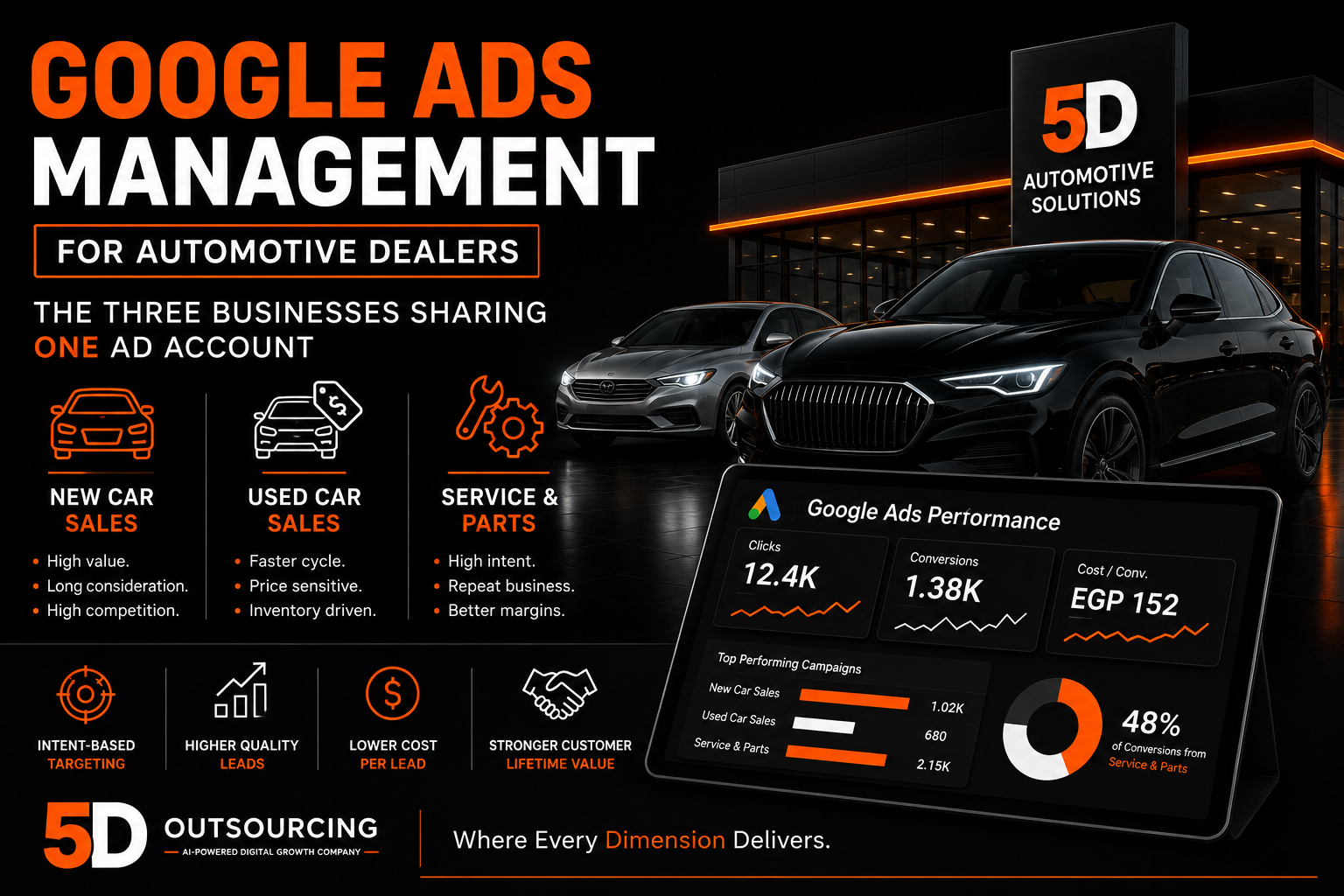
Google Ads Management for Automotive Dealers: The Three Businesses Sharing One Ad Account
The most valuable thing a car dealership can buy on Google is usually not a car sale.
It is a brake job. A 40,000-kilometer service. A tire replacement. Those clicks cost a fraction of what a model-name click costs, they convert within days instead of months, they carry margins that vehicle sales rarely match, and the customer who books one is the same person who will buy their next car from whoever serviced the last one.
Almost no dealership in Egypt advertises that way. The budget goes to new vehicle campaigns, the service department gets whatever is left over, and the account is judged on a metric — cost per lead — that measures the slowest, most expensive, least attributable part of the business.
This page explains how we approach Google Ads for automotive dealers in Egypt — new car dealerships, used car showrooms, multi-brand groups, service centers and parts retailers: why a dealership is really three businesses sharing one ad account, how to structure campaigns around make, model and trim rather than “car dealership,” what to do about inventory that changes weekly, and how to close an attribution loop when the sale happens in a showroom six weeks after the click.
Talk to a PPC Specialist on WhatsApp
A Dealership Is Three Businesses Sharing One Ad Account
New vehicle sales, used vehicle sales, and service and parts. They sit under one roof and one brand, and they are almost entirely different commercial machines.
New vehicle sales
Long consideration cycle, frequently measured in weeks or months. High ticket, low frequency. The search behavior is model-specific and research-heavy, the competition includes the manufacturer’s own campaigns and every other dealer carrying the same brand, and the conversion that matters — a signed order — happens in a showroom, not on a website.
Used vehicle sales
Faster cycle, more price-sensitive, and structurally awkward to advertise because every unit is a one-of-one item that disappears the moment it sells. Search behavior mixes model queries with budget queries (“used SUV under X”) and condition queries. Trade-in intent sits alongside purchase intent and is worth capturing separately, because a trade-in is inventory acquisition, which for many used-car operations is the harder half of the business.
Service and parts
Short cycle, repeat purchase, defined need, and by a wide margin the most efficient thing in a dealership ad account. Someone searching for a service booking or a specific part has an immediate problem and a near-term decision. Clicks are cheaper because fewer advertisers compete for them, conversions are faster because the action is a booking rather than a purchase, and the customer relationship it creates is the one that feeds future vehicle sales.
Running these three as one campaign with one budget and one target cost per lead guarantees that the slowest and most expensive of them consumes the account. Separating them — separate campaigns, separate budgets, separate success metrics, separate landing experiences — is the single structural change that most improves dealer performance. The general principle behind that split is in our Google Ads and PPC management approach.
The Keyword Unit: Make, Model, Trim, Intent
“Car dealership Cairo” is not how cars are searched for. Buyers search a make and model, and as they get closer to a decision they add a trim, a model year, a body style, a fuel type, or a price qualifier.
That makes the campaign architecture a matrix, similar in shape to what we build for other inventory businesses: every model you carry, crossed with the intent modifiers that reveal where the searcher is in the journey.
- Research intent: model name alone, model reviews, specifications, comparisons against a rival model. High volume, low immediate conversion, valuable for remarketing pools.
- Price intent: model plus price, installment, financing, or monthly payment. Genuine buying signal.
- Availability intent: model plus “for sale,” plus a city, plus “showroom,” plus “near me.” The highest-value queries in the account.
- Transactional intent: test drive, booking, offers, and dealer name searches. Cheapest conversions in the sales side of the account.
Structuring by model and intent rather than by broad category is what lets you bid differently on a research click and an availability click — which is the difference between a campaign that spends efficiently and one that pays showroom prices for browsing traffic.
The Brand-Term Problem Nobody Wants to Discuss
When someone searches your dealership’s name, or the manufacturer’s name plus your city, several parties may be competing for that click at once: the manufacturer’s national campaign, other authorized dealers of the same brand, used-car marketplaces, classified portals, and aggregators.
Three consequences follow.
Bidding on your own name is usually correct. It is cheap, it defends a click that was already yours, and leaving it undefended hands your highest-intent traffic to whoever is willing to pay for it. The counterargument — that you would have got the click for free organically — is only true if nobody else bids, and in this category somebody almost always does.
Manufacturer campaign rules matter. Many manufacturers set conditions on how dealers may use brand and model names in paid search, sometimes including restrictions on bidding on the manufacturer’s own terms or requirements about landing page destinations. We would treat this as a question to answer before launch rather than after: check your dealer agreement and any co-op advertising terms, because the answer changes the campaign structure.
Co-op funding changes the arithmetic. Where a manufacturer contributes to advertising spend, the conditions attached — approved creative, approved landing pages, reporting requirements — shape what the account can and cannot do. Structuring campaigns so that co-op-eligible spend is cleanly separated from unrestricted spend makes both easier to run and easier to claim.
Advertising Inventory That Changes Every Week
The used-car problem
Every used vehicle is a unique item with a short shelf life. Building a campaign per car is unmanageable, and advertising a car that sold last week produces an angry click and a wasted budget.
The workable patterns are inventory-driven rather than keyword-driven: campaigns organized by model, body style and price band rather than by individual unit, with landing pages that show live inventory matching that segment, and a feed or automated process that removes sold stock. The advertising then promotes a category you reliably have, and the page does the work of showing what is currently available.
Vehicle ad formats — verify availability before planning around them
Google has developed inventory-feed-based ad formats for the automotive category that display specific vehicles from a dealer’s stock. Availability of these formats varies by country and has changed over time, and we would not build a media plan around them without first confirming they are live and eligible for the Egyptian market in your account. Treat this as a question to verify with current Google Ads documentation and your account representative rather than an assumption. Where they are not available, the model-and-segment structure described above is the reliable alternative.
Supply and pricing volatility
The Egyptian automotive market has been subject to significant supply and pricing movement in recent years, driven by import conditions, currency movement and availability constraints. We will not attach numbers to that here, because figures in this area go out of date quickly and a stale figure in an advertisement is worse than none.
The operational consequence is what matters: pricing shown in ads and on landing pages needs a defined update cycle and an owner, availability claims need to reflect actual stock, and campaigns for models you cannot currently supply should be paused rather than left running. An advertisement promising a price you can no longer honor generates the most expensive kind of lead — one that arrives angry.
The Service Department Playbook
This is where most dealer accounts have the largest unclaimed gain, so it is worth setting out specifically.
What people search. Brand service center plus city. Specific maintenance intervals. Named repairs and symptoms. Part names and part numbers. Warranty and recall questions. Roadside and emergency queries. Each of these is a defined need with a near-term decision.
Why the economics are better. Fewer advertisers compete for service queries than for model queries, so the click is typically cheaper. The action is a booking rather than a purchase, so the conversion window is days rather than months. And the measurement is cleaner: a service booking is a trackable event in a way a showroom visit is not.
Why it matters beyond the margin. A service customer is a retained customer, and retained customers are where replacement vehicle sales come from. Advertising service is not a distraction from selling cars; it is the cheapest available route into the relationship that produces the next sale.
The competitive reality. Independent workshops compete hard for these queries, often on price. The dealership’s argument is genuine expertise, warranty preservation, and manufacturer-specification parts — which needs to be made explicitly in the ad and on the page, because it is the reason to pay more.
Landing Pages: Where Automotive PPC Usually Breaks
Sending model-specific traffic to a homepage or a generic “our cars” page is the most common and most expensive error in this category. The searcher named a model; the page must answer with that model.
What a model landing page needs: the specific vehicle, trims and specifications, current pricing or a clear statement about how pricing is provided, real photographs rather than only manufacturer renders, financing and installment options where offered, availability, and an obvious next action — book a test drive, request a quotation, start a WhatsApp conversation, or call.
Two further requirements are structural rather than cosmetic. The page must load fast on mobile, because image-heavy vehicle pages are frequently slow and a slow page bleeds paid traffic before it renders — see website speed and performance optimization. And the primary action must be reachable without scrolling through a specification table. The wider conversion logic sits in our landing page optimization guide, with the diagnosis of why paid traffic fails to convert in why ads are not converting and traffic without leads. Where the site itself is the constraint rather than the campaign, that is a website problem, not a bidding one.
Phone Calls, Showroom Visits, and the Attribution Gap
This is the defining measurement problem of automotive advertising, and most dealer reporting quietly ignores it.
A significant share of dealership inquiries arrive by phone or WhatsApp rather than by form. A larger share of actual sales close in a showroom, weeks after the click that started the process. Google Ads, by default, can see the click and the form fill. It cannot see the walk-in or the signature.
Closing that gap requires work outside the ad account:
- Call tracking so that phone inquiries are attributed to campaigns rather than counted as anonymous volume.
- A CRM that records the source of every lead at intake, including walk-ins asked how they heard of you.
- Offline conversion import, which allows a sale recorded in your CRM weeks later to be fed back to Google Ads and matched to the original click — the mechanism that lets automated bidding optimize toward actual sales rather than form fills.
- Consistent lead-stage definitions, so “lead,” “qualified lead,” “test drive,” and “sale” mean the same thing in the CRM as in the ad report.
Without this, an account gets optimized toward whatever is cheapest to generate, which is rarely what is most valuable to sell. Building that loop is what marketing automation and CRM integration is for, and it is the highest-return technical work available to most dealerships. Our position, and we would label it an evidence-based recommendation rather than a documented ranking or bidding factor, is that a dealership without offline conversion tracking is running an expensive account partly blind — and that fixing the measurement usually produces a larger gain than any bidding adjustment.
Local Visibility: Showrooms and Service Centers Are Separate Entities
A group with three showrooms and two service centers has five physical locations, each with its own catchment and its own set of “near me” searches. Each needs a verified business profile with accurate hours, contact routes, and correct categorization, and location-based campaign settings that reflect real drive-time catchments rather than a single citywide radius.
Location assets in the ad account matter here as well: a searcher looking for a service center wants an address and a route, and an ad that supplies one converts better than one that sends them to a homepage. See Google Business Profile optimization and local SEO strategy.
Fleet and Corporate Sales: A Fourth Motion
Dealerships selling to companies — fleet vehicles, commercial vans, corporate car policies — are running a B2B sale inside a B2C account. The buyer is a procurement or administration manager, the cycle is long, the deal size is large, and the search volume is small.
Search advertising can capture the narrow band of explicit fleet queries, but for reaching those decision-makers by role rather than by query, LinkedIn Ads is usually the better instrument. The two work together: search catches the ones already looking, LinkedIn reaches the ones who have not started.
Budget Allocation Across the Three Businesses
There is no universal correct split, and anyone offering one without seeing your margins is guessing. What is defensible is the method:
Start from gross profit per transaction in each line, not revenue. Apply your actual close rates from inquiry to sale for each. Work out what a lead is genuinely worth in each business, and let that — rather than an equal split or historical habit — set the budgets. In most dealerships this exercise reveals that the service department is being underfunded relative to what it returns, and that new vehicle campaigns are being asked to carry a cost per lead that the sales cycle cannot support.
The comparative economics of search against social for this category are in Google Ads versus Facebook Ads — worth reading, because automotive is one of the categories where Facebook and Instagram advertising genuinely earns a place alongside search rather than instead of it, particularly for used inventory and for building the audience that later searches by name. The long-term trade-off against organic is set out in SEO versus Google Ads, and general budget benchmarks in our PPC cost guide.
Seasonality and Timing
Automotive demand is not evenly distributed across the year. Ramadan and the Eid periods change both consumer behavior and showroom traffic patterns. Model-year transitions and new model launches create demand spikes for the incoming model and clearance pressure on the outgoing one. Service demand has its own rhythm, rising ahead of long holiday travel periods and with seasonal conditions.
The practical discipline is to plan budget against that calendar rather than dividing the annual figure by twelve, and to have campaigns and landing pages ready before a launch or a season rather than during it.
Measuring Automotive Google Ads Properly
The metrics worth reporting, in rough order of importance:
- Cost per sale, by business line — not cost per lead, which flatters the wrong campaigns.
- Test drive bookings and showroom appointments, tracked as distinct conversions from general inquiries.
- Service bookings and their cost, reported separately from vehicle leads so the service department’s efficiency is visible.
- Phone and WhatsApp inquiry volume attributed to campaign.
- Lead-to-sale close rate by campaign and by model, which is where the CRM earns its keep.
- Gross profit generated per campaign, where the CRM can supply it — the only metric that actually settles budget arguments.
Be honest about lag. A campaign launched this month will still be producing sales three months from now, and judging it on this month’s closed business understates it. Equally, a campaign generating cheap leads that never close is failing regardless of how good the cost per lead looks. Both errors are avoided by the same fix: measure to the sale, and accept the delay.
Common Mistakes in Automotive Google Ads
- One campaign for the whole dealership. Three businesses with different economics, funded and judged as one.
- Ignoring the service department. The cheapest clicks, fastest conversions and best margins in the account, unfunded.
- Broad category keywords. “Car dealership Egypt” attracts browsing, not buying.
- Sending model traffic to the homepage. The searcher named a model; make the page answer with it.
- Advertising sold or unavailable stock. Expensive clicks that end in a disappointed customer.
- Prices in ads with no update cycle. In a volatile market, an unmaintained price is a liability.
- No call tracking. A large share of inquiries arrive by phone and go uncounted.
- No offline conversion import. The ad platform optimizes toward form fills because that is all it can see.
- Optimizing to cost per lead. It rewards whatever is cheapest to generate, not what sells.
- One location setting for a multi-site group. Five physical sites, one catchment.
- Ignoring the dealer agreement. Manufacturer rules on brand terms and landing pages are cheaper to check than to breach.
- Slow, image-heavy vehicle pages. Paid traffic lost before the page renders.
How 5D Approaches Google Ads for Automotive Dealers
How an engagement is scoped
We start by separating the three businesses and establishing what a lead is worth in each — which requires your gross profit and close-rate data, not just your ad account. Then the current state: what the account is actually spending against, whether calls are tracked, whether the CRM records source, what the landing page situation is per model, and whether anything is feeding sales data back to the platform.
That produces a plan with a defined order: measurement infrastructure first where it is missing, because optimizing an account that cannot see its own outcomes wastes budget; then campaign restructuring by business line and by model; then landing pages; then bidding and budget allocation against the trade calendar.
What we will not do
We will not promise a cost per acquisition before seeing the account and the margins, we will not guarantee lead volumes, and we will not present platform-reported conversions as sales. Where a dealership has no way to connect a showroom sale back to a campaign, we will say so and propose fixing it rather than reporting numbers that imply a certainty the data does not support.
Where this sits in the wider system
Our Google Ads management runs on a minimum six-month engagement, starting at 15,000 EGP per month, with higher tiers for larger accounts and multi-location groups. Structure and inclusions are on our Google PPC package page, and the broader service view in digital marketing packages and pricing in Egypt. Management fees are separate from media spend, which goes to Google directly.
Paid search is one dimension of the digital marketing and AI search engine we run. For dealerships the adjacent capabilities that most often matter are organic search for the research-stage queries paid cannot economically cover, conversion rate optimization and A/B testing on the booking and inquiry paths, and website development where the inventory display is the bottleneck. The complete channel view for this sector is our pillar page on digital marketing and AI search for automotive companies in Egypt.
Whether a dealership needs all of that is a question we would rather answer after an audit than assume. We are a strategic growth partner rather than a vendor selling the largest available scope. Read more about 5D, browse the full range of packages, see our frequently asked questions, or view the complete service overview. If you are weighing how to resource this, in-house versus outsourced marketing sets out the honest version of that decision.
Related Guides and Services
Paid search foundations: Google Ads and PPC management · PPC cost guide · why ads are not converting · Google Ads versus Facebook Ads · SEO versus Google Ads
Turning clicks into showroom visits: landing page optimization · CRO services · A/B testing · conversion funnel explained · UX optimization · traffic without leads
Local and multi-site visibility: local SEO strategy · Google Business Profile optimization
Infrastructure: marketing automation and CRM · speed and Core Web Vitals · corporate website design · WordPress development · maintenance and support
How other sectors run Google Ads: real estate (long consideration, high ticket) · hotels and hospitality (winning direct bookings) · construction (project-led buying) · healthcare (trust-led) · e-commerce (transactional)
Regional expansion: Saudi Arabia · UAE · Qatar · Kuwait
Frequently Asked Questions
Should a dealership bid on its own brand name?
In most cases yes. Brand clicks are inexpensive, they defend traffic that was already heading to you, and in this category other parties — marketplaces, aggregators, sometimes other dealers of the same brand — frequently bid on them. The argument against, that you would get the click organically anyway, only holds if nobody else is bidding. Check your dealer agreement first, since some manufacturers set conditions on brand-term use.
Why advertise the service department instead of putting everything into car sales?
Because the economics are better and the two are connected. Service clicks are usually cheaper, the conversion window is days rather than months, the margins are typically stronger, and the customer who services with you is the one most likely to buy their next car from you. Advertising service is not a diversion from selling vehicles — it is the cheapest route into the relationship that produces the next sale.
How do we advertise used cars when the stock changes constantly?
Not one campaign per vehicle. Structure by model, body style and price band, send traffic to landing pages that display live matching inventory, and automate the removal of sold stock. The campaign then promotes a segment you reliably have, and the page handles what is actually available today.
How do we connect a showroom sale back to a Google Ads click?
Three pieces have to be in place: call tracking so phone inquiries are attributed, a CRM that records lead source at intake including for walk-ins, and offline conversion import so a sale recorded weeks later is fed back to Google Ads and matched to the original click. Without that third piece, automated bidding optimizes toward form fills because form fills are all it can see.
What should we measure — cost per lead or something else?
Cost per sale, by business line. Cost per lead rewards whatever is cheapest to generate, which in a dealership is rarely what is most valuable to sell. Once offline conversions are flowing, gross profit per campaign becomes measurable, and that is the number that settles budget arguments.
Should we show prices in our ads and on landing pages?
Only with a defined update cycle and a named owner. In a market with pricing volatility, an unmaintained price is a liability — it generates inquiries you cannot honor and damages trust at the first conversation. Where pricing cannot be kept current, state clearly how a quotation is obtained rather than publishing a number that will age badly.
How much should a dealership spend on Google Ads per month?
It depends on how many models and locations you are covering and what a sale is worth to you, which is why we would not quote a media budget before seeing your margins and close rates. Our management fee starts at 15,000 EGP per month on a minimum six-month engagement, scaling to 25,000 and 40,000 EGP for larger accounts. Media spend goes to Google directly and is separate from that.
Do Facebook and Instagram ads work for car dealerships?
Yes, and automotive is one of the categories where they earn a place alongside search rather than instead of it — particularly for used inventory, for visual model launches, and for building the audience that later searches for you by name. Search catches people already looking; social reaches people who have not started. They answer different questions, and judging social by search’s cost-per-lead standard will always make it look worse than it is.
How long before Google Ads produces sales for a dealership?
Inquiries can arrive within days of launch. Sales lag, because vehicle purchases take weeks to close — which means a campaign judged on the first month’s closed business will look worse than it is, and one judged only on lead cost will look better. Plan for a meaningful read at around ninety days, and make sure the tracking is in place before the clock starts.
Can you guarantee a number of leads or sales?
No. Anyone guaranteeing lead volumes or sales in this category is either padding the definition of a lead or is going to disappoint you. We commit to method, account structure, measurement infrastructure, reporting and continuous optimization against the metrics that reflect actual business outcomes.
Start by Separating the Three Businesses
Before any bidding change, any new campaign, any budget increase: separate new vehicle sales, used vehicle sales, and service and parts into distinct campaigns with distinct budgets and distinct definitions of success. Then find out what a lead is genuinely worth in each one.
Most dealerships discover two things when they do it. The service department has been quietly subsidizing the sales campaigns while receiving almost no budget of its own. And the account has been optimized for months toward a metric that does not correspond to anything that appears in the accounts.
Our case studies include paid-campaign results as reported by Meta, with the reporting period stated, so you can judge the work on documented numbers.
Leave a Reply