
No products in the cart.
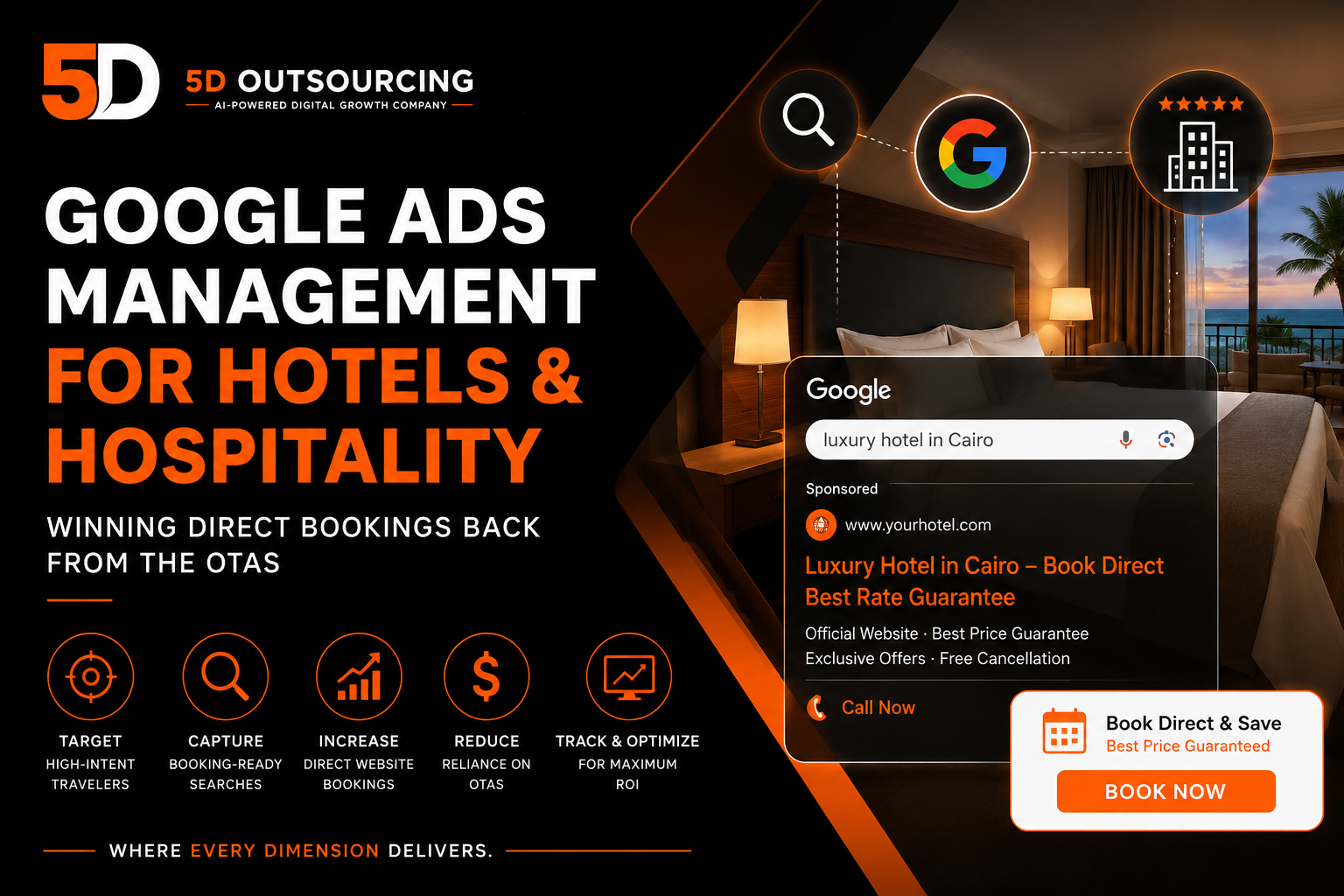
Google Ads Management for Hotels & Hospitality: Winning Direct Bookings Back From the OTAs
Most hotels in Egypt do not lose direct bookings to the hotel down the road. They lose them to the online travel agencies that already have the guest’s attention — and, more often than management realizes, to OTAs bidding on the hotel’s own name in Google. A guest who intended to book with you directly ends up booking through a distributor instead, and the property pays a commission on a booking it had already won.
That is the central problem hotel Google Ads exists to solve, and it makes hospitality PPC structurally different from the lead-generation campaigns that dominate most agency playbooks. There is no form fill and no sales call. The conversion is a completed transaction with a real revenue value attached, made by a traveler who may have started researching two months earlier, on a different device, in a different country, in a different language and currency.
This page explains how we approach Google Ads for hotels in Egypt — resorts, city hotels, boutique properties, serviced apartments and hospitality groups: how the campaign architecture should be built, what to do about brand-term bidding, which Google ad products only exist for accommodation, why hotel conversion tracking breaks more often than in any other vertical, and how the whole thing is paced against a season rather than a calendar month.
Talk to a PPC Specialist on WhatsApp
Why Hotel PPC Is a Different Discipline From Lead-Generation Google Ads
A standard Google Ads program — build search campaigns around service keywords, write ad copy, drive traffic to a landing page, count the form fills — produces a technically competent account that will still underperform badly for a hotel. Three structural differences explain why, and each one changes the campaign build.
You are not only competing with other hotels. You are competing with your own distributors
Online travel agencies are simultaneously your largest source of bookings and your most aggressive competitor in search. They have far larger advertising budgets than any individual property, sophisticated bidding infrastructure, and — critically — a commercial incentive to intercept demand that was already heading to you. When a traveler searches your hotel’s exact name, the results they see frequently include several OTA listings for your property before they reach your own website.
Every one of those intercepted bookings carries a distribution cost. Commission rates are negotiated per contract and vary by channel and market; the figures commonly reported in the hospitality industry sit in the region of fifteen to twenty-five percent, but we would treat that as an industry-reported range rather than a confirmed number for any specific property. What matters for the campaign decision is simpler: whatever your actual commission is, the cost of a click on your own brand term is almost always a fraction of it. That arithmetic drives most of what follows.
The conversion is a transaction, not a lead
This is genuinely good news, and most hotel accounts fail to exploit it. Unlike a clinic or a law firm, a hotel knows the exact revenue value of every conversion at the moment it happens — the room rate, the length of stay, the arrival date. That makes value-based bidding possible in a way it simply is not for lead-generation businesses, provided the tracking is implemented correctly.
It also raises the stakes on measurement. A lead-gen campaign can be optimized on cost per lead and still be roughly right. A hotel campaign optimized on cost per booking, with no revenue value attached, will systematically overinvest in one-night low-rate stays and underinvest in the seven-night bookings that actually carry the property. The economics of this are closer to e-commerce than to services — the same logic we set out in our guide to Google Ads and PPC for e-commerce stores, where the conversion also carries a variable transaction value.
Demand is seasonal in two directions at once
Most businesses have one seasonality curve. A hotel in Egypt has at least two running simultaneously: the destination’s own season, and the outbound travel season of each source market. A Red Sea resort’s European demand peaks when Northern Europe is cold; its Gulf demand follows a different rhythm shaped by summer heat and school holidays; its domestic demand follows Egyptian holidays and long weekends. Cairo city hotels layer business travel and conference demand on top of leisure, with their own weekday-weekend inversion.
A single national campaign with one budget and one bid strategy cannot serve those curves. They peak at different times, convert at different rates, tolerate different costs per click, and often require different languages. Campaign structure has to reflect that from the start rather than be patched later.
The Brand-Term Question Every Hotel Asks First
“Why should we pay Google for traffic that was searching for us anyway?” It is the right question, it comes up in every hospitality engagement, and it deserves a real answer rather than a reflexive agency yes.
Why OTAs bid on your property’s name
Because it works, and because the economics favor them. A traveler searching a specific hotel name has already made most of the decision — they are at the highest-intent point in the entire funnel. Intercepting that search costs the OTA a click and earns them a commission on a booking they contributed nothing to generating. Some distribution contracts restrict brand bidding; many do not, and enforcement is inconsistent. Check your own contracts before assuming you have protection you do not have.
The case for defending your brand terms
Brand keywords are typically the cheapest clicks in a hotel account, because your own property is the most relevant possible result for its own name — relevance drives quality, and quality lowers cost. Against a commission you would otherwise pay on the same booking, the comparison is usually not close.
Defending brand terms also gives you control the organic result cannot: you choose the headline, you can state your direct-booking advantage, you can point the click at the booking engine rather than the homepage, and you can run sitelinks to the specific room types, offers or F&B pages that convert.
The case against — and how to test it honestly
The argument against is real: if you already rank first organically for your own name and no competitor or OTA is bidding above you, brand ads may cannibalize clicks you would have received for free. The honest position is that this is testable rather than something to assume in either direction.
The test is straightforward — pause brand campaigns for a defined period, and measure total direct bookings, not just paid bookings. If total direct volume holds, the ads were cannibalizing. If it drops, they were defending. Run it long enough to clear your booking window and avoid running it across a demand spike, or the seasonality will drown the signal. We would rather run that test with a property than bill for a campaign we cannot justify, and the general principle behind it is covered in our A/B testing guide.
The Google Ads Products That Only Exist for Accommodation
Hospitality has ad formats no other vertical can use, and a large share of hotel accounts in this market never touch them — running only standard search campaigns and leaving the formats built specifically for their business unused.
Hotel ads and free booking links
Google supports accommodation-specific advertising in which your rates and availability appear directly in the hotel results and map surfaces, alongside the OTAs listing the same property. Google also supports free booking links, which allow a property’s direct rates to appear without paid placement. Both require your rates and availability to be fed to Google — usually through a connectivity partner, channel manager or booking engine provider that supports the integration.
This is the single highest-leverage item on most hotel accounts we audit, for a specific reason: it places your direct rate next to the OTA rate at the exact moment the traveler is comparing them. Everywhere else in the funnel you are arguing that booking direct is better. Here you are simply showing it. Whether a given property can use it depends on what its booking engine and channel manager support, which is a technical question to answer before budget planning, not after.
Metasearch, and where it fits
Travelers comparing accommodation frequently do so on metasearch surfaces rather than in standard search results. Participation is a distribution decision as much as an advertising one, and it should be evaluated on the same commission-versus-cost arithmetic as brand defense: what does a direct booking acquired here cost, compared with the same booking arriving through a commissioned channel?
Where Performance Max helps, and where it quietly cannibalizes
Performance Max can extend reach across surfaces a search-only account never touches. The practitioner concern — and we would label this as widely observed in the industry rather than confirmed by Google — is that in accounts without careful brand exclusions, Performance Max can absorb brand-term traffic and report it as newly generated demand. For a hotel, where brand searches are both high-volume and high-intent, that inflates apparent performance while adding little incremental revenue.
Our position is to use it deliberately, with brand exclusions applied, and to hold it to the same incrementality standard as any other campaign type rather than trusting the reported return at face value.
Campaign Architecture for a Hotel or Resort
A hotel account should be built as several distinct campaign groups with separate budgets, because they serve different intents at different costs and cannot be allowed to compete for the same pool of money.
Brand defense
Your property name, common misspellings, name plus “official”, name plus “booking”, name plus “direct”, and name plus location. Tightly matched, separately budgeted, and never merged with generic campaigns — if brand and generic share a budget, brand’s superior metrics will consume it and your acquisition of new demand quietly stops.
Destination and category demand
The genuinely competitive layer: hotels in a destination, resorts with a given feature, accommodation for a trip type. Costs per click are higher and conversion rates lower, because the traveler has not yet chosen a property. This is where budget discipline and negative keywords matter most, and where the ad copy has to do real differentiation work rather than just state the property name.
Source-market campaigns
Separated by geography, because a traveler searching from Riyadh, from Milan and from Cairo are three different buyers with different seasons, different booking windows, different devices, different languages and different price sensitivity. Running them in one campaign averages all of that into a bid strategy that fits none of them.
For properties drawing meaningfully on Gulf demand, the regional context in our market guides is directly relevant — Saudi Arabia, the UAE, Qatar and Kuwait each behave differently as source markets and should not be treated as one GCC block.
F&B, events, spa and day-use — the revenue most hotels never advertise
City hotels in particular carry substantial non-room revenue that almost never appears in the ad account: restaurants, brunches, weddings and private events, spa and pool day passes, meeting rooms. These are local-intent searches with completely different geography, seasonality and conversion paths than room bookings, and they are usually far cheaper to win because no OTA is competing for them.
Wedding and event inquiries in particular behave like classic lead generation rather than transactions, which means they need their own conversion path, their own landing pages and their own follow-up process — the discipline covered in our landing page optimization guide and, for the follow-up, marketing automation and CRM integration.
Corporate, MICE and long-stay
Corporate accounts, conference and event business, and extended-stay demand are B2B sales cycles wearing a hospitality label. They convert through inquiry and negotiation, not through the booking engine, and the searcher is a procurement or events manager rather than a traveler. Where this segment matters to a property, LinkedIn Ads often reaches the decision-maker more precisely than Google can, because the targeting is by role rather than by query.
Source Markets, Language and Currency
Language is not a translation setting
Arabic and English campaigns are not the same campaign in two languages. They surface different competitors, carry different costs per click, and reflect different search behavior — and a Gulf traveler searching in Arabic is not looking for the same things, or using the same terms, as a European traveler searching in English. Ad copy, extensions, landing pages and the booking engine itself all need to work in the language the campaign is targeting, or the click arrives somewhere the traveler cannot transact.
Currency, and the moment a rate stops looking like a deal
A rate that reads as excellent value in one currency can read very differently in another, and a booking engine that displays only Egyptian pounds to an international traveler introduces friction at precisely the wrong moment. If your engine supports currency display by market, use it. If it does not, that is a booking-engine limitation worth quantifying, because it is costing conversions on every international campaign you run.
The Booking Engine Is Your Landing Page — and Usually the Problem
In most hotel accounts we audit, the ads are not the weakest component. The path from click to confirmed booking is.
Speed, and the third-party booking engine
Hotel websites are image-heavy by necessity, and most hand the actual transaction to a third-party booking engine loaded in an iframe or on a separate domain. That combination produces some of the slowest transaction paths on the web. Every second of delay costs conversions on traffic you have already paid for, which makes performance work one of the highest-return investments available to a property running paid media — see website speed and performance optimization, and where hosting is the constraint rather than the code, our web hosting and domain package.
The handoff where bookings die
The transition from the hotel’s own site to the booking engine is where most hotel funnels leak: the design changes, the language sometimes resets, the currency sometimes resets, the selected dates are sometimes lost, and the traveler is left unsure whether they are still dealing with the hotel. Every one of those is fixable, and each fix compounds across every campaign in the account.
The structural problem is the same one e-commerce faces at checkout, and the diagnostic approach transfers directly — our analysis in CRO for e-commerce stores: fixing cart abandonment and checkout friction applies almost line for line to booking abandonment. The broader engagement is conversion rate optimization services, and if your site is already receiving traffic and producing few bookings, why your website gets traffic but no leads is the right starting diagnosis.
What to test first
In rough order of return: date and occupancy persistence through the handoff; mobile completion of the full booking flow; visible direct-booking benefits at the rate-comparison moment; currency and language continuity; and the number of steps between rate selection and confirmation. The underlying principles are in our UX optimization guide and conversion funnel explained.
Where the booking engine itself is the ceiling — no mobile optimization, no currency handling, no way to pass conversion data back — the honest answer is that the engine needs replacing rather than the campaigns needing more budget. Sometimes the fix is a site rebuild: WordPress development, a website redesign, or our website design and development package, with website development cost in Egypt setting realistic expectations on budget.
Conversion Tracking That Actually Works Across a Booking Engine
Why hotel tracking breaks more often than any other vertical
Because the booking usually completes on a domain the hotel does not control. Cross-domain tracking has to be configured deliberately, and when it is not, the booking either goes unrecorded or is attributed to a referral rather than to the campaign that produced it. We regularly find hotel accounts optimizing toward the wrong campaigns for months because the revenue data reaching Google Ads was incomplete.
What proper measurement requires
- Cross-domain tracking configured between the website and the booking engine, so the session survives the handoff.
- Transaction value passed with the conversion — the actual booking revenue, not a flat placeholder. Without it, value-based bidding is impossible and the account will favor cheap short stays.
- Cancellations accounted for. Gross bookings overstate performance in a business with meaningful cancellation rates. Where the engine can report cancellations back, the reporting should reflect net revenue.
- Non-room conversions tracked separately — event inquiries, restaurant reservations, spa bookings — so they are not averaged into room performance.
- Phone and WhatsApp bookings captured. A meaningful share of hospitality bookings in this market close through direct contact rather than the engine, and an account that only counts online bookings undercounts its own performance.
Attribution across a long booking window
Travel research runs long. A guest may first search two months before arrival, return several times, switch devices, and book on a different one. Short attribution windows and last-click models will systematically credit the final brand search and undervalue the destination campaign that created the demand.
Be realistic about the limits here: no attribution model in a long, multi-device, partly offline funnel is exact. Anyone presenting hotel attribution as precise is presenting an estimate as a measurement. What we can do is set the windows and model appropriately, connect the booking system back to the source where the property’s systems allow it, and report the uncertainty honestly.
Seasonality and the Booking Window
Planning against two calendars
Hotel media planning works backward from the arrival date, not forward from the campaign start date. If a source market books sixty days ahead on average, the campaign driving those arrivals runs two months before the season you are filling. Budget planned by calendar month rather than by arrival month will consistently spend late.
Budget pacing through a season
Flat monthly budgets are the wrong instrument. Spend should follow the booking curve for each source market: heavier during that market’s research and booking window, lighter when it is not in market, with headroom retained for the late-booking layer. Different markets peak at different times, which is another reason they belong in separate campaigns with separate budgets.
The last-minute layer
Distressed inventory and short-notice demand behave differently from advance booking — shorter consideration, higher urgency, more mobile, more local and regional. It warrants its own campaigns that can be activated and paused against occupancy rather than left running year-round. Budget behavior in these compressed, competitive windows is covered in our PPC cost guide.
Rate Parity, Ad Copy, and What You Can Actually Promise
Distribution contracts frequently include rate parity provisions restricting a hotel from publicly undercutting the rates it gives its distributors. The specifics vary by contract and by jurisdiction — some markets have restricted the broadest forms of these clauses, and we would not assert what applies to any given property without seeing its agreements.
The practical consequence for ad copy is that “cheapest rate guaranteed” claims may not be available to you. What usually is available: value that is not rate. Room upgrades subject to availability, flexible check-in or check-out, complimentary breakfast, resort or parking credit, loyalty benefits, direct cancellation flexibility, and simply the fact that booking direct means dealing with the property rather than an intermediary if plans change.
Those are often more persuasive than a small price difference anyway, and they are yours to offer. Have your commercial team confirm what the contracts permit before the copy goes live rather than after.
Where Google Ads Hands Off to Everything Else
Paid search buys immediate visibility. It does not build the durable asset, and a property running only paid media is renting its demand permanently.
Organic and local visibility
The Google Business Profile is not optional for a hotel — it drives map visibility, carries the review layer travelers read before booking, and feeds the local results that paid campaigns cannot fully cover. See Google Business Profile optimization and local SEO strategy. The broader trade-off between building organic and buying reach is set out in SEO versus Google Ads.
AI search and the “where should I stay in…” query
A growing share of destination research now happens inside AI assistants and AI-generated results, where a traveler asks for recommendations and receives a synthesized answer citing a small number of sources. Paid search does not appear in that answer. Being cited there depends on the property being a clearly recognized entity with consistent, structured, verifiable information across the web.
The mechanics are in our guides to generative engine optimization, optimizing for Google AI Overviews, AI search ranking factors and entity optimization. For a baseline on where a property currently stands, an AI search audit is the starting point, with AI search consulting as the strategy layer.
Social, and the inspiration layer
Hospitality is one of the few categories where interruption marketing genuinely works, because travel is aspirational and visual. Facebook and Instagram ads create demand that Google then captures when the traveler starts searching, and the two work best as a sequence rather than as alternatives — the reasoning is in Google Ads versus Facebook Ads. For properties building an organic social presence alongside it, our social media starter package is the usual entry point.
Measuring Hotel PPC Against Revenue, Not Clicks
The metrics that mean something
Return on ad spend calculated on actual booking revenue, net of cancellations. Cost per acquisition compared against the commission the same booking would have cost through a distributor — the single most useful number in a hospitality account, because it frames paid media as a distribution cost rather than a marketing expense. Direct booking share as a percentage of total bookings, tracked over time. Average booking value and length of stay by campaign, so you can see which campaigns bring the guests worth having. And occupancy contribution by source market.
Click-through rate, impression share and cost per click remain useful as diagnostics. They are not outcomes, and a report built on them is a report avoiding the revenue question.
The blended view
The strategic question is not “what is our ROAS” — it is what a booking costs across all channels, and whether shifting share from commissioned distribution to direct acquisition improves total contribution. Answering that requires the property’s booking data alongside the ad data, which is a systems question as much as a marketing one. Where a hotel wants that loop closed, it is what marketing automation and CRM integration is built for.
Common Mistakes That Cost Hotels Direct Bookings
- Not defending brand terms while OTAs bid on them. The most expensive omission available, and the easiest to fix.
- One campaign for all source markets. Averages away every difference that matters.
- No transaction value passed to the conversion. The account optimizes toward cheap short stays because that is all it can see.
- Broken cross-domain tracking to the booking engine. Months of optimization against incomplete data.
- Sending paid traffic to the homepage rather than to a page matching the search — dates prefilled, right room type, right offer.
- Ignoring hotel-specific ad formats and free booking links — leaving the products built for your business unused.
- Performance Max with no brand exclusions, absorbing brand demand and reporting it as new.
- Flat monthly budgets in a business where demand arrives in waves against arrival dates.
- Never advertising F&B, events, spa or day-use — uncontested local revenue left on the table.
- Counting gross bookings. Cancellations are real; reporting that ignores them overstates everything.
- Optimizing ads while the booking engine stays slow and clunky. Paying more for traffic that a fixable funnel keeps losing.
- Judging paid media against a marketing budget rather than against distribution cost. The wrong comparison produces the wrong decision.
How 5D Manages Google Ads for Hospitality
How an engagement is scoped
We start with an audit before proposing spend: current account structure and where budget is actually going; whether brand terms are defended and who else is bidding on them; conversion tracking integrity across the booking engine, including whether revenue values are being passed at all; booking engine performance and the mobile completion path; source-market mix against campaign structure; what hotel-specific formats the property’s technology stack can support; and the non-room revenue that is currently unadvertised.
That produces a plan sequenced against your arrival calendar and your source markets, not against a generic month one through twelve. In most cases the tracking and booking-path fixes come before any budget increase, because raising spend on a funnel that leaks is the fastest way to waste money we can think of.
Our Google Ads management runs on a minimum six-month engagement, with packages starting at 15,000 EGP per month and scaling to 25,000 and 40,000 EGP as account complexity increases — a single property with two source markets and a multi-property group running several languages and seasons are genuinely different scopes. Advertising media spend is separate from the management fee. Package detail is on our Google PPC Starter Package page, and broader budget context in digital marketing packages and pricing in Egypt. The full service view is Google Ads and PPC management services.
Where this connects to the rest of the growth system
Paid search is one dimension of the digital marketing and AI search engine we run, and for a hotel it works best alongside the organic and AI-search visibility that survives when campaigns pause, the SEO program that builds it, the social layer that creates demand before anyone searches, and the website and booking path where every campaign either converts or does not. The complete channel view for this sector is our pillar page on digital marketing and AI search for hospitality and hotels in Egypt.
Whether a property needs all of that is a question we would rather answer after an audit than assume in advance. Some hotels need a full program. Some need brand campaigns switched on and their conversion tracking repaired, and would be poorly served by anything larger. We are a strategic growth partner rather than a vendor selling the biggest available scope, and the diagnosis comes before the prescription. You can read more about 5D Outsourcing, browse the full range of packages, or see our frequently asked questions.
Related Guides and Services for Hotels and Hospitality
Paid media foundations: Google Ads and PPC management · PPC cost guide · why your ads are not converting · the role of PPC in digital marketing · Facebook and Instagram ads · LinkedIn Ads for B2B
Turning clicks into bookings: CRO services · checkout and cart abandonment · landing page optimization · conversion funnel explained · UX optimization · traffic without conversions · A/B testing
Organic and AI visibility: SEO versus Google Ads · local SEO strategy · Google Business Profile optimization · generative engine optimization · Google AI Overviews · zero-click optimization
The website and booking path: speed and Core Web Vitals · WordPress development · website redesign · maintenance and support · technical SEO audit checklist
How other sectors handle paid search: Google Ads for real estate (high-value, long consideration) · Google Ads for healthcare (restricted advertising categories) · Google Ads for e-commerce (transaction-value bidding)
Frequently Asked Questions
Should we bid on our own hotel name in Google Ads?
In most cases yes, and the reason is arithmetic rather than ideology: a brand click is typically one of the cheapest in the account, while the same booking arriving through a distributor carries a commission. If no OTA or competitor is bidding on your name and you already rank first organically, the case is weaker — and that is testable by pausing brand campaigns and measuring total direct bookings, not just paid ones, over a period long enough to clear your booking window.
How is Google Ads for a hotel different from other businesses?
The conversion is a transaction with a known revenue value rather than a lead, which makes value-based bidding possible. Your own distributors compete against you in the auction. There are ad formats specific to accommodation that no other vertical can use. Demand follows arrival dates and source-market seasons rather than calendar months. And the booking usually completes on a third-party engine, which makes tracking harder than in almost any other category.
What budget does a hotel need for Google Ads?
It depends on the property’s size, its source markets, its season, and how contested its destination is — a boutique city hotel and a large Red Sea resort targeting four countries are not comparable. What we can say is that management fees and media spend are separate, and that the useful benchmark is not a marketing budget but your current distribution cost: what you already pay in commission to fill the same rooms. Our PPC management starts at 15,000 EGP per month; the media budget is set from the audit.
Can Google Ads reduce our OTA commission costs?
It can shift booking share toward direct channels, which reduces commission on the bookings that shift. We would frame that as the realistic objective rather than promising a commission reduction figure, because the outcome depends on your rate competitiveness, your booking engine, your season and your market. Any agency quoting you a specific percentage before seeing your data is guessing.
Do we need Google Hotel ads and free booking links, or are search campaigns enough?
Search campaigns alone leave out the surface where travelers actually compare rates for your specific property. Hotel-specific formats and free booking links put your direct rate alongside the OTA rates at the comparison moment. Whether you can use them depends on your booking engine and channel manager supporting the required connectivity — a technical question worth answering before you plan budget.
Our bookings happen on a separate booking engine domain. Can conversions still be tracked?
Yes, with cross-domain tracking configured properly and transaction values passed back with the conversion. This is the most common thing we find broken in hotel accounts, and it matters more than any bidding change — an account optimizing on incomplete revenue data will make confidently wrong decisions for as long as it runs.
How far in advance should campaigns run before a season?
Work backward from your average booking window per source market rather than from the calendar. If a market books around two months ahead, the campaign filling that season runs two months before it. Markets with longer lead times need earlier starts, and running them all on one schedule means arriving late for some and early for others.
Should we advertise our restaurant, spa and events separately?
Usually yes, and it is often the most overlooked opportunity in a hotel account. Non-room revenue targets local rather than travel intent, has different seasonality, and faces no OTA competition — which typically makes it cheaper to win than room bookings. Event and wedding inquiries in particular behave as lead generation and need their own landing pages and follow-up process.
Can you guarantee a specific occupancy or revenue increase?
No. Occupancy depends on rate strategy, product, competitive supply, market conditions and factors well outside any advertising account. We commit to method, structure, measurement and reporting against real booking revenue — not to an occupancy number. Any agency guaranteeing one is selling something it cannot control.
We already work with OTAs. Does paid search cannibalize that?
Partly, and deliberately. The strategic point is that a booking arriving direct costs you an ad click, while the same booking arriving through a distributor costs a commission. Shifting a portion of demand toward direct improves contribution per booking. Most properties are not trying to eliminate distribution — OTAs deliver genuine reach and discovery — but to stop paying commission on demand that was already theirs.
Start With an Audit, Not a Budget Increase
If you are running Google Ads already, the first question is not how much more to spend — it is whether your brand terms are defended, whether your conversion tracking is passing real booking revenue, and whether your booking path is losing guests you have already paid for. Those three usually matter more than the budget line. If you are not running paid search yet, the starting point is the same audit, plus an honest look at what your current distribution mix is costing you.
Leave a Reply