
No products in the cart.
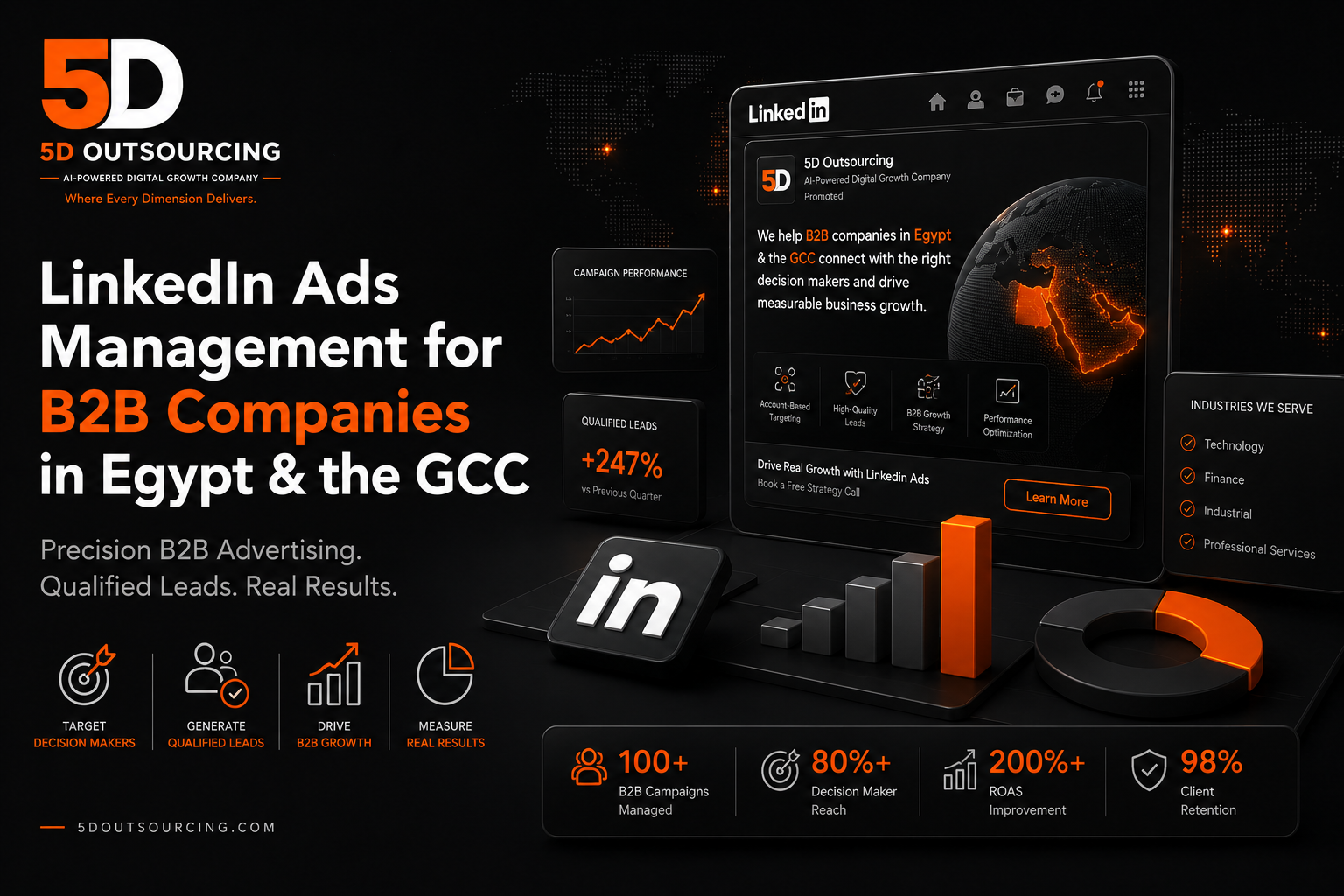
LinkedIn Ads Management for B2B Companies in Egypt & the GCC
Neither Google Ads nor Facebook and Instagram Ads can do what LinkedIn does natively: target by job title, seniority, company size, and industry, reaching the specific professional decision-maker a B2B business actually needs to reach, rather than a broader audience defined by personal interests or search behavior. For manufacturing, SaaS, logistics, and other B2B categories we work with, this precision often justifies LinkedIn’s higher cost per click when the alternative is paying for a much larger volume of clicks from people who were never the actual buyer in the first place.
Why LinkedIn Fills a Gap Google and Facebook Ads Don’t
Our Google Ads vs. Facebook Ads comparison covers search intent versus interest-based targeting, but neither platform lets you target specifically by professional role. LinkedIn’s targeting is built entirely around professional identity — job title, function, seniority level, company size, and industry — making it uniquely suited to reaching a specific type of business decision-maker directly, rather than hoping the right person happens to fall within a broader demographic or interest audience.
How LinkedIn Ads Work for B2B
Precise professional targeting
Campaigns can be built around exact job titles, seniority levels, company size, industry, and even specific named accounts — a level of professional targeting precision Google and Facebook simply don’t offer, since neither platform organizes its data around professional identity the way LinkedIn does natively.
Higher cost per click, but higher relevance for B2B
LinkedIn typically carries a meaningfully higher cost-per-click than Google or Facebook Ads, reflecting both the platform’s smaller scale and the premium advertisers pay for this precision — the right comparison isn’t cost-per-click in isolation, but cost per qualified B2B lead, where LinkedIn frequently outperforms broader platforms despite the higher sticker price.
Native lead generation without leaving the platform
LinkedIn’s Lead Gen Forms auto-populate with a user’s LinkedIn profile information, letting prospects submit an inquiry without leaving the platform or manually filling out a form — reducing friction meaningfully compared to sending a click to an external landing page, particularly on mobile.
Account-based marketing capability
For businesses running account-based marketing strategies, LinkedIn allows targeting specific named companies directly — a capability particularly relevant for B2B sales teams pursuing a defined list of target accounts rather than a broad, undefined market.
LinkedIn Ad Formats
Sponsored Content
Native ads appearing directly in the LinkedIn feed, generally the most commonly used format for both awareness and lead generation campaigns, since they blend naturally with organic professional content.
Message Ads and Conversation Ads
Ads delivered directly to a prospect’s LinkedIn inbox, useful for more personal, direct outreach-style messaging — though they require careful, non-spammy execution to avoid feeling intrusive to a professional audience.
Lead Gen Forms
As covered above, these native forms reduce friction for B2B lead capture directly within the platform, often producing higher form completion rates than sending traffic to an external landing page.
Text and Dynamic Ads
Smaller-format ads appearing in the LinkedIn sidebar, generally lower cost but also lower visibility than Sponsored Content — useful as a supplementary format rather than a primary campaign driver.
Building a LinkedIn Campaign That Actually Converts
Targeting built around the real decision-maker, not just the industry
Effective LinkedIn campaigns target specific job functions and seniority levels relevant to the actual purchasing decision — a campaign aimed broadly at “manufacturing industry” without job title or seniority filtering wastes much of LinkedIn’s core targeting advantage.
Content built for a professional context
Ad creative and messaging should reflect the more professional, less casual context LinkedIn users are in compared to Facebook or Instagram — leading with genuine business value and credibility rather than the more casual or emotionally driven messaging that performs well on consumer social platforms.
Landing pages matched to a B2B evaluation process
Given the longer B2B sales cycles covered in our manufacturing and SaaS marketing articles, LinkedIn landing pages should reflect that reality — offering substantive content (a demo, a consultation, a technical resource) rather than expecting an immediate purchase decision, following the same principles in our landing page optimization guide.
Conversion tracking built around qualified leads, not clicks
Given LinkedIn’s higher cost per click, performance should be measured on qualified lead volume and, where trackable, progression to actual sales conversations — not raw click count, connecting to the same funnel-stage thinking covered in our conversion funnel guide.
Which B2B Industries Benefit Most From LinkedIn Ads
LinkedIn tends to perform particularly well for categories where the buyer is a specific, identifiable professional role — manufacturing procurement and engineering contacts, SaaS decision-makers evaluating software purchases, logistics and supply chain managers, and financial or professional services buyers. This overlaps directly with the B2B verticals covered elsewhere on this site, where Google Ads captures active search intent and LinkedIn adds precision targeting for reaching the specific professional role behind that search.
LinkedIn Ads for GCC Expansion
For Egyptian businesses expanding into Saudi Arabia, UAE, and the wider GCC, LinkedIn’s professional targeting extends naturally across borders — company size, industry, and job title filtering work the same way for a regional audience as a domestic one, making it a practical channel for reaching GCC-based B2B decision-makers without needing an entirely separate regional strategy. This connects to our broader business development services for companies pursuing regional expansion.
What LinkedIn Ads Typically Cost
LinkedIn generally carries the highest cost-per-click among major ad platforms, reflecting both smaller platform scale and the value of its professional targeting precision. For a general framework on how PPC budgets should be evaluated across platforms, see our PPC cost guide — LinkedIn campaigns should be budgeted and measured against cost-per-qualified-lead rather than compared directly against Google or Facebook’s lower cost-per-click figures.
Common Mistakes in LinkedIn Ads Campaigns
- Targeting broadly by industry alone without filtering by job title or seniority, wasting LinkedIn’s core precision advantage
- Using consumer-style, casual ad creative that doesn’t match the professional context LinkedIn users are in
- Sending traffic to a generic landing page instead of using native Lead Gen Forms to reduce B2B friction
- Comparing LinkedIn’s cost-per-click directly against Google or Facebook without accounting for the higher relevance and lead quality it typically delivers
- Expecting an immediate purchase decision instead of building campaigns around the longer B2B evaluation cycle
- No structured testing of targeting and creative — see our A/B testing guide for the framework this should follow
Frequently Asked Questions
Is LinkedIn Ads worth the higher cost compared to Google or Facebook?
For B2B businesses targeting a specific professional decision-maker, LinkedIn’s precision targeting often delivers a better cost-per-qualified-lead despite the higher cost-per-click, since the audience is inherently more relevant to a defined business buyer.
What businesses benefit most from LinkedIn Ads?
B2B businesses selling to a specific, identifiable professional role — manufacturing procurement, SaaS decision-makers, logistics managers, and professional or financial services buyers — tend to see the strongest results from LinkedIn’s job title and seniority targeting.
What are LinkedIn Lead Gen Forms?
Native lead capture forms that auto-populate with a user’s LinkedIn profile information, letting prospects submit an inquiry without leaving the platform or manually completing a form, reducing friction compared to an external landing page.
Can LinkedIn Ads target specific companies?
Yes, LinkedIn supports account-based marketing targeting, allowing campaigns to focus on specific named companies rather than a broad, undefined market — particularly useful for B2B sales teams pursuing a defined target account list.
How does LinkedIn Ads compare to Google Ads for B2B lead generation?
Google Ads captures active search intent from people already looking for a solution, while LinkedIn adds precision targeting by professional role — many B2B businesses use both together, with Google Ads capturing search-driven demand and LinkedIn reaching specific decision-makers directly.
How 5D Outsourcing Manages LinkedIn Ads for B2B Companies
5D Outsourcing manages LinkedIn Ads campaigns for B2B companies in Egypt and across the GCC as part of an integrated growth strategy. Our LinkedIn Ads work typically includes:
- Precision targeting built around real decision-maker job titles, seniority, and company profile
- Campaign structure combining Sponsored Content, Lead Gen Forms, and, where relevant, account-based targeting
- Landing page and lead capture strategy matched to longer B2B evaluation cycles
- Conversion tracking built around qualified leads, not raw click volume
- Coordination with Google Ads campaigns for a complete B2B paid strategy
This work sits alongside our broader Google Ads and PPC management services and Facebook and Instagram Ads management services, all coordinated through our core digital marketing and AI Search capability.
Leave a Reply