
No products in the cart.
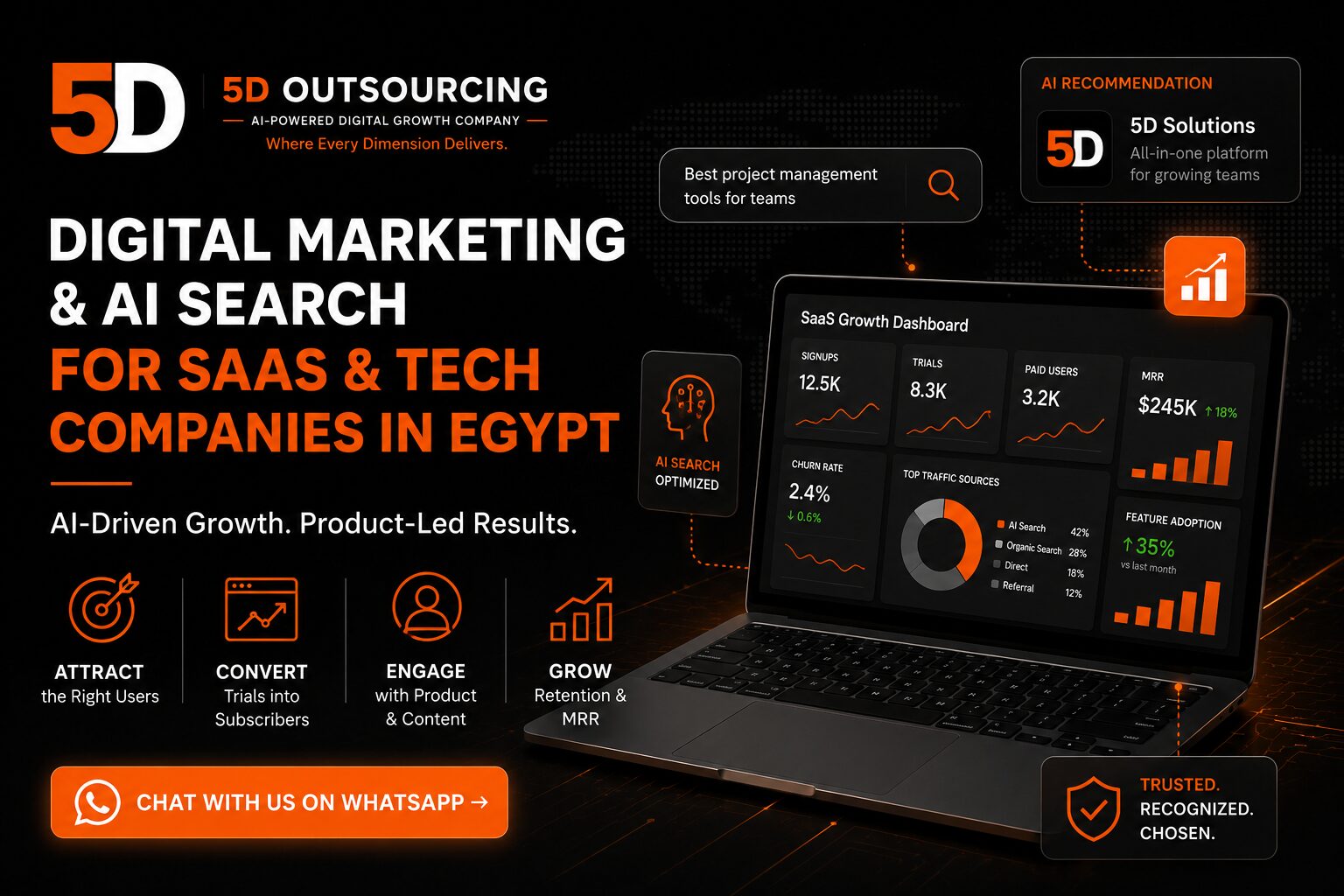
Digital Marketing & AI Search for SaaS & Tech Companies in Egypt
A SaaS company doesn’t sell a product in the traditional sense — it sells ongoing access, which means the marketing job doesn’t end at the sale. It has to attract the right kind of user, convince them to start a trial or demo, and build enough trust during that trial that they convert to a paying subscriber and stay one. That’s a fundamentally different marketing problem than almost every other category we’ve covered — closer to a continuous relationship than a single transaction, and increasingly shaped by how AI systems now discover and recommend software in the first place.
At 5D Outsourcing, we build digital marketing and AI Search systems for B2B and technology-driven businesses across Egypt and the GCC, including SaaS and software companies competing in a category where AI search visibility increasingly determines which tools even make it onto a buyer’s shortlist. This article explains what makes SaaS marketing structurally different from every other industry we work with, and what a real digital strategy for a software company actually needs to include.
Why SaaS Marketing Is a Different Kind of B2B
SaaS shares some DNA with the manufacturing and construction marketing we’ve covered — technical buyers, longer evaluation cycles, credibility built through substance rather than emotional appeal. But it diverges sharply in one critical way: the product itself is usually the primary conversion mechanism, through a free trial or demo, rather than a sales conversation happening entirely offline.
The trial or demo is the real conversion event, not the website form
Where a manufacturer’s website funnels a visitor toward a request-for-quote, and a law firm’s website funnels a visitor toward a phone call, a SaaS website’s most important job is usually funneling a visitor into the product itself — a free trial, a freemium signup, or a live demo. The marketing site’s role is to get someone into that experience with the right expectations and enough context to actually evaluate the product fairly.
Buyers actively research and compare before they’ll even start a trial
Software buyers, especially technical ones, rarely sign up for a trial blind. They compare feature sets, read reviews, check comparison and “alternatives to” content, and increasingly ask AI tools directly for software recommendations before ever landing on a vendor’s own site — meaning a SaaS company’s visibility outside its own domain often matters as much as the site itself.
Content has to serve both technical depth and genuine usefulness
SaaS audiences, particularly for developer tools and technical products, are quick to spot marketing content that’s shallow or evasive. Documentation-quality content, genuine technical guides, and substantive comparisons tend to build far more trust than promotional copy — much like the technical precision manufacturing buyers respond to, but applied to software concepts rather than material specifications.
Retention and churn make the marketing job continuous, not a single transaction
Because SaaS revenue is recurring, marketing’s job doesn’t stop at the sale — onboarding content, feature education, and continued engagement all influence whether a new subscriber sticks around long enough to become a stable, valuable customer. This is a meaningfully different mandate than most of the industries covered elsewhere on this site, where the marketing relationship largely ends once the deal closes.
Why AI Search Matters More for SaaS Than Almost Any Other Category
As covered in our guide to how AI search is changing SEO, users increasingly ask AI systems direct questions rather than browsing search results — and “what’s the best tool for X” is one of the most common categories of question AI assistants now field. This makes Generative Engine Optimization (GEO) and strong entity signals genuinely commercially critical for SaaS companies in a way that’s less pronounced in slower-moving, less digitally-native industries.
Comparison and “alternative to” content is exactly what AI systems synthesize
AI Overviews and conversational AI tools frequently generate software comparisons and recommendations by synthesizing information across multiple sources. Genuine, well-structured comparison content — covered in our GEO guide — gives a SaaS company a real chance of being one of the tools referenced in that synthesized answer, rather than left out entirely because the only comparison content available online comes from competitors or third-party review sites.
Entity recognition determines whether AI systems trust and cite a product
Our entity optimization guide explains how AI systems need consistent, structured, corroborated signals to confidently reference a brand. For SaaS specifically, this means consistent product naming, clear feature and pricing information, and structured data that helps AI systems understand exactly what the product does and who it’s for — work we deliver directly through our entity and knowledge graph optimization services.
Zero-click visibility still builds awareness even without a click
As explained in our zero-click optimization guide, being mentioned or cited in an AI-generated answer builds brand awareness and consideration even when the user doesn’t click through immediately — often planting the product name that gets searched directly later, once the buyer is further along in their evaluation.
SEO for SaaS Companies
Feature and use-case pages structured around search intent
Beyond a general product page, individual feature and use-case pages targeting specific buyer questions and search terms give search engines and AI systems far more surface area to understand and rank the product for — following the same on-page depth covered in our on-page SEO optimization guide, applied to distinct product capabilities rather than a single monolithic product page.
Genuine comparison and “versus” content
Honest, substantive comparison pages against relevant alternatives — not thinly veiled competitor attacks, but genuinely useful comparisons that help a buyer make an informed decision — tend to rank well, build trust, and, as covered above, are precisely the kind of content AI systems draw on when generating software recommendations.
Documentation and technical content as an SEO asset
For developer-facing tools especially, documentation, API references, and technical guides often attract meaningful organic traffic from developers actively solving a problem — traffic that frequently converts at a higher rate than generic marketing content, since it reaches people already deep in a relevant technical task.
A content engine built for a technical, skeptical audience
Sustained content production — following the systems covered in our AI content workflows guide and multi-format content pipelines guide — helps SaaS companies build the topical authority described in our SEO content strategy guide at the pace a competitive software category typically demands.
Technical SEO for JavaScript-heavy marketing sites
SaaS marketing sites are often built on modern JavaScript frameworks that can create their own crawlability and indexing challenges if not configured carefully — a technical consideration layered on top of the standard technical SEO foundation covered in our technical SEO audit checklist.
Content Strategy and Community for SaaS Brands
Brand voice consistency across a fast-moving content operation
As SaaS companies scale content production, maintaining a consistent, recognizable voice across every piece — covered in our brand voice engineering guide — becomes both harder and more important, since AI systems and readers alike use that consistency as a trust signal reinforcing the brand’s expertise.
Community-led growth as a genuine SaaS growth channel
Many of the strongest SaaS brands build growth through active user communities rather than advertising alone — a strategy covered in depth in our community-led growth guide, particularly relevant for developer tools and products with naturally social or collaborative use cases.
User-generated content as both trust signal and content engine
Customer reviews, case studies, and user-created content — covered in our UGC strategy guide — carry particular weight for SaaS buyers comparing tools, since independent user testimony is generally trusted more than a vendor’s own marketing claims.
PPC for SaaS Companies
Trial and demo signups as the primary conversion goal
Google Ads campaigns should be built around trial or demo signup as the core conversion action, with landing pages designed specifically for that goal rather than a generic contact form — following the same principles in our landing page optimization guide, adapted to a product-led rather than sales-led conversion path.
Competitor and category keyword targeting
SaaS PPC frequently includes bidding on competitor brand terms and category-defining keywords — a more aggressive keyword strategy than most other industries we work with, reflecting how directly comparison-driven SaaS buyer research tends to be.
Budget discipline given typically lower individual deal value than manufacturing or construction
Unlike manufacturing or construction, where a single closed deal can justify significant per-lead spend, SaaS subscription values are often lower per individual customer, making efficient cost-per-trial and cost-per-conversion tracking especially important — see our PPC cost guide for the general framework this builds on.
Website Development for SaaS Companies
A marketing site built to funnel visitors into the product
The website’s core job is getting the right visitors into a trial or demo with accurate expectations — meaning clear, honest product messaging, transparent pricing where appropriate, and a low-friction signup path matter more here than almost any other design consideration.
Fast, reliable performance as a credibility signal
A slow or unstable marketing site undermines confidence in the product itself for a technical audience — connecting directly to our website speed and performance optimization services and ongoing website maintenance and support, since technical buyers are quick to judge a software company by the quality of its own website.
Structured, testable landing pages
Given how directly measurable SaaS conversion paths are — trial starts, demo requests — this is a category particularly well suited to structured A/B testing and the funnel-stage thinking covered in our conversion funnel guide and UX optimization guide.
Building Toward the GCC as a SaaS Company
SaaS companies based in Egypt and expanding into Saudi Arabia, UAE, and the wider GCC face the same regional authority-building work covered in our manufacturing marketing article — demonstrated credibility, regional entity signals, and content built for GCC-specific buyer context. This connects to our broader business development services for technology companies pursuing regional expansion alongside their digital marketing strategy.
Measuring SaaS Marketing Performance
SaaS marketing performance should be measured through the full funnel — trial or demo signups, activation rate, and eventual conversion to paid — rather than top-of-funnel traffic alone, since a large volume of trial signups that never activate or convert reflects a targeting or onboarding problem more than a marketing success. Tracking AI visibility, using the framework in our how to measure AI search visibility guide, is increasingly relevant here too, given how much software discovery now happens through AI-assisted research.
What SaaS Digital Marketing Typically Costs in Egypt
SaaS marketing engagements are generally scoped around sustained content production, comparison and category content, technical SEO for JavaScript-driven sites, and conversion-focused landing page work — a content-heavy investment profile compared to more transactional categories. For general context on how SEO and PPC investment is typically structured, see our SEO pricing in Egypt guide and PPC cost guide, with SaaS engagements scoped individually based on product complexity, competitive category intensity, and content velocity required.
Common Mistakes in SaaS Marketing
- Websites funneling visitors toward a generic contact form instead of a clear trial or demo path
- No genuine comparison or “alternatives to” content, ceding that entire conversation to competitors and third-party review sites
- Marketing copy that reads as evasive to a technical audience actively looking for specifics
- Ignoring AI search visibility despite how often software buyers now ask AI tools directly for recommendations
- Measuring success on trial signups alone without tracking activation and conversion to paid
- Weak or unmaintained documentation content, missing a genuinely high-intent organic traffic source
- No community or user-generated content strategy despite how much SaaS buyers trust independent user testimony
How 5D Outsourcing Works With SaaS & Tech Companies
5D Outsourcing builds digital marketing and AI Search systems for SaaS and technology companies in Egypt and across the GCC as part of an integrated growth strategy. Our work for SaaS companies typically includes:
- Feature, use-case, and comparison page SEO built for both search engines and AI systems
- Content strategy connecting documentation, thought leadership, and community-led growth
- Google Ads campaigns built around trial and demo signup as the core conversion goal
- Conversion-focused landing pages refined through structured A/B testing
- Entity optimization and GEO strategy so the product surfaces in AI-generated software recommendations
- Website performance and maintenance support built for a technically discerning audience
- GCC market expansion support through our business development services
This work connects to our core digital marketing and AI Search capability and our full AI Search suite — consulting, audit, and implementation — giving SaaS and technology companies the same structured, integrated approach we apply across every industry we work with, built specifically around how software gets discovered, evaluated, and adopted today.
Chat With Us on WhatsApp →
Get a Digital Marketing Strategy Session →
Leave a Reply