
No products in the cart.
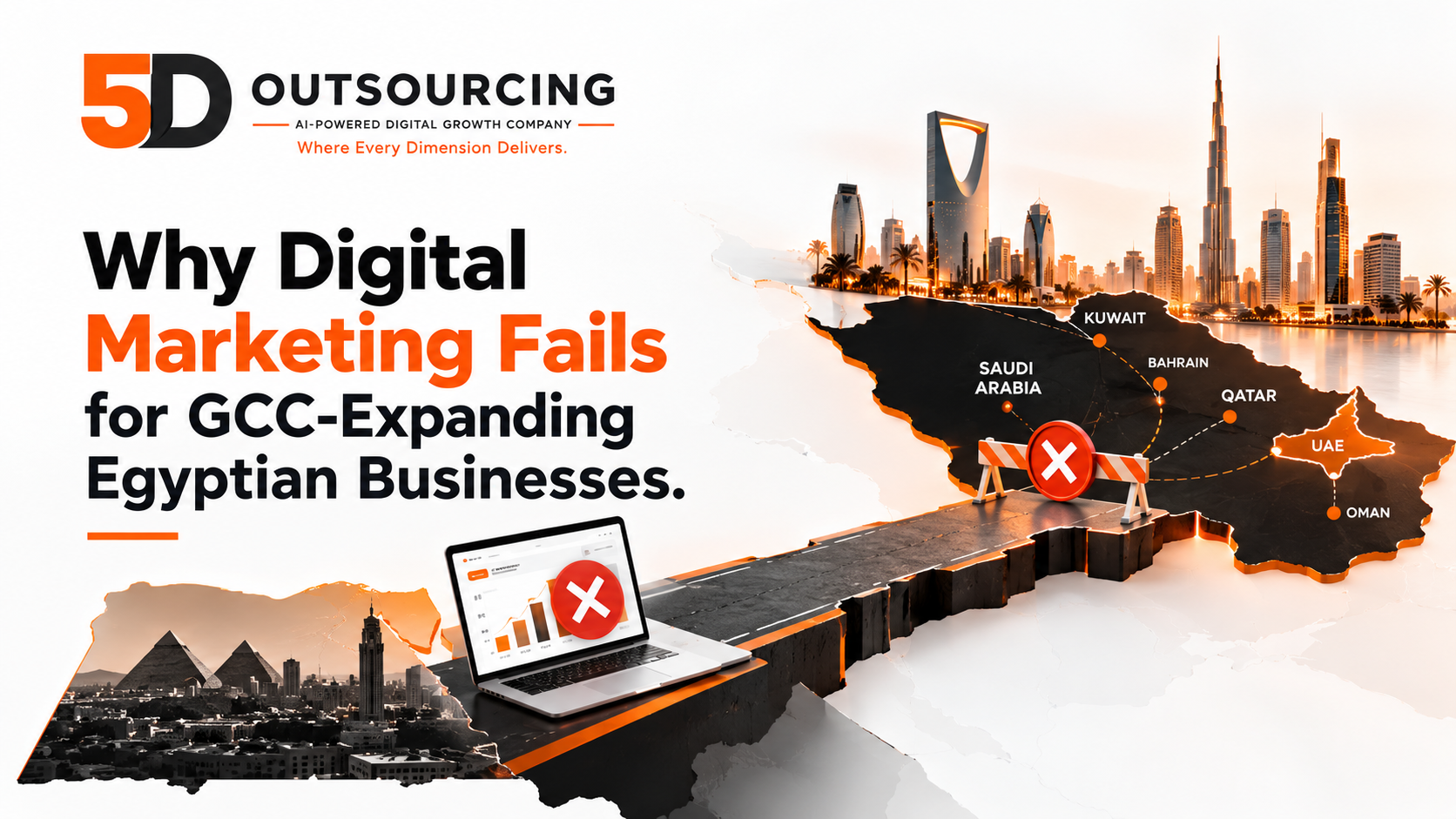
Why Digital Marketing Fails for GCC-Expanding Egyptian Businesses
Most Egyptian companies that fail in the Gulf do not fail at marketing. They fail at readiness, and marketing is simply the thing that makes the failure expensive and visible.
The pattern is consistent enough to predict. A company with a solid position in Egypt decides the Gulf is the growth market. It commissions campaigns, builds a landing page, runs ads targeting Saudi Arabia and the UAE, and waits. Inquiries arrive — fewer than expected, and of mixed quality. Some go quiet after the first exchange. A few ask a question the company cannot answer: can you invoice us locally, do you have a registered entity here, are you VAT registered, who do we call in Riyadh. Several months and a real budget later, the conclusion is “Gulf marketing does not work for us.”
What actually happened is that the marketing worked exactly as intended. It put the company in front of Gulf buyers, and those buyers discovered the company was not yet able to transact with them.
This page sets out why digital marketing fails for Egyptian businesses expanding into the GCC, what the real blockers are, and what to fix before spending on campaigns. We write it from a position of interest and some experience: 5D is an Egyptian company doing this ourselves, with Saudi Arabia as our own first expansion market, and we have made or come close to making several of the mistakes below.
Mistake 1: Treating “the GCC” as One Market
The single most common error, and it is built into the way most expansion plans are written. “We are expanding to the Gulf” is not a strategy, because the Gulf is not a market. It is six countries with different regulatory regimes, different business cultures, different buying processes, different competitive intensity and different search behavior.
Saudi Arabia and the UAE in particular reward completely different approaches. Simplifying, but usefully: Saudi Arabia is a larger domestic market where Arabic-language search matters more, local presence expectations are stronger, and government and semi-government procurement is a significant share of serious opportunity. The UAE is more international, more English-dominant in B2B, more crowded with regional and global competitors, and faster-moving commercially. Qatar and Kuwait are smaller, more relationship-driven, and often reached effectively only after one of the bigger two is working.
The practical consequence: one campaign targeting “GCC” will produce results you cannot interpret, because you will not know whether the performance came from one market working and another failing, or from everything being mediocre. One market at a time, properly, beats four at once, thinly. Our market-specific views are in our guides to Saudi Arabia, the UAE, Qatar and Kuwait.
Mistake 2: Marketing Before the Business Can Transact
This is the one that wastes the most money, and it is not a marketing problem at all.
Gulf buyers — particularly corporate and government buyers — frequently need things that an Egypt-only company cannot provide on day one: an invoice from a locally registered entity, tax registration in their country, a local bank account to receive payment, a contactable local presence, vendor registration on their procurement platform, and sometimes contractual terms governed by local law. In some sectors there are also data residency expectations, meaning client data must be stored in-country.
We will not list specific requirements, thresholds or tax rates here, because these vary by country and by sector and they change. What we will say plainly is this: find out what your target buyer needs from a supplier before you spend on reaching them, and verify it with a local advisor or the relevant authority rather than with an agency. Egyptian companies can and do invoice Gulf clients directly for services under a written contract, so this is not a blocker for every buyer; what varies is whether a specific buyer’s procurement accepts a foreign supplier. If the answer is that your best prospects cannot buy from an Egyptian entity, no campaign fixes that. Marketing will only accelerate the discovery.
Our interpretation, labeled as strategic interpretation rather than a documented finding: a large share of “GCC marketing did not work” stories are actually stories about companies that generated qualified demand they were structurally unable to convert.
Mistake 3: Making Price the Only Argument
In Egypt, cost advantage is frequently the winning argument. Many Egyptian companies therefore lead with price in the Gulf, and some stop there.
The cost level itself is not the problem. Gulf buyers generally know that Egyptian rates are lower and they understand the currency gap, and some look for Egyptian providers for exactly that reason, so a fair price is part of the appeal. The mistake is making it the only argument. A low price with nothing behind it gives a buyer nothing to defend internally, and it is the one argument any competitor can undercut. We have no Gulf-specific study for this; it is practitioner observation, not a documented finding.
The more durable position pairs verifiable capability with a defined scope and clear, transparent pricing, so the buyer sees both the cost advantage and the reason to trust it. That is a different message, a different website, and different sales material — not a translated version of the Egyptian one.
Mistake 4: Arabic That Signals “Foreign”
Arabic is not one register, and Gulf audiences notice immediately.
Egyptian colloquial Arabic is widely understood across the region, which creates a false sense of safety. Understood is not the same as appropriate. In Gulf-facing commercial communication, Modern Standard Arabic is the safer default for formal material, with Gulf register used where the context genuinely calls for it. Egyptian colloquial in a Saudi-facing proposal or landing page reads as a foreign company that did not bother to localize.
Two further points that get missed. First, keyword research must be done per market — the terms Gulf buyers search are frequently not the terms Egyptians use for the same service, and translating your Egyptian keyword list is not research. Second, English matters more than many Egyptian companies expect in UAE B2B contexts, so the language decision should follow your actual buyer rather than a general assumption about the region. The content framework for doing this properly is in our SEO content strategy guide.
Mistake 5: The Trust Signals That Worked in Egypt Do Not Transfer
An Egyptian company selling in Egypt relies heavily on relationships, referral and reputation that exists in people’s heads. None of that is visible to a Gulf buyer evaluating you cold.
What Gulf buyers tend to check instead: a registered entity and licensing, a local address and a local contact number, a verifiable business profile, named leadership with real credentials, client references from their own market, and a website that looks like it belongs to a company of the size you claim to be.
The hardest of these is in-market references, and it is genuinely circular: you need Gulf clients to win Gulf clients. The honest ways through it are to start with the one or two clients who will take a chance on you, document that work properly, and be transparent that your deeper track record is Egyptian. Pretending to a Gulf history you do not have is the fastest way to lose a deal at the diligence stage. The credibility layer sits in corporate website design and local visibility in local SEO strategy and Google Business Profile optimization — noting that a verified business profile generally requires a real, verifiable presence in that country, which brings us back to Mistake 2.
Mistake 6: A Website That Reveals You Are Not Really There
Gulf buyers read a website for signals of presence, and most Egypt-built sites fail several of them without the owner noticing.
The recurring giveaways: only an Egyptian phone number and address; prices in Egyptian pounds on a page aimed at Saudi buyers; case studies entirely from Egypt; business hours that do not match the target market’s working week; a contact form that assumes an Egyptian address format; and no market-specific pages at all, so a Saudi visitor lands on content written for Cairo.
Fixing this does not require a fake local presence — it requires being explicit. A page that says clearly “we are an Egyptian company serving Saudi clients, here is how we work with you, here is our local contact route, here is what we can and cannot do on invoicing” converts better than a page that is vague enough to raise the question without answering it. Speed matters too, since a site built and hosted for Egyptian visitors is not automatically fast for Gulf ones — see website speed and performance optimization.
Mistake 7: Running One Ad Account for Everything
Combining Egypt and the Gulf, or several Gulf markets, into one campaign structure produces data you cannot act on.
The markets have different competitive intensity and therefore different click costs, different language requirements, different landing page needs and different conversion rates. Merged into one campaign with one budget and one target cost per lead, the cheaper market absorbs the spend and the expensive one — which may be the strategically important one — never gets enough data to be judged.
Separate campaigns per market, separate budgets, separate landing pages, separate reporting. It is more work to set up and the only structure that lets you decide where to invest next. The platform-level trade-offs are in Google Ads and PPC management, with the B2B targeting route in LinkedIn Ads — frequently the better instrument for Gulf corporate buyers, who are often easier to reach by role than by search query. Where the leads arrive but do not convert, the diagnosis is in why ads are not converting.
Mistake 8: Expecting Egyptian Timelines
Sales cycles in Gulf corporate and government buying are typically longer than Egyptian companies plan for, involve more stakeholders, and frequently include a relationship-building stage that cannot be compressed by a campaign. In-person presence and introductions still carry weight that digital channels do not replace.
The budgeting error that follows is predictable: a three-month campaign is funded, judged on closed business at month three, and cancelled just as the pipeline it created starts to mature. If the real cycle is six to nine months, a three-month test cannot answer the question it was bought to answer — and the organic side compounds even more slowly, which is covered in why SEO is not working and the comparison in SEO versus Google Ads.
Mistake 9: No Way to Tell Which Market Is Working
Expansion decisions require market-level attribution, and most companies entering the Gulf cannot produce it.
If inquiries arrive by phone, WhatsApp and email into a shared inbox with no record of source or country, there is no way to know which market is producing opportunity, which channel produced it, or what a lead from Riyadh costs compared with one from Dubai. The expansion then gets managed on impressions rather than evidence.
The minimum viable setup is a CRM that records country and source at intake, separate tracking per market, and defined lead stages that mean the same thing to the sales team and the ad account. That is what marketing automation and CRM integration is for, and it should be in place before the campaigns rather than after.
Mistake 10: Ignoring the Entity Problem in Search and AI Answers
A company expanding into a new market becomes, briefly, an ambiguous entity: an Egyptian address in some places, a new Gulf presence in others, inconsistent descriptions, perhaps a second business profile and a second phone number.
Traditional search tolerated that reasonably well. AI-mediated search is less forgiving, because it works from resolved entities — it needs to know what your organization is, where it operates and what it does before it will confidently name you in an answer to “best X company in Riyadh.” Inconsistent data across markets is one of the easiest ways to be left out of that answer.
Getting this right means deciding the canonical facts about your organization and expressing them consistently everywhere, including in structured data. The mechanics are in entity optimization explained and generative engine optimization, with the broader shift in how AI search is changing SEO. A current-position assessment is an AI search audit.
What to Do Instead: A Sequence
The order matters more than any individual step.
1. Pick one market. Choose on the basis of where your capability is genuinely competitive, where you have any existing relationship to build on, and where the regulatory path is manageable — not on market size alone.
2. Establish what the buyer requires of a supplier. Entity, tax registration, invoicing, payment, procurement registration, data location. Verify with a local advisor. This determines whether you are running a marketing project or a company-formation project.
3. Decide the positioning for that market. Not a translation of the Egyptian one. Capability and proof first, with clear pricing rather than price as the only argument.
4. Build the market-specific assets. A page or section for that market, in the right language and register, with local contact routes, locally relevant proof, and explicit answers to the questions in step 2.
5. Put measurement in before spend. CRM with country and source captured at intake, separate tracking per market, agreed lead definitions.
6. Then run campaigns, scoped to that one market, funded for the real sales cycle rather than a quarter.
7. Prove it, then replicate. Move to the second market once the first is producing, using what you learned rather than assuming it transfers.
If that sequence reads as mostly non-marketing work, that is the honest finding of this page. Steps 1, 2 and 3 are business decisions. A good agency can help you think them through, and cannot make them for you — the framework for that kind of diagnosis is in digital growth consulting.
What We Have Learned Doing This Ourselves
5D is an Egyptian company with the GCC as its own expansion path, and Saudi Arabia as the first target market. That gives us two things worth stating plainly, one useful and one limiting.
The useful part: we have run this process on ourselves and for clients in the region, including an SEO engagement for a transport company in Saudi Arabia that reached a first-position ranking for its primary target keyword. We know which of the mistakes above are expensive because we have encountered them rather than read about them.
The limiting part, which we would rather say than have you discover: we do not have an operating office in every GCC market. For a company that needs on-the-ground teams in several countries simultaneously, that should be part of the vendor conversation at the first meeting. What we can do is the digital growth work — market research and positioning, market-specific websites and content, Arabic and English search visibility, entity and AI search readiness, paid campaigns structured per market, and the measurement layer underneath — and tell you honestly when the blocker is something a marketing partner cannot solve.
Delivery detail for the two priority markets is in SEO and AI search services in Saudi Arabia and website design and development in the UAE. For larger organizations where governance and architecture dominate, see enterprise digital marketing and AI search services. How we think about the work is in the 5D philosophy; read more about 5D, browse the service overview and packages and pricing, or see our frequently asked questions. If you are weighing how to resource an expansion, in-house versus outsourced marketing sets out that decision.
Related Guides
GCC markets: Saudi Arabia · UAE · Qatar · Kuwait · SEO in Saudi Arabia · website development in the UAE
Diagnosing the real blocker: digital growth consulting · why ads are not converting · why SEO is not working · conversion funnel explained
Visibility and entity readiness: entity optimization · generative engine optimization · AI search audit · local SEO strategy · Google Business Profile optimization
Execution: Google Ads management · LinkedIn Ads · Facebook and Instagram Ads · corporate website design · CRM integration · CRO services
Frequently Asked Questions
Why does digital marketing fail for Egyptian companies expanding to the GCC?
Usually because the marketing works and the business is not ready. Campaigns put the company in front of Gulf buyers who then ask for things an Egypt-only company often cannot provide — a locally registered entity, local tax registration and invoicing, in-country payment, procurement registration, a local contact. The marketing exposed a readiness gap rather than causing one.
Can we market in the GCC without a local entity?
For some buyers and sectors, yes. For corporate and government buyers, frequently not — many require a locally registered supplier to transact. The answer differs by country and sector and it changes, so establish what your specific target buyer requires, verified with a local advisor or the relevant authority, before committing campaign budget.
Should we target all GCC countries at once?
No. The Gulf is six countries with different regulation, buying processes, competitive intensity and search behavior. A single “GCC” campaign produces data you cannot act on, because you cannot separate one market working from another failing. Prove one market, then replicate with what you learned.
Should our Gulf content be in Arabic or English?
It depends on the market and the buyer. Arabic-language search generally matters more in Saudi Arabia; English is frequently dominant in UAE B2B contexts. Where Arabic is used, Modern Standard Arabic is the safer default for formal commercial material — Egyptian colloquial is understood across the region but reads as un-localized in Gulf-facing proposals and landing pages. Keyword research must be done per market, not translated.
Is being cheaper an advantage in the Gulf?
It is part of the appeal, but not enough on its own. Gulf buyers generally know Egyptian rates are lower and understand the currency gap, and some look for Egyptian providers for that reason. What does not work is price as the only argument: a low price with no proof gives a buyer nothing to defend internally, and any competitor can undercut it. Pair clear pricing with verifiable capability and a defined scope. We have no Gulf-specific study for this; it is practitioner observation, not a documented finding.
How long before GCC marketing produces results?
Longer than an Egyptian benchmark would suggest. Gulf corporate and government cycles typically involve more stakeholders and a relationship stage that campaigns cannot compress. The common failure is funding a three-month test, judging it on closed business at month three, and cancelling it as the pipeline matures. Fund for the real cycle, and agree before launch what a fair read looks like.
What should we fix before spending on GCC campaigns?
Pick one market. Establish what buyers there require of a supplier. Decide market-specific positioning rather than translating the Egyptian one. Build the market-specific pages, language and contact routes. Put CRM and per-market tracking in place. Then run campaigns. Most of that list is business work rather than marketing work, which is the honest finding.
Do we need a separate website for each GCC market?
Not necessarily a separate website, but you do need market-specific pages or sections — right language and register, local contact routes, locally relevant proof, and explicit answers about entity and invoicing. A Saudi visitor landing on content written for Cairo is the most common version of this mistake.
How do we build credibility in a market where we have no clients yet?
Accept that it is circular and work through it honestly. Win the one or two clients willing to take a chance, document that work properly, and be transparent that your deeper track record is Egyptian. Claiming a Gulf history you do not have loses deals at the diligence stage, which is later and more expensive than losing them at the pitch.
Can 5D support a GCC expansion?
For the digital growth side, yes — market research and positioning, market-specific websites and content, Arabic and English search visibility, entity and AI search readiness, per-market campaign structures, and the measurement layer underneath. We have delivered client work in Saudi Arabia and are running this expansion ourselves. What we do not have is an operating office in every GCC market, so if you need on-the-ground teams in several countries at once, that belongs in the first conversation.
Find Out Whether You Have a Marketing Problem
Before approving a Gulf campaign budget, answer one question: if a serious buyer in Riyadh or Dubai wanted to sign with you next week, could you invoice them, take payment, and give them someone local to call?
If the answer is no, that is the project. The marketing comes after, and it will work considerably better for having waited.